Can You Walk From Pompeii To Mount Vesuvius?
No practical walking route links Pompeii to the Vesuvius crater. Here is what actually works: the EAV 808 bus, shared shuttles and combo tours from Pompei.

Can You Walk From Pompeii To Mount Vesuvius?
No, there is no practical way to walk from Pompeii to Mount Vesuvius. No verified walking route links the two, the roads between them are busy provincial carriageways without sidewalks for most of the way, and the crater trail itself starts on the opposite side of the mountain, at the Quota 1000 plaza above Ercolano. Visitors base themselves in Pompei and take the EAV 808 bus, a shared shuttle or a combo tour instead. Once you've sorted out how you'll actually get up the mountain, our guide to how much time you really need at Mount Vesuvius helps you plan the rest of your day around the crater walk and the ride up.
The map is the trap. Pompeii and the volcano look almost stuck together when you zoom out, and photos of the ruins always seem to have Vesuvius looming directly behind them. What the map does not show is the terrain in between: a wedge of towns, orchards and motorway-standard road that you cannot cross on foot in any way anyone has documented, and that this site's research found no verified route across. The park's own access instructions point drivers to the A3 exit at Torre del Greco and then the SP144 to the Quota 800 car park, and point everyone else to public transport hubs on the Ercolano side. Nothing in the official material describes a walking approach from Pompeii.
That is worth internalizing early, because it changes the plan. The question to ask is not "which footpath" but "which transfer". Readers weighing that choice are comparing exactly three workable options: the EAV 808 public bus from Pompei Piazza Anfiteatro, a shared shuttle or transfer product with the crater ticket bundled, or a combo tour that runs Pompeii and Vesuvius as one booked day. All three are covered in detail below, with prices and timings from the live listings and the official timetable, and this Mount Vesuvius Tours article keeps to figures the site has verified on the official pages.
For a quick side-by-side, these three products represent the three approaches: the full combo with bus transfer, its sister tour without pickup, and a Sorrento-departure alternative with skip-the-line access at both sites.
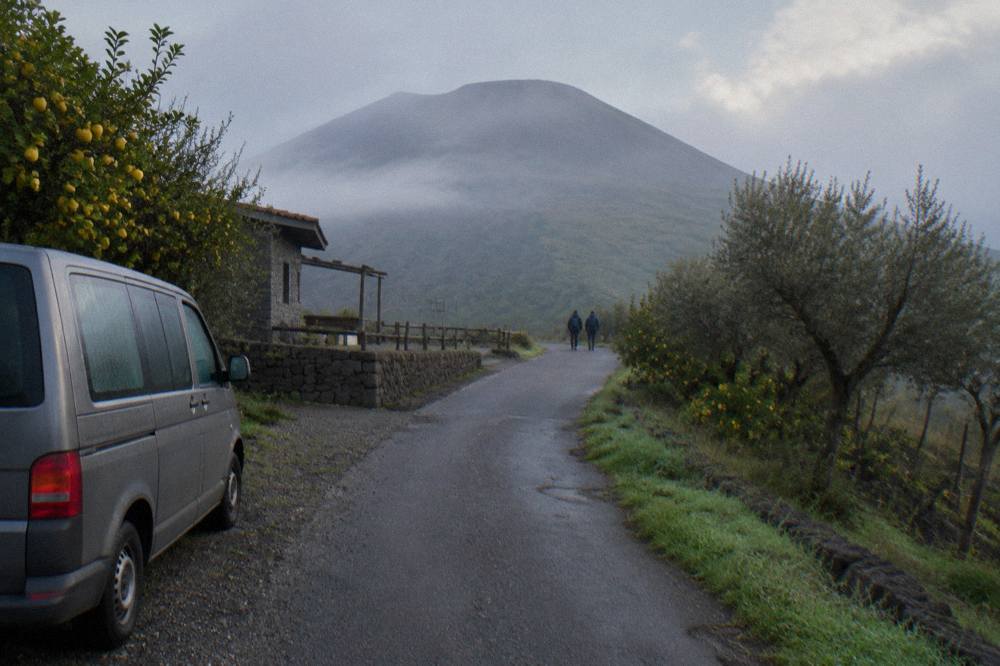
How Do You Get From Pompeii To Vesuvius Without Walking?
The cheapest standing option is the EAV 808 public bus, which runs from Pompei Piazza Anfiteatro up to the Quota 1000 parking area in about 55 minutes for €3.80 paid on board, with nine departures a day in each direction. The alternative is a paid transfer product, from around €35.10 per person, which bundles the ride with the crater entry ticket that the bus does not include.
The 808 is a real scheduled service, not a tourist shuttle, and its timetable is published by EAV. Nine buses run up between 08:30 and 14:30, arriving at Quota 1000 from 09:25, and nine run back down between 09:35 and 16:50. The fare is €3.80 for a single ride bought on board, or an AC3 ticket at €2.80 if you can buy it at a station beforehand. The timetable in force is published on the official EAV page for line 808.
One catch deserves emphasis: the last bus up arrives at 15:25, which is after the last winter entry time at the crater (15:00 in January, February, November and December), and cutting it fine even in October, when last access is 16:00. Plan an upward departure no later than the 13:30 run if you want a comfortable hour at the top outside summer. Check the crater's seasonal access hours before you commit to an afternoon bus, because the closing time is a last-access time and the visit must end within an hour of it.
Paid transfers solve the ticket question as well as the ride. The basic bus transfer with park entry included starts from €35.10 per person (4.3 across 1,923 reviews), and a roundtrip version from Ercolano with the park ticket starts from €36 per person (4.2 across 1,308 reviews). Products that start where you already are, in Pompei itself, include the shared-bus crater transfer at from €49 per person and the roundtrip easy transfer at from €39 per person, both of which bundle the entry ticket.
Is a bus-and-ticket bundle the right call for your date?
That box points to the related tour for this article, the From Pompeii day tour, because it is the cleanest single answer to the underlying problem: it stacks a Pompeii visit and the Vesuvius transfer into one booked product with pickup, so no walking and no bus timetable maths. But if a same-day DIY plan is what you want, read the two sections below first.
How Long Does The Bus From Pompeii To Vesuvius Take?
The EAV 808 takes about 55 minutes from Pompei Piazza Anfiteatro to Quota 1000, one way. Add the crater trail itself, which the park measures at 4,010 metres round trip and two and a half hours at a steady pace, plus queueing and the walk from the parking area, and a realistic Vesuvius stop from Pompei is three to four hours door to door.
Those numbers come from the park's own trail infobox and the EAV timetable, not from operator marketing. The trail is rated low difficulty by the park, but it is a genuine uphill walk on volcanic gravel to a turnaround at 1,170 metres; the public path ends there, below the 1,281-metre summit, and the upper rim route is closed to the public and used by researchers only. Every visitor above 1,000 metres is accompanied by the park's volcanological guides, which is a standing rule rather than an optional extra.
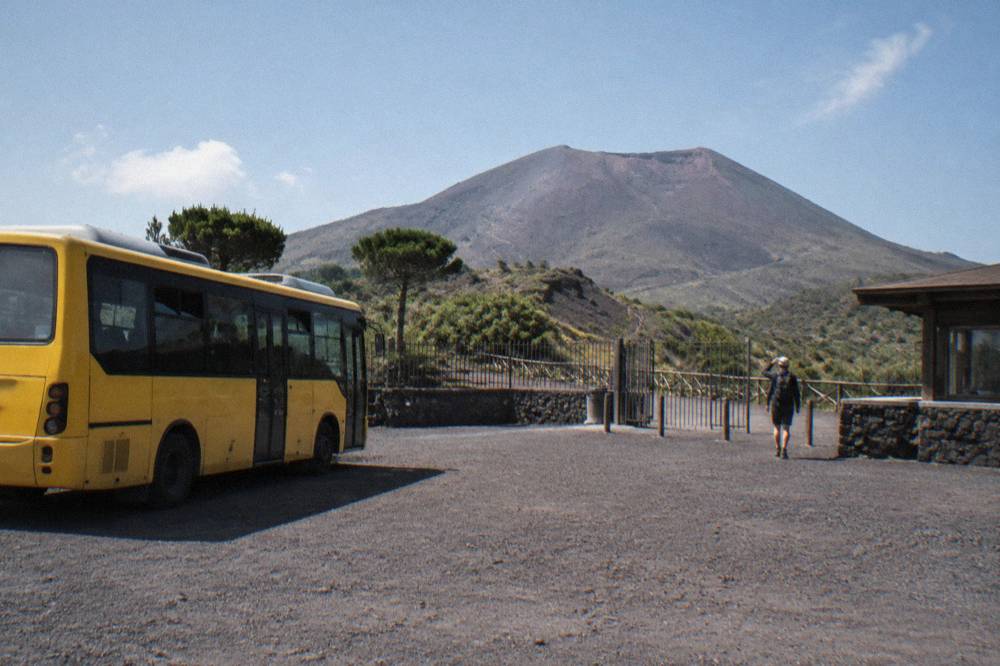
Here is the condensed timetable, so you can see the timing problem at a glance:
| Direction | First run | Last run | Journey time | Notes |
|---|---|---|---|---|
| Up, Pompei Piazza Anfiteatro to Quota 1000 | 08:30 | 14:30 (arrives 15:25) | ~55 min | 9 departures a day |
| Down, Quota 1000 to Pompei Piazza Anfiteatro | 09:35 | 16:50 (arrives 17:45) | ~55 min | 9 departures a day |
| Fare | €3.80 single on board | €2.80 AC3 pre-bought | n/a | Crater ticket not included |
Notice the shape of the day this forces. A morning Pompeii visit followed by an afternoon volcano visit works, but only if you finish at the ruins in time for a 13:00-ish bus. Attempting it the other way round, volcano first, means an 08:30 start from Pompei and a crater arrival at 09:25, which is actually the most relaxed sequence and is exactly what the better combo tours do.
A detail most first-page sources skip: Campania Express, the tourist train that once linked Naples, Ercolano and Pompei Scavi with nicer rolling stock, is suspended from 1 October 2026 until further notice, so any older guide recommending it as the spine of a DIY day is out of date. The ordinary Circumvesuviana trains still run, and fares for them are not stated on the pages this site verified, so check the operator directly.
Can You Do Pompeii And Vesuvius In The Same Day?
Yes, comfortably, and most visitors who try do. The EAV bus takes 55 minutes between the two, a combo tour takes six to eight hours door to door, and the sites' opening hours overlap generously in every season. The only real constraint is the crater's seasonal last-access time, which runs from 15:00 in winter to 18:00 in July and August.
The classic structure is Pompeii in the morning, Vesuvius in the afternoon. Pompeii opens at 9:00 year round, with last entrance at 17:30 from 16 March to 14 October and 15:30 the rest of the year, per the official Pompeii timetables page. The crater opens at 9:00 every month too. So a 9:00 entry at Pompeii, three hours among the ruins, and a 13:00-ish bus or transfer up the mountain lands you at Quota 1000 with two to four hours of access window left, depending on the month.
Full planning is laid out in the Pompeii And Vesuvius In One Day guide, including what to cut when time runs short. What belongs here is the transport spine: from Pompei, the 808 bus, a shuttle product, or a booked combo that does the thinking for you. The range of products covering both sites runs from lean transfer-and-ticket bundles to full guided days with lunch.
Ticket prices for the two sites stack like this:
| Item | Price | Basis |
|---|---|---|
| Pompeii Express (ancient city only) | €20 | Per person, official tariff |
| Pompeii+ (city, suburban villas, shuttle) | €25 | Per person, official tariff |
| Vesuvius crater ticket | €10 | Per person (€11.68 via the park's authorised online seller) |
| Bus 808 one way | €3.80 | Per person, on board |
| Combo tour covering both, from Pompei | from €102 | Per person, listing price |
The From Pompeii day tour, the featured product for this article, is that last row: about six hours, a guided Pompeii segment, and the bus transfer up the mountain, from €102 per person, rated 4.2 across a small pool of 44 reviews. A pickup-inclusive sister version with essentially the same itinerary starts from €96 per person and carries a larger review pool of 280.
Is It Better To Do Pompeii Or Vesuvius First?
Going up Vesuvius first, straight from Pompei on the 08:30 bus, is the more forgiving order: the crater is cooler in the morning, the trail is emptier, and you reach Pompeii before the worst of the midday heat. Doing Pompeii first suits visitors who want the ruins with a guide while their energy is highest, and it is what most organized tours schedule.
Neither order is wrong; they suit different travellers. The volcano-first plan is the DIY optimist's route: bus at 08:30, crater by 09:25, down by 11:35 at the latest sensible return, Pompeii for the whole afternoon. It depends entirely on catching an early bus, and on the crater access window in shoulder months, so check the season table before committing. The Pompeii-first plan, which most tours run, protects the longer and more demanding visit: two to three hours of guided ruins in relative cool, lunch, then the mountain when the midday queue at the trailhead has thinned.
The full argument, with the failure modes of each order, is in Should I Go To Pompeii Or Vesuvius First?. And travellers starting from Naples rather than Pompei have a parallel decision laid out in Can I Take A Guided Tour From Naples To Vesuvius And Pompeii?, which covers the bigger combined-day products from the city.
Can You Walk To Vesuvius From Pompeii?
This phrasing of the question, without the "Mount", returns the same answer from every official source: no. The park lists 11 numbered trails and none of them approaches from Pompeii; all crater access runs through the Ercolano side at Quota 1000. Walking along the SP or A3 carriageways between the two is not a documented or sensible option.
It helps to picture the geography honestly. Pompeii sits on the southern coastal plain; the crater trailhead sits at 1,000 metres on the western flank above Ercolano. Everything connecting the two is road: the autostrada corridor, the provincial road to the car park, and the shuttle stretch from Quota 800 to Quota 1000, which the park describes as 1.8 km or about 30 minutes on foot for people who have parked, not as public through-route. Even with a car you are told to park at Quota 800 and walk or take the €1 municipal shuttle for that last stretch.
So the walking you can do at Vesuvius is the crater trail itself, 4,010 metres round trip from the Quota 1000 plaza, and nothing more. Some visitors hope for a scenic ridge hike linking the sites, in the way you might link villages on a coastal path; nothing like that exists here in any verified form. If a long walk on the mountain is the goal, the trail network is described in the park's own materials, but every one of those trailheads is reached from the Ercolano or Terzigno side, never from Pompei.
The practical translation: your "walking day" budget should go into the crater trail and the ruins, and your transfer budget into the 808, a shuttle, or a tour. A dedicated transfer-and-ticket product from Pompei, for example the shared-bus crater transfer at from €49 per person (4.1 across 551 reviews), exists precisely for travellers who booked their own Pompeii tickets and only need the volcano leg solved.
How Many People Died In Pompeii When Mount Vesuvius Erupted?
The traditional date of the eruption that buried Pompeii is August 24, AD 79, though a 2018 find at Pompeii, a charcoal inscription reading 17 October, points to an autumn date, and the park's own team called October highly probable. Casualty figures for Pompeii are not established: this site does not print a number, because no verified count exists.
The honest answer is that nobody knows the total. Excavation has recovered remains of a portion of the population, and estimates beyond that are reconstructions rather than records. What is documented is the mechanism: the eruption, described in the letters attributed to Pliny the Younger, buried Pompeii under pumice and ash and Herculaneum under pyroclastic material, preserving both to a degree almost unique in archaeology. Visitors standing at the crater rim are looking into the caldera of the volcano that did it, last eruption March 1944, monitored today at green alert level by INGV's Vesuvius Observatory.
The reason this question belongs on a transfer article is timing. The date debate, August versus October, is a reminder that the eruption story and the modern visit are intertwined: the crater trail's fumaroles, the steaming vents on the inner walls visible from the rim, are the living evidence that the volcano is dormant, not extinct. Guides on the trail point them out, and they are the single most common thing visitors photograph after the Bay of Naples panorama.
What Does A Combo Tour From Pompei Actually Include?
Combo tours from Pompei bundle the two site visits, the road transfer between them and, in most cases, both entry tickets, in a single booked day of roughly six hours. The From Pompeii day tour includes pickup, a guided Pompeii segment and the bus up to the crater, from €102 per person; the no-pickup variant starts from €96.
The value of a combo is not the discount, which is modest or nil against DIY; it is the removal of the two failure points this article keeps circling: the bus timetable and the crater's online-only ticketing. A tour operator holds allocated entry, rides on a schedule built around the last-access window, and gets you back down without watching the clock. Reviews of the transfer products back this up: one guest review of the basic bus transfer calls it an "easy way to get from Pompeii to Vesuvius and back again", noting the drop-back at Pompeii station.
For visitors adding Herculaneum to the same trip, the three-site products run from around €112.50 per person from Pompei; that is a full eight-hour day and a different proposition from the two-site day, best considered once the Pompeii-plus-Vesuvius plan is settled.
The priority-access alternative from Sorrento, in the trio above and again below, is the same structure for Sorrento-based visitors: skip-the-line entry at both sites in an eight-hour day, from €115 per person, rated 4.7 across 1,577 reviews.
The From Pompeii day tour remains the natural pick for anyone already sleeping in Pompei: it solves the transfer, the crater ticket timing and the ruins guidance in one booking, with free cancellation flagged on the listing.
Common Questions About Walking From Pompeii To Vesuvius
Can You Walk From Pompeii To Mount Vesuvius?
No. No verified walking route exists between the two, the connecting roads have no documented pedestrian path, and the crater trail starts at Quota 1000 on the Ercolano side. Take the EAV 808 bus, a shuttle, or a combo tour.
Can You Walk To Vesuvius From Pompeii?
No. Same answer in different words: the park's 11 numbered trails are all reached from the Ercolano or Terzigno sides, never from Pompei. Walking at Vesuvius means the 4,010-metre crater trail from Quota 1000.
Can You Do Pompeii And Vesuvius In The Same Day?
Yes. The 808 bus takes about 55 minutes between them, and combo tours cover both in six to eight hours. The constraint is the crater's seasonal last-access time, 15:00 in winter to 18:00 in July and August.
How much is the bus from Pompeii to Vesuvius?
The EAV 808 costs €3.80 for a single ride paid on board, or €2.80 with an AC3 ticket bought in advance. The crater entry ticket is not included and must be bought online separately.
Do you need to book Vesuvius tickets in advance?
Yes. Crater tickets are sold only online by time slot, released 30 days ahead, with a last-minute release of 10 named tickets per slot half an hour before. Tours that bundle entry remove this step.
Should you do Pompeii or Vesuvius first?
Vesuvius first suits DIY travellers who can catch the 08:30 bus and want the crater cool and quiet. Pompeii first is what most tours run, protecting the longer visit for the morning. Both work within the access windows.