Is There A Shuttle Bus From Pompeii To Vesuvius?
Yes, there is a public shuttle bus from Pompeii to Vesuvius: the EAV line 808, plus a fleet of bookable transfer tours from Pompeii. Here is how both work, what they cost and how to choose.
Is There A Shuttle Bus From Pompeii To Vesuvius?
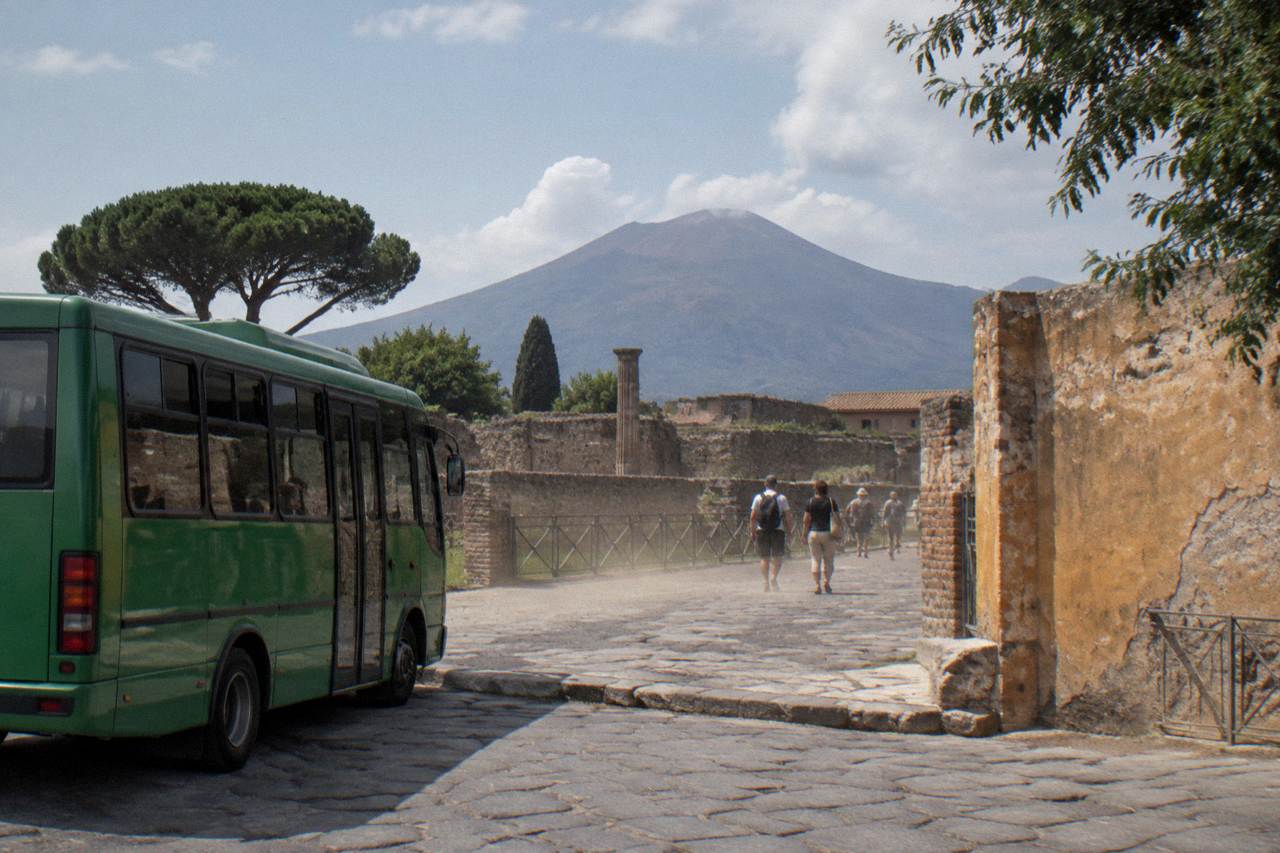
Yes. Two kinds of shuttle connect Pompeii with Vesuvius, and they suit different travellers. The public option is the EAV line 808 bus, which runs nine times a day from Pompei Piazza Anfiteatro to the Quota 1000 trailhead for €3.80 on board. The commercial option is a bookable transfer tour, from about €35.10 per person, which bundles the park entry ticket and guarantees a seat.
The public bus is the EAV line 808, and its timetable is published by the transport authority on the official EAV downloads page. Nine departures a day climb from Pompei Piazza Anfiteatro between 8:30 in the morning and 14:30 in the afternoon, calling at Villa dei Misteri, Porta Marina, Torre del Greco and Ercolano Osservatorio before reaching the Vesuvius stop at Quota 1000. The run takes about 55 minutes each way. It is a scheduled public service, so no booking is needed: you pay the driver, or board with a prepaid AC3 ticket bought at a station or online for €2.80.
The commercial alternative is a family of transfer products sold as tours. The Bus Transfer to Vesuvius with Park Entry Fee from MOTORENT S.R.L. runs from €35.10 per person, rates 4.3 across 1,923 reviews, and includes the park entry fee, which matters because the park sells crater tickets online only. A rival product, the Mount Vesuvius Transfer with Entry Tickets from VISITING CAMPANIA, starts at the same €35.10 per person with a 4.4 rating across 1,785 reviews. Both depart from Naples or Pompeii and last about three hours. These are road transfers, not off-road drives: what you are buying is a guaranteed seat, a timed ticket and a fixed return time.
Which one fits depends on your appetite for logistics. The EAV bus is the cheapest way up the mountain from Pompeii, but it binds you to its clock, and its last uphill run arrives at 15:25, which is after the winter-season last entry to the crater trail, so in the colder half of the year an afternoon bus is not a plan, it is a missed visit. A transfer tour costs roughly ten times the bus fare but solves the ticket problem in the same transaction. For the full picture on getting from the excavations to the trailhead by every means, read the companion guide How To Get From Pompeii To Mount Vesuvius, and for picking a packaged product, the Vesuvius tours from Pompeii hub gathers every shuttle and transfer option on this site in one place.
How Much Does The Shuttle From Pompeii To Vesuvius Cost?
The public EAV 808 bus costs €3.80 per single journey paid on board, or €2.80 with an AC3 ticket bought in advance at a station or online. That fare covers only the ride. The park's crater ticket is separate: €10 under the park's own ticketing rules, or €11.68 through the park's authorised online seller. Bookable transfer tours start at €35.10 per person with entry included.
Counting the true cost of the public route means adding the pieces. The bus fare is one line, the crater ticket is another, and then there is the last hop: the 808 stops at Quota 1000, the plaza where the crater trail begins, so no extra shuttle is needed on this route. Park at the bottom of the mountain and the picture changes, because private cars cannot use the plaza and visitors driving up must park at Quota 800 and either walk 1.8 km in about 30 minutes or take the Ercolano municipal shuttle for €1 each way. Bus riders skip all of that, which is part of why the Pompeii departure is the most practical public-transport approach to the volcano.
| Option | Upfront cost | What is included | Watch out for |
|---|---|---|---|
| EAV 808 bus, ticket on board | €3.80 single | The ride only | No booking; buy crater ticket separately, online only |
| EAV 808 bus, AC3 prepaid | €2.80 single | The ride only | Must be bought at a station or online before boarding |
| Crater trail ticket (required) | €10, or €11.68 online | Timed trail access, volcanological guide | Online only, 50 tickets per 10-minute slot, released 30 days ahead |
| Bookable transfer tour, Pompeii or Naples start | From €35.10 per person | Ride plus park entry | Fixed departure and return times |
| Full-day combo tour with shuttle legs | From €77.40 per person | Transport, both sites, tickets | A full day committed |
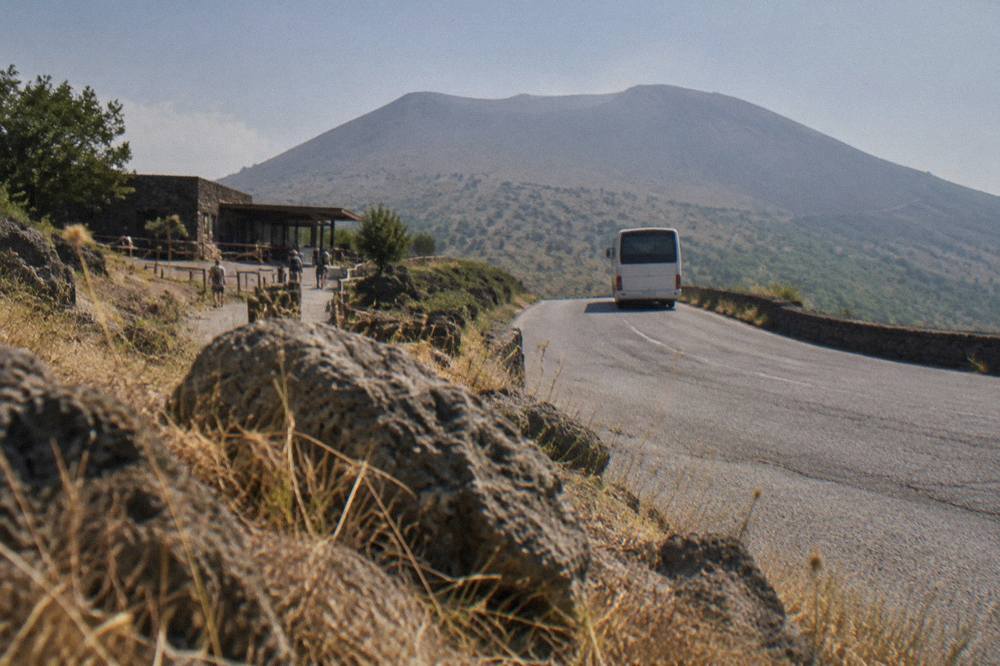
One structural point about the crater ticket that catches people out: the park sells nothing at a window. Tickets go on sale online only, in 10-minute time slots of 50 tickets each, released 30 days ahead, and a sold-out day releases 10 last-minute tickets per slot 30 minutes before the slot, buyable only over the wifi near the entrance, maximum 5 per email, named to the holder. The park explains the whole system on its official Gran Cono page. This is exactly why the transfer tours that bundle entry are popular: they convert two fragile bookings into one.
Where Does The Pompeii Shuttle Drop You At Vesuvius?
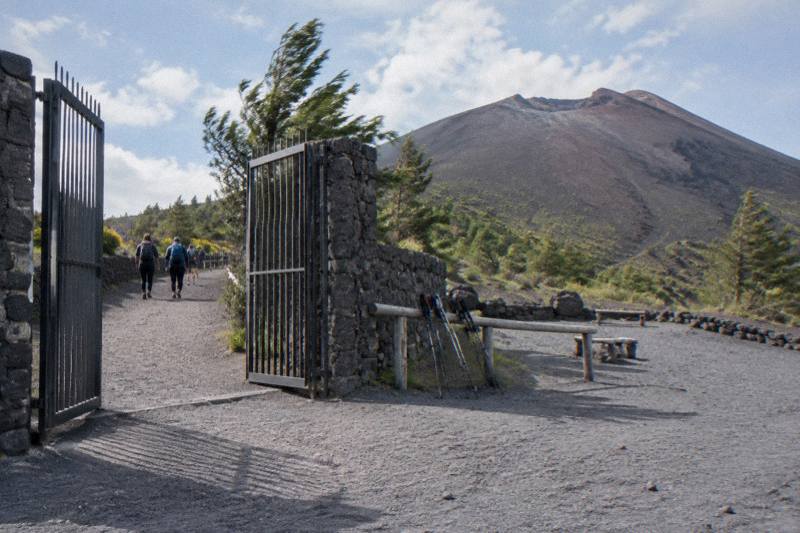
The EAV 808 terminates at Quota 1000, the plaza at 1,000 metres on the Ercolano side where the Gran Cono crater trail begins, with a 55-minute ride from Pompei Piazza Anfiteatro. The trail runs 4,010 metres round trip to a turnaround at 1,170 metres, officially rated low difficulty, about 2 hours 30 minutes of walking in total.
Quota 1000 is not a viewpoint, it is a trailhead, so know what you are being dropped into. The Gran Cono path climbs from the plaza to a ticket hut at 1,118 metres and ends at the Capannuccia turnaround at 1,170 metres; the summit itself, at 1,281 metres per INGV, is off-limits because the upper rim route is reserved for researchers. Every visitor above 1,000 metres is accompanied by the park's volcanological guides as a mandatory service, in groups, keeping to the right side of the walkway. The crater at the top is elliptical, up to 580 metres across, with fumaroles steaming on the inner walls of a volcano that last erupted in March 1944.
Access hours change by month, and the bus schedule has to be read against them. Crater access runs 09:00 to 15:00 in January, February, November and December; 09:00 to 16:00 in March and October; 09:00 to 17:00 from April to June and in September; and 09:00 to 18:00 in July and August. The closing time is the last access, and the visit must end within one hour of it. The bus's last uphill arrival at 15:25 only works inside the two summer windows; in shoulder and winter months you need an earlier departure. For climate context month by month, the site's Mount Vesuvius by month season pages carry the full table.
Facilities at the plaza are thin. There is no parking for private cars there, and the park states there are no public toilets there for the time being, a point worth knowing before a two-and-a-half-hour round trip with children. The nearby toilets-and-parking infrastructure sits lower down at Quota 800, run by the Comune di Ercolano. If any of this sounds like more organising than a holiday should involve, the packaged route is the escape hatch: the Mount Vesuvius 4x4 tours hub on Mount Vesuvius Tours gathers every shuttle and transfer product on the site, from the €35.10 basics upward.
Is There A Shuttle From Vesuvius To Pompeii?
Yes, the same EAV 808 bus comes back down. Nine return runs a day leave Quota 1000 between 09:35 and 16:50, reaching Pompei Piazza Anfiteatro about 55 minutes later, with the last down bus of the day at 16:50 arriving in Pompeii at 17:45. The fare is the same €3.80 on board or €2.80 prepaid, and the last uphill bus arrives too late for winter last entry.
The return timetable is where most self-planned itineraries are actually won or lost. Nine downhill departures are spread across the day, and the last one leaves Quota 1000 at 16:50. If your crater slot is late afternoon in July or August, when access runs to 18:00, the public bus cannot serve you: your slot's one-hour visit window can end after the final departure. In that case the plan has to bend, either toward an earlier slot or toward a transfer tour with a fixed, known return. The full nine-up, nine-down schedule in force from 1 October 2026 looks like this:
| Direction | First departure | Last departure | Journey time | Stops on the way |
|---|---|---|---|---|
| Up, Pompei Piazza Anfiteatro to Quota 1000 | 08:30 | 14:30 (arrives 15:25) | About 55 minutes | Villa dei Misteri, Porta Marina, Torre del Greco Via De Nicola, Ercolano Osservatorio, Seggiovia q.750 |
| Down, Quota 1000 to Pompei Piazza Anfiteatro | 09:35 | 16:50 (arrives 17:45) | About 55 minutes | Same stops in reverse order |
A guest review of the bookable bus transfer product captures why many travellers pay for the return leg to be someone else's problem. Nicola from the United Kingdom writes: "Easy way to get from Pompeii to Vesuvius and back again. Well organised and they will drop you back at Pompeii station or the original meeting point." The product she reviewed, from €35.10 per person including park entry, is the middle option between the €3.80 public bus and a full guided day.
Two sibling products deserve a mention here because they solve the same return-leg question from different angles. The Pompeii: Mount Vesuvius Crater Transfer with Ticket from Tempio Travel, from €49 per person and rated 4.1 across 551 reviews, is a shared bus with a self-guided hike, while From Ercolano: Vesuvio Park Entry Ticket and Roundtrip Bus from Vesuvio Express, from €36 per person and rated 4.2 across 1,308 reviews, does the same from the Ercolano side for anyone travelling on the Circumvesuviana line toward Naples. Note that the Campania Express tourist train is suspended from 1 October 2026, so it is not an option for reaching either shuttle.
Can You Do Pompeii And Vesuvius In The Same Day?
Yes, comfortably, and most people do. Pompeii needs a focused three to four hours on the shortest circuit, the bus between the two takes about an hour each way, and the crater trail adds about two and a half hours of walking. A realistic self-planned day starts Pompeii at 9:00, catches a midday bus, and takes a 15:00 or 16:00 crater slot.
The arithmetic works because the two sites are close and their clocks are compatible. Pompeii opens at 9:00 year-round, with last entrance at 17:30 in the summer season from 16 March to 14 October and 15:30 in the winter season, and it is closed only on 25 December and 1 January. Crater access ends between 15:00 and 18:00 depending on month. So the day has a natural shape: ruins in the cooler morning, volcano in the afternoon, and the order is not arbitrary, as the next section explains.
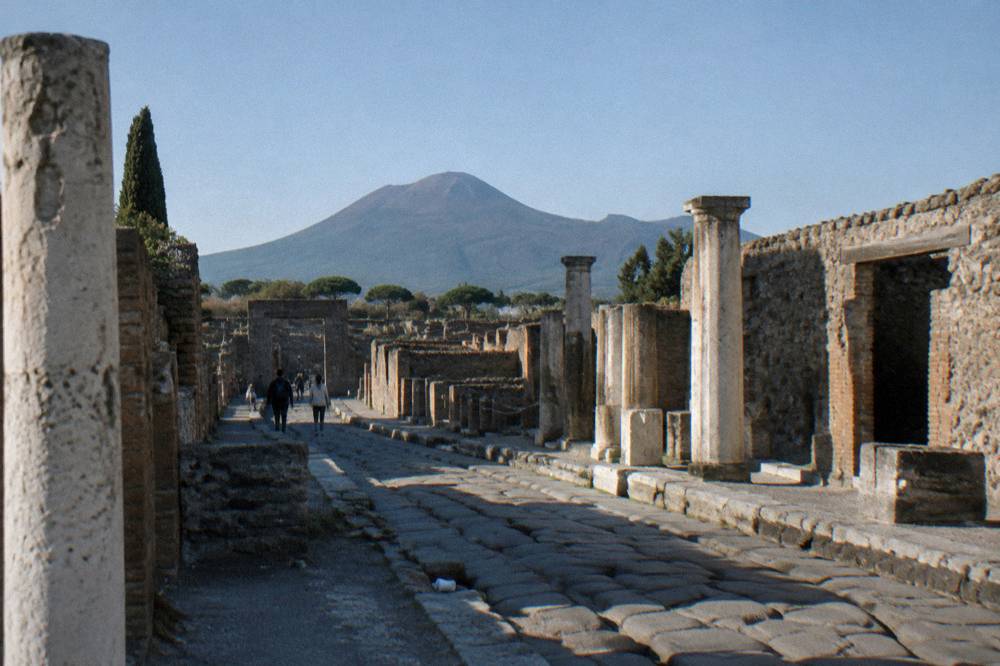
Pompeii's own ticket structure rewards a quick decision. From 12 January 2026 the options are Pompeii Express at €20 for the ancient city only, Pompeii+ at €25 adding the suburban villas and the Villa Regina shuttle, and a three-day Pompeii Plus at €30, with reduced €2 entry for EU citizens aged 18 to 24, free entry on the first Sunday of every month, and a 20,000-visitor daily cap. From 1 January 2027 the official single ticket becomes €25 across all park sites, valid 30 days with one entry per site. Full details are on the Pompeii Archaeological Park's ticketing page.
Buying the day pre-assembled is the other route. The A Journey Into The Past: Pompeii And Vesuvius Tour from VISITING CAMPANIA, from €77.40 per person and rated 4.3 across 256 reviews, covers both sites in six to seven hours with bus transfers and tickets, departing Pompeii with pickup. If you would rather see the question analysed from every angle, the site's dedicated one-day pairing guide lays out the full comparison of timings, tickets and energy budgets.
Is It Better To Do Pompeii Or Vesuvius First?
Most itineraries run better with Pompeii first and Vesuvius second. The ruins need stamina and shade, both of which fade through the day, while the crater trail is a short, exposed climb best taken in afternoon light after the ruins crowds thin. The one firm exception is heat: in July and August many travellers invert the order, doing the volcano in the relative cool of the morning. If you have another day in the area, our guide to why Pompeii stole the spotlight from Herculaneum explains why the quieter site deserves a place on your itinerary.
The practical case for ruins-first is about ticket flexibility. Pompeii admits 20,000 people a day and rarely sells out for a morning arrival, whereas the crater trail caps at 2,160 to 3,240 visitors a day in timed 10-minute slots of 50 tickets. Locking the crater slot for the afternoon and letting Pompeii absorb the morning keeps the fragile booking safe and the flexible one free. It also front-loads the site that needs the most walking while legs are fresh.
The heat exception is real and worth planning around. Summit highs run about 6 to 7 degrees below Naples every month in the modelled 1991-2020 climate average, so 29.3 degrees in Naples in August means roughly 22.8 degrees on the trail, a meaningful discount but with no shade on the cone itself. A review from Millie from the United Kingdom on the full-day Naples tour makes the point from the ground: "Very uneven surfaces and very hot in summer so trainers and water bottles." Whichever order you choose, trainers and water apply to both sites.
The three-site question sits behind this one. Combining Pompeii, Herculaneum and Vesuvius in a single booked day is a well-served format: the featured Pompeii-Herculaneum And Vesuvius Full-Day Tour, from €125 per person and rated 4.2 from a small pool of 32 reviews, handles all three in eight hours with transfers and skip-the-line tickets, an option worth weighing if shuttles, slots and opening hours sound like work.
Can You Walk From Pompeii To Mount Vesuvius?
Not realistically as part of a visit. The road distance from Pompeii to the Quota 1000 trailhead is well over 10 kilometres of provincial road, and the final stretch from Quota 800 to Quota 1000 alone is 1.8 kilometres, about 30 minutes on foot, before the crater trail even begins. There is no marked walking route, and the traffic rules ban pedestrians' practical options on Via Osservatorio at set hours.
The geometry is the enemy. Pompeii sits on the coastal plain; the crater trailhead sits at 1,000 metres above it. Walking from one to the other means hours on an unshaded provincial road built for buses, with the vertical gain of a mountain hike attached at the end. Even travellers arriving by car at the Quota 800 car park face the official 30-minute, 1.8 km walk or the €1 municipal shuttle to the plaza, and that is the short version. Parking along the provincial road is run by the Comune di Ercolano with a maximum stay of 4 hours, and cars up to 8 seats pay €7 in Area B, so a driving visit has its own clock too.
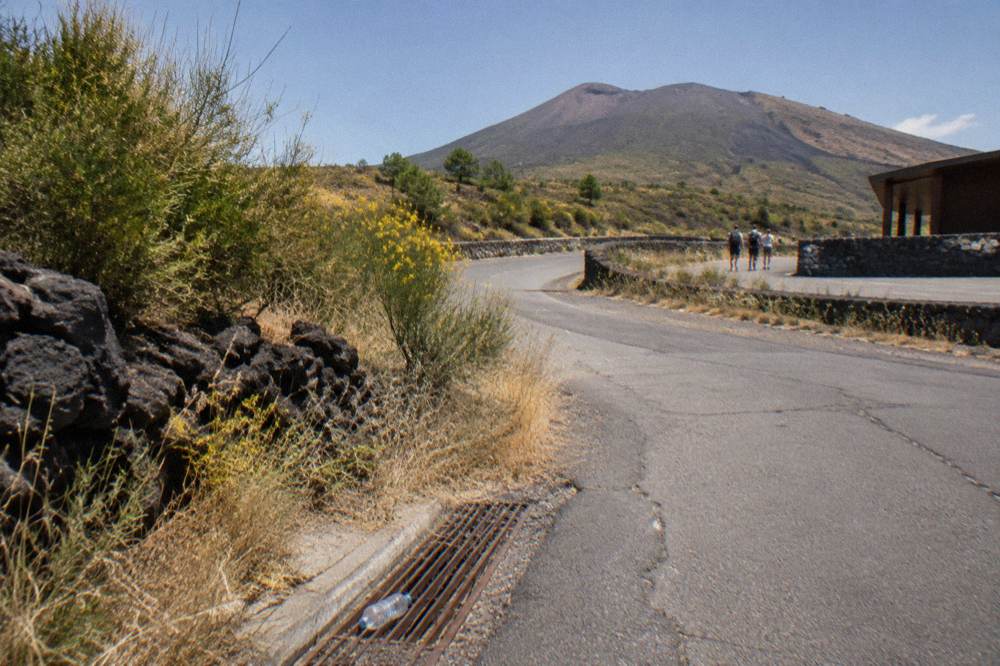
What people sometimes mean by this question is whether the two can be linked without a tour, and the answer is yes, by the EAV 808 bus covered at the top of this article or by any of the transfer products, several of which depart within walking distance of the Pompeii excavations. The From Pompeii: Mount Vesuvius Hike and Tour by Bus product from Around Vesuvio, from €35.10 per person and rated 4.1 across 213 reviews, is a three-hour bus-and-hike product, and From Pompeii: Mount Vesuvius Guided Tour with Transfer from Askos Tours, from €65 per person and rated 4.8 across 282 reviews, adds an expert guiding layer, with a minimum age of 4. For the reverse-commuter question, What Is The Best Way To Get To Vesuvius From Naples? covers the capital-side routes, including the one train option worth knowing about.
How Many People Died In Pompeii When Mount Vesuvius Erupted?
No verified figure exists, and this site prints none. The eruption of AD 79, traditionally dated August 24 though a 2018 find points to October, buried Pompeii and Herculaneum and killed a number of people that archaeology has never been able to count. Around 700,000 residents now live in the 25 municipalities of the official red zone, which is why the volcano is among the most closely monitored on earth.
The reason no honest number can be given is that the victims countable in the archaeological record, roughly a fraction of the plaster casts and skeletal finds at Pompeii and Herculaneum, represent only those who did not flee. A large share of the population escaped in the hours between the eruption column rising and the pyroclastic surges arriving, and no census of the dead was ever taken. Any specific figure you see quoted elsewhere is an estimate dressed as a count, and the honest answer is that the event was catastrophic on a scale that numbers do not capture. The AD 79 date itself is not settled either: the traditional August 24 comes from Pliny's account written decades later, while a charcoal graffito found at Pompeii reading 17 October led the park's team to call an October date highly probable.
What is countable is the monitoring that now surrounds the mountain. Vesuvius last erupted in March 1944, with lava reaching the towns on 21 March, and it has been quiet since. The Osservatorio Vesuviano publishes the alert level and a monthly bulletin at its current-status page: the level is green, parameters within base values, with the September 2026 bulletin recording 121 small earthquakes, the strongest at magnitude 1.7. For the full story of the eruption and its aftermath, the site's guides on the 79 AD eruption and on whether Vesuvius will erupt again carry the detail.
The eruption history is not just background colour for the shuttle question; it is the reason the trail exists in its managed form. The crater you climb to see is the collapse scar of AD 79, the guided-only rule above 1,000 metres exists because the volcano is dormant rather than extinct, and the timed-slot ticketing exists because demand for that view outstrips what the path can carry. A visit built around the 808 bus or a transfer tour is a visit inside that system, and the smoother the transport, the more of the day is left for the two sites themselves.
Common Questions About The Pompeii To Vesuvius Shuttle
Is There A Shuttle Bus From Pompeii To Vesuvius?
Yes. The public EAV line 808 bus runs nine times a day from Pompei Piazza Anfiteatro to the Quota 1000 trailhead, about 55 minutes, for €3.80 on board or €2.80 with a prepaid AC3 ticket. Bookable transfer tours from €35.10 per person bundle the ride with the park entry ticket.
Is There A Shuttle From Vesuvius To Pompeii?
Yes, the same EAV 808 bus. Nine downhill runs a day leave Quota 1000 between 09:35 and 16:50, arriving at Pompei Piazza Anfiteatro about 55 minutes later. The last return at 16:50 is the one timing detail that can end a late-afternoon crater slot in summer.
Can You Do Pompeii And Vesuvius In The Same Day?
Yes. A realistic self-planned day gives Pompeii the morning on an Express ticket from €20, then a midday bus and an afternoon crater slot from €10, with the crater trail taking about 2 hours 30 minutes round trip. Combo tours from €77.40 per person assemble the same day in one booking.
Is It Better To Do Pompeii Or Vesuvius First?
Usually Pompeii first: it needs the most walking and shade, while the crater slot is the booking worth protecting and the trail suits an afternoon. In peak summer heat, many travellers invert the order and take the volcano in the cooler morning, when the summit runs about 6 to 7 degrees below Naples.
Can You Walk From Pompeii To Mount Vesuvius?
Not as a practical visit. The route is well over 10 kilometres of provincial road with a 1,000-metre vertical gain, no marked walking path, and traffic restrictions on the final stretch. Even drivers park at Quota 800 and face a 1.8 km, 30-minute walk or the €1 shuttle before the crater trail starts.
Do I Need To Book The Vesuvius Crater Ticket In Advance?
Yes. The park sells crater tickets online only, in 10-minute slots of 50 tickets released 30 days ahead. A sold-out slot releases 10 named last-minute tickets 30 minutes before, over the wifi near the entrance, capped at 5 per email, which is a fallback rather than a plan. Transfer tours from €35.10 per person include entry.