Why Is Herculaneum Not As Famous As Pompeii?
Herculaneum is smaller, harder to reach and was dug up later than Pompeii, yet many archaeologists rate it the better site. Here is why Pompeii won the fame war, and how to see both.
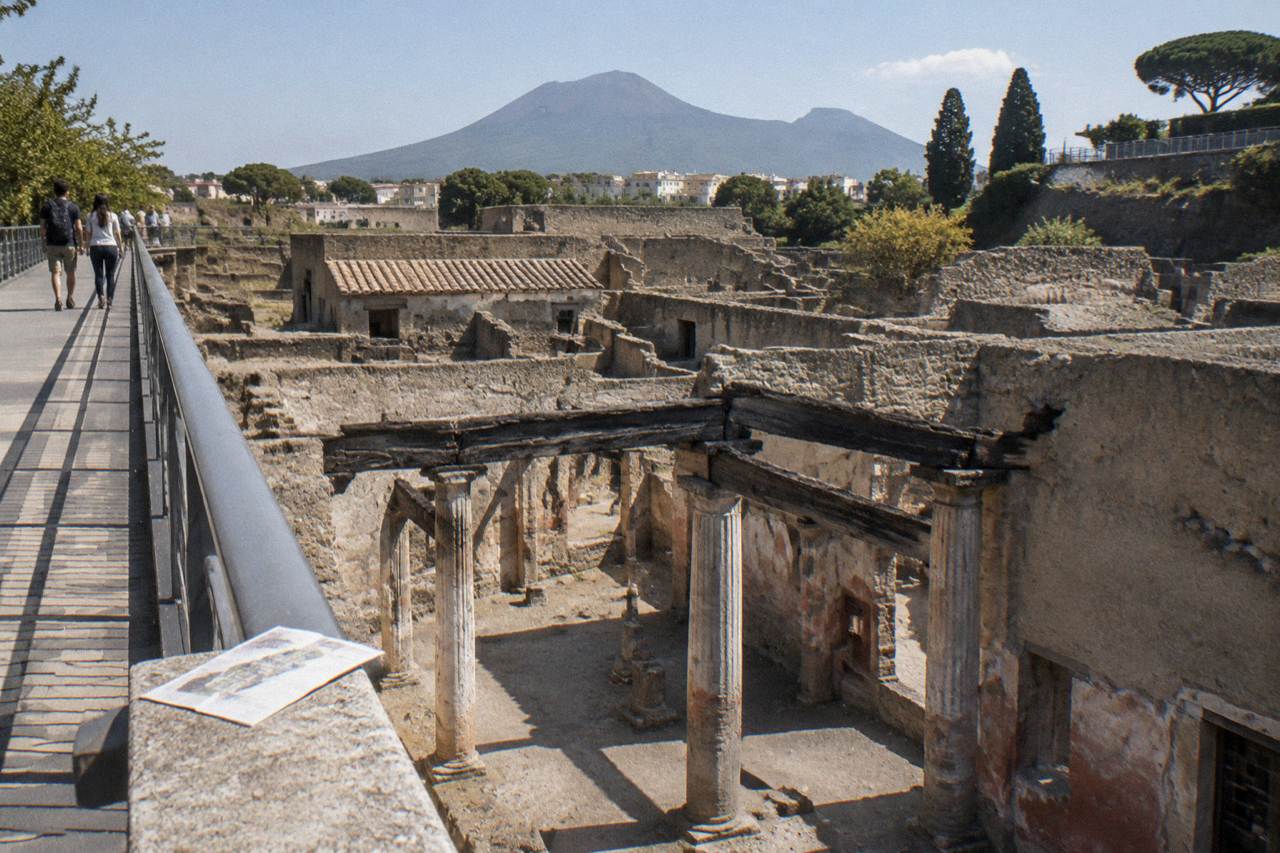
Pompeii is a city and Herculaneum is a town, and that single fact explains most of the fame gap. Pompeii covers roughly a full Roman urban footprint with forums, amphitheatres and grand villas open to the sky, while Herculaneum preserves a smaller, wealthier seaside settlement buried deeper under material that sealed rather than smothered it. Add earlier excavation, a rail station at the gate, a 20,000-person daily cap that still dwarfs its neighbour, and a century of novels and films, and the imbalance compounds. None of it means Herculaneum is the lesser visit. Many archaeologists argue the opposite. If you want to judge for yourself, our guide comparing Pompeii and Herculaneum tours lays out what each site does best and how to fit both into one trip.
The buried towns sit twelve minutes apart on the same Circumvesuviana line from Naples, and both owe their destruction to the same event: the AD 79 eruption of Vesuvius, traditionally dated August 24, though a 2018 find points to October. A charcoal graffito at Pompeii reads 17 October, and the park team called an October date highly probable. The fame contest between the two sites is really a contest between two ways of dying: one city frozen in ash and pumice, one sealed in a dense pyroclastic material that preserved wood, food and fabric. One became a global byword. The other stayed a connoisseur's stop.
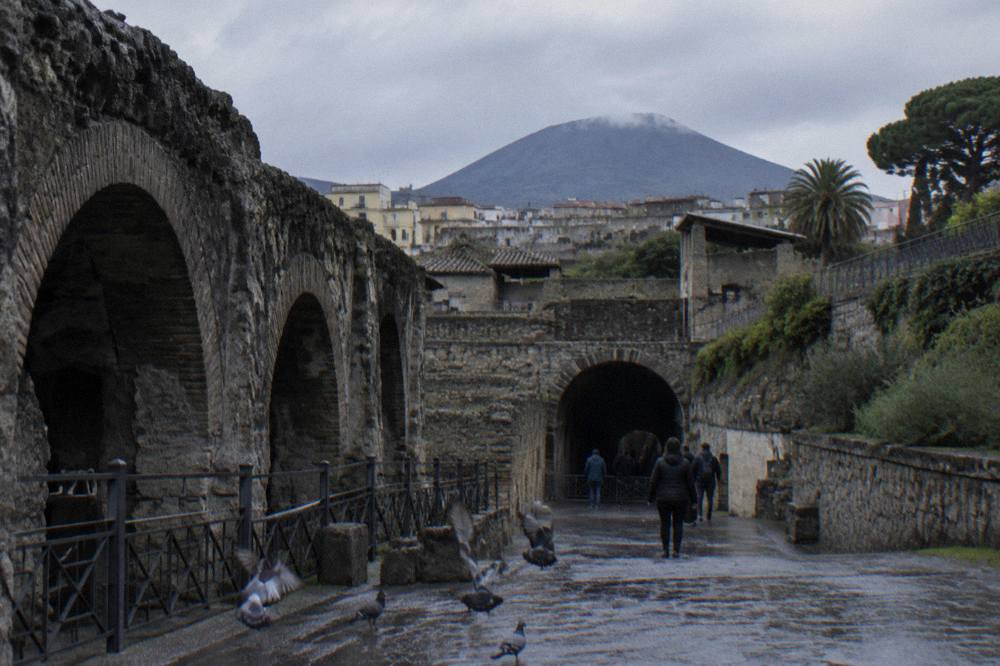
This article works through the real reasons Pompeii won, question by question, and then turns practical: what each site costs, how the hours compare, whether one day covers both, and how a Vesuvius hike slots between them. The short version for tour planners is that Herculaneum rewards a half day, pairs naturally with the crater, and is far easier to read at street level than its giant neighbour. Readers comparing the full two-site itinerary can start with the guide to Pompeii And Vesuvius In One Day and the pairing question Should I Go To Pompeii Or Vesuvius First?.
Why Is Herculaneum Not As Famous As Pompeii?
Herculaneum sits in Pompeii's shadow for five stacked reasons: it is only a quarter the size, its excavation began decades later, the volcanic material that preserved it also sealed it beneath deep, hard deposits, no rail line originally ran to its gate, and no blockbuster novel or film ever carried its name, so the visitor ratio still favors the bigger site every day.
Size is the honest starting point. Pompeii was a substantial city with an amphitheatre, two theatres, a large forum and a full grid of streets; walking its full extent is a genuine day's work. Herculaneum was a coastal town of perhaps a few thousand residents, and only part of even that has been uncovered, because the modern town of Ercolano sits directly on top of the rest. A visitor can cross exposed Herculaneum end to end in twenty minutes. That difference shaped everything that followed: bigger ruins made bigger news, drew bigger crowds and justified bigger transport investment.
Timing mattered just as much. Pompeii's ruins were identified and dug first in a sustained way, and the name spread through European drawing rooms within a generation. Herculaneum was actually found earlier, via a well shaft that happened to strike the theatre, but the overlying material was so hard that tunneling was slow, secretive and small-scale. The easy-to-dig ash and pumice of Pompeii gave excavators a showpiece. By the time Herculaneum was opened properly, Pompeii owned the story.
Transport sealed it. The Naples to Pompeii railway put the big site on the tourist map for every Grand Tour traveller, and Herculaneum's excavations sat below a modern town with no comparable access for a long stretch of the sites' shared history. Even today the Circumvesuviana stop Ercolano Scavi is a fifteen-minute downhill walk from the ticket office, while Pompeii Scavi station opens directly opposite the Porta Marina entrance. Momentum of that kind rarely reverses.
Fame also feeds on narrative. Pompeii's dead, its plaster casts and its frozen bread ovens supplied a century of art, from Bulwer-Lytton's novel to Hollywood. Herculaneum's quieter story, organic material preserved in dark volcanic layers, needed a laboratory to appreciate, and laboratories do not sell newspapers. One recent review of the combined three-site day run by Di Sarno Car Service captures what visitors actually take away from seeing both on the same day: "We had a good hike to the crater of Mt. Vesuvius with a beautiful view of Naples, the crater, the country side, Sorrento and Capri. The ruins of Herculaneum and Pompeii were incredible." Jody S. names Herculaneum first, but the fame ranking still belongs to Pompeii.
Is Herculaneum Actually The Better Site To Visit?
On preservation, yes, and by a wide margin: Herculaneum retains two-storey buildings, wooden doors, window frames, beds and carbonised food because the material that buried it sealed the town in a low-oxygen deposit, while Pompeii's looser ash preserved stone and plaster but burned away almost all organics. On scale, spectacle and the "whole lost city" feeling, Pompeii wins. Serious visitors with time do both and rank them for different reasons.
The physics of the two burials explains the difference. Pompeii, further from the volcano, received a rain of pumice and ash that collapsed roofs but left airspaces; bodies decayed and later excavators poured plaster into the voids to make the famous casts. Herculaneum, closer to the crater, was hit by successive pyroclastic surges whose fine, hot material packed solid. Wood did not burn so much as carbonise. Roof beams, doorways, a wooden screen, cloth and loaves of bread survived in a way that has no equal at Pompeii. The boatsheds by the ancient shoreline, where skeletons sheltering from the eruption were found, are among the most affecting archaeology in Italy.
There is a practical fame dividend, too. Pompeii's 20,000-person daily cap is there because the site can genuinely fill up: admission slots between 16 March and 14 October allow a maximum of 15,000 entries from 9:00 to 13:00 and another 5,000 from 13:00 to 17:30, per the official Pompeii timetables and tickets page. Herculaneum never approaches those numbers. Walking its quiet streets at opening time, with Vesuvius looming directly overhead, delivers something the big site cannot: intimacy. The trade-off is stamina versus depth; Pompeii exhausts and impresses, Herculaneum concentrates.
The hours are close enough that the two sites work in tandem. Herculaneum runs 8:30 to 19:30 from 16 March to 14 October, with last entry at 18:00, and 8:30 to 17:00 from 15 October to 15 March, last entry 15:30, closed only 25 December, as listed on the official Herculaneum tickets page. Pompeii in the same seasons opens 9:00, with last entry 17:30 and closing 19:00 in summer, and last entry 15:30, closing 17:00 in winter. First Sundays of the month are free at both, with direct access. One caveat carried on the official page: the Villa dei Papiri and the Ancient Theatre at Herculaneum are closed until further notice for excavation and restoration works, with no reopening date announced.
| Site | Full ticket | Reduced ticket | Summer hours (16 Mar to 14 Oct) | Winter hours (15 Oct to 15 Mar) |
|---|---|---|---|---|
| Pompeii Express (city only) | €20 | €2 (EU 18 to 24) | 9:00, last entry 17:30, close 19:00 | 9:00, last entry 15:30, close 17:00 |
| Pompeii+ (city and villas) | €25 | €2 (EU 18 to 24) | Same as above | Same as above |
| Herculaneum | €16 | €2 (18 to 25) | 8:30 to 19:30, last entry 18:00 | 8:30 to 17:00, last entry 15:30 |
Prices above come from the official sites. A change is already announced for Pompeii: from 1 January 2027 a single €25 ticket covers all Pompeii Archaeological Park sites, valid 30 days with one entry per site, while the outlying locations such as Oplontis, the Stabiae museum and Boscoreale remain €8 each.
What Famous Person Died At Pompeii?
The best-known victim is Pliny the Elder, the Roman admiral and naturalist who sailed toward the eruption to rescue people and died on the shore near Pompeii; his nephew Pliny the Younger watched the disaster from Misenum and wrote the two letters that give science the term "Plinian eruption". No comparable celebrity death is attached to Herculaneum, whose victims were ordinary townspeople and boat-shed shelterers. Fame, again, followed the famous name.
Pliny the Younger's account, written to the historian Tacitus about 25 years after the event, is the reason the world has an eyewitness narrative at all. He describes the pine-tree-shaped cloud, the daylight darkness, the ash falling like a heavy hailstorm, and his uncle's fatal decision to land. Those letters fixed Pompeii in the historical record with a literary anchor Herculaneum never received. Volcanologists still classify eruptions of that type as Plinian in his family's honour.
The date in those letters is also the source of the traditional August 24 timing, now debated. A charcoal inscription found in 2018 at Pompeii reads 17 October, and Pompeii's own park team called an October date highly probable, which would push the eruption into the autumn of AD 79. For visitors, the debate matters less than the vividness: both sites preserve the same frozen afternoon, whether it fell in late summer or mid-autumn. Secondary coverage of the inscription debate, including CNN's report on the find, quotes the park's statement directly.
Celebrity deaths aside, the human story at Herculaneum is arguably more moving precisely because it is anonymous. The skeletons in the boat sheds were people waiting for a rescue fleet that could not land. Pompeii sells spectacle; Herculaneum sells proximity. Travellers who want both sites plus the volcano in a single guided day often end up on the three-site itinerary, and the question Can I Take A Guided Tour From Naples To Vesuvius And Pompeii? covers how those days are structured from the Naples side.
What Food Is Pompeii Famous For?
Pompeii is famous for its carbonised food: whole loaves of bread found still in bakery ovens, eggs, nuts, figs and dried fruit sealed by the eruption, and the garum fish-sauce workshops that made the town's name across Roman trade. Its bakeries, with stone mills driven by donkeys and brick ovens, are the most-photographed food archaeology in the world. Herculaneum holds equally striking finds, but the pantry of record, in the public mind, is Pompeii's.
Around thirty bakeries have been identified at Pompeii, and their carbonised loaves, round and scored into eight segments, are so iconic that modern bakeries around Naples sell replicas. The town also produced garum, a fermented fish sauce that Roman cooking used the way modern kitchens use soy sauce or anchovy, in industrial quantities for export. Amphora stacks, shop counters with embedded dolia for serving hot food, and the famous graffiti menus give an unusually complete picture of a Roman fast-food economy.
Herculaneum's food record is actually finer-grained in places, carbonised figs and a loaf still bearing its maker's stamp among them, but the volume of evidence at Pompeii, from dozens of thermopolia snack bars, keeps the food story anchored there. Modern visitors extend the theme on the volcano side: the Vesuvius slopes grow Lacryma Christi DOC wines on volcanic soil in 15 municipalities, and several roster tours build lunch around that tradition. The Mount Vesuvius Vineyard Tour with Wine Tasting and Lunch from Cantina del Vesuvio runs 1.5 to 2 hours from €55 per person, rated 4.8 from 212 reviews, for travellers who want the food story without the ruins.
For a fuller pairing of ruins and table, the combined Pompeii-and-Vesuvius day trips that include a meal are rounded up in this site's tour coverage, and the Lunch & Wine Tasting in the National Park of Mt Vesuvio option from €58 per person, rated 5.0 from 241 reviews, adds an organic-farm lunch to any self-planned ruins morning. This is the same resource Mount Vesuvius Tours uses to sort meal-inclusive days from ticket-only transfers.
Can You Do Both Pompeii And Herculaneum In One Day?
Yes, and it works best in one specific order: Herculaneum first at 8:30 opening, when it is coolest and quietest, then Pompeii after midday when the midday slot cap of 5,000 entries means the morning crowds have drained away. Both sit on the same Circumvesuviana line, twelve minutes apart, and both can be combined with a Vesuvius crater visit on an organised three-site day of roughly 8 hours. Independent visitors should pick two of the three sites.
The arithmetic is unforgiving. Herculaneum deserves two to three hours; Pompeii deserves four at absolute minimum and rewards six. Add transit, security lines and the walk between stations and the day is full without the volcano. The organised three-site days solve this by cutting each stop to a guided core: the roster's Day Trip to Pompeii, Herculaneum and Vesuvius from Naples runs about 8 hours from €120 per person, rated 4.6 from 588 reviews, with hotel pickup. The Around Vesuvio version from €112.50 per person, rated 4.1 from 1,098 reviews, strings all three with transfers. These are long days, and summer heat makes the crater climb the hardest leg, but the structure is proven.
Independent planners should note the ticket logic. Pompeii Express covers the ancient city only, which is all a one-day visitor needs; the Pompeii+ add-on matters only if the suburban villas are on the list. Herculaneum's €16 full ticket is separate, and the sites do not share entry. Buying Pompeii in advance is wise in peak season given the entry slot system, and the three-site itineraries that do the whole circuit are compared side by side in the site's tour roundups, which sort them by departure point and price.
Two hours of prose-worthy detail on the pairing: the private-tour option run by A DRIVE INTO THE BLUE covers Herculaneum, Pompeii and Vesuvius with pickup in 8 to 9 hours from €265 per group, rated a perfect 5.0 from 309 reviews, one of the largest review pools among private three-site operators on the roster. A guest review of that day praises the pacing: "Antonino was awesome! He was very knowledgeable about each location on the tour and made sure we had plenty of time to fully see what we wanted and to ask questions." Jessica E.'s review reflects a common finding, that private drivers beat public transport on this itinerary because the sites are close but the connections between them are not.
| Tour (roster name) | Duration | From price | Rating | Sites |
|---|---|---|---|---|
| Day Trip to Pompeii, Herculaneum and Vesuvius from Naples | 8 hours (approx.) | €120 per person | 4.6 from 588 reviews | All three, Naples pickup |
| Pompeii, Herculaneum, & Vesuvius Full Day Tour | 7.5 to 8.5 hours | €112.50 per person | 4.1 from 1,098 reviews | All three, Naples or Pompeii |
| Private Tour: Herculaneum, Pompeii, Vesuvius with pickup | 8 to 9 hours | €265 per group | 5.0 from 309 reviews | All three, private |
| Vesuvius and Herculaneum | 5 hours | €84 per person | 4.3 from 21 reviews (small pool) | Two sites, Pompeii departure |
| Small-Group Herculaneum & Vesuvius Tour with Pizza Lunch | 7 hours | €140 per person | 4.0 from 276 reviews | Two sites plus meal |
The small-pool entry is named as such deliberately: 21 reviews is a thin base, and the rating should be read accordingly. All prices are per person unless marked per group, and every figure here is a "from" price on the live listing.
Can You Do Pompeii As A Day Trip From Rome?
Yes, comfortably by high-speed train: Rome to Naples takes about 70 minutes, then the Circumvesuviana to Pompei Scavi adds roughly 40 more, putting you at the Porta Marina entrance by late morning. Organised coach and train day tours from Rome run 9 to 12 hours and typically pair Pompeii with Vesuvius, since Herculaneum is the harder add-on on a tight clock. Doing all three ancient stops from Rome in one day is not realistic.
The roster carries several proven Rome options. The From Rome: Pompeii Day Trip with Optional Vesuvius and Lunch runs 9 to 12 hours from €56 per person, rated 4.6 from 5,931 reviews, with pickup flagged. The City Wonders variant with optional crater add-on and pizza lunch is also rated 4.6 from 6,517 reviews at the same €56 from-price. For a longer food-forward version, the Pompeii & Mt. Vesuvius Day Trip from Rome with Lunch runs about 12 hours from €180.07 per person, rated 4.8, though from a small pool of 37 reviews. The trade-off in every case is fixed timing: a Rome day tour cannot linger, and the crater leg depends on the seasonal last-entry times, which run to 18:00 in July and August but only 16:00 in March and October and 15:00 through the winter months.
Herculaneum's absence from most Rome itineraries repeats the fame pattern. Tour operators build around the name that sells. Travellers based in Rome who specifically want Herculaneum usually take the train to Naples or Ercolano themselves, or overnight in Naples and join a locally-run day. The fast-train option From Rome: Pompeii or Herculaneum & Vesuvius by fast train, 10 hours from €147.60 per person, rated 4.1 from 25 reviews (a small pool), is the roster's direct attempt at giving Rome visitors the smaller site with the volcano.
How Does A Vesuvius Hike Change The Herculaneum Story?
Standing on the crater rim makes the relationship between the sites physical: from the Gran Cono trail at 1,175 m you look straight down at the grid of modern Ercolano pressed against Herculaneum's excavated pit, with Pompeii's sprawl further west. The trail is 4,010 m round trip, officially rated low difficulty, and every visitor above 1,000 m is accompanied by the park's volcanological guides, which turns the walk into a live geology lesson no museum matches.
The pairing of Herculaneum and the crater is, in this site's view, the most underrated day in the Bay of Naples. You read the eruption at street level in the morning, then climb into its source in the afternoon. The Naples: Mount Vesuvius and Herculaneum Guided Tour packages exactly that, about 8 hours from €101.70 per person, rated 4.3 from 109 reviews, departing Naples. The shorter Vesuvius and Herculaneum option at 5 hours from €84 per person suits cruise-adjacent schedules. Crater access is by timed online ticket only, 50 per 10-minute slot released 30 days ahead, with a last-minute release of 10 named tickets per slot half an hour before entry, and the park's adult ticket is €10 under its ticketing rules while the authorised online seller shows €11.68.
Weather governs everything on the summit leg. The trail and box office close automatically on days with an orange regional weather alert or higher, with automatic refunds for slots inside a closure, and the visit must end within one hour of the last access time. Climatically, summit highs run about 6 to 7 C below Naples every month in the modelled 1991-2020 climate average, and November is the wettest summit month with 180 mm of rain, so the pairing day wants a clear forecast and layers. For hikers weighing fitness, the guided crater options from every departure point are collected on the site's hiking-tour pages.
A worthwhile variant folds in the food of the slopes: the Small-Group Herculaneum & Vesuvius Tour with Pizza Lunch runs 7 hours from €140 per person, rated 4.0 from 276 reviews, pairing the ruins and the crater with a proper Campanian lunch. Between the two, the solo-tour traveller short on time should favour the direct Naples guided pairing, while groups and families usually prefer the lunch-inclusive small-group format.
What Is Herculaneum, Missouri Famous For?
Herculaneum, Missouri is a small city on the Mississippi River south of St. Louis, famous as a lead-smelting town dominated for over a century by the Doe Run company smelter, and cited locally for an early Civil War skirmish described as the first gunfire west of the Mississippi. It was named by settlers after the Italian site, one of many American place names borrowed from classical antiquity. It has no archaeological connection to the eruption.
The name is the whole link. Early American settlers reached freely for classical names, and a river bluff town borrowed one of the most famous in the schoolbooks of the day. The Missouri city's actual claims to fame are industrial and martial: the smelter, and the local tradition that the first shots fired west of the Mississippi in the Civil War rang out near the town. Italian Herculaneum's fame, by contrast, rests on a disaster in AD 79 and the preservation that followed.
The curiosity is worth a paragraph in this article because it shows how far the classical name travelled even while the real site struggled for attention. Everyone knew the word Herculaneum; comparatively few had seen the excavations. That is the fame gap in miniature: a name in every encyclopedia, a queue at the other town's gate.
Which Vesuvius Tour Suits The Herculaneum Curious?
Travellers who finish Herculaneum wanting the full eruption story should book a day that includes the crater, either the two-site Herculaneum plus Vesuvius pairing of about 5 to 8 hours, or the full three-site Pompeii, Herculaneum and Vesuvius itinerary of about 8 hours from €112.50 per person. Rome-based visitors have one fast-train option at 10 hours. Private versions from €265 per group suit families and anyone pacing their own day.
The decision comes down to stamina and appetite. The two-site day keeps Herculaneum's intimacy and adds the geological payoff without Pompeii's scale. The three-site day is the complete narrative, city to town to crater, but it is a marathon: 8 hours minimum, and hot in summer. The private three-site tours, from €265 per group with pickup, buy flexibility that matters when a site captures you and you want another hour. Every roster tour named in this article flags free cancellation on the listing, which is worth confirming on the operator's live page before locking a date, since crater legs reshuffle when weather alerts close the trail.
Booking far ahead matters most for the crater ticket itself, sold online only in timed slots released 30 days out, and for Pompeii in high season under the slot caps. Herculaneum rarely sells out, one more quiet advantage of the lesser-famous site.
Common Questions About Herculaneum And Pompeii
Why Is Herculaneum Not As Famous As Pompeii?
Herculaneum is much smaller, was excavated later and under far harder material, lacked a rail line at its gate for the tourist age, and never received a famous novel or film. Pompeii's scale, its early identification and its literary afterlife compounded into global name recognition that Herculaneum has never matched.
Which is better preserved, Pompeii or Herculaneum?
Herculaneum. Its burial in hot, fine pyroclastic material sealed the town with little oxygen, preserving wooden doors, upper storeys, food and fabric. Pompeii's looser ash preserved stone, plaster and voids for the famous casts, but burned away most organic material.
Can You Do Both Pompeii And Herculaneum In One Day?
Yes. Both are on the Circumvesuviana line about twelve minutes apart. Independent visitors should do Herculaneum first at 8:30 opening, then Pompeii after midday. Organised three-site tours add Vesuvius and run about 8 hours from €112.50 per person.
What Famous Person Died At Pompeii?
Pliny the Elder, the Roman admiral and naturalist, died on the shore near Pompeii during a rescue attempt. His nephew Pliny the Younger survived and wrote the eyewitness letters that gave volcanology the term Plinian eruption.
Can You Do Pompeii As A Day Trip From Rome?
Yes. High-speed trains reach Naples in about 70 minutes and the Circumvesuviana adds roughly 40 more to Pompei Scavi. Organised day tours from Rome run 9 to 12 hours from €56 per person, most pairing Pompeii with an optional Vesuvius visit.
Is Herculaneum cheaper to visit than Pompeii?
Slightly. Herculaneum's full ticket is €16 with a €2 reduction for visitors aged 18 to 25. Pompeii Express is €20, and the wider Pompeii+ ticket is €25. From 1 January 2027 a single €25 ticket covers all Pompeii park sites.