Vesuvius National Park Visitor Guide
Vesuvius National Park packs an active volcano, eleven numbered trails and some of the densest archaeology in Europe into a ring of land between Naples and the Sorrento peninsula. This guide covers the park's layout, its trail system, the rules that govern crater access, and how tour products map onto it.
Short answer
Vesuvius National Park covers the Somma-Vesuvius volcanic complex around the 1,281 m summit. Trail 5, the Gran Cono, is the only route with ticketed crater access, sold online only from €10 (€11.68 through the authorised seller), and every visitor above 1,000 m is accompanied by the park's volcanological guides. The park has 11 numbered trails in total.
Vesuvius National Park is one of the smallest national parks in Europe and one of the most visited volcanoes on Earth, a combination that shapes everything about how you experience it. The park was created to protect not just the volcano but the odd, beautiful belt of farmland and forest that clings to its slopes: vineyards growing in black volcanic soil, abandoned lava flows from the 1944 eruption, and the smoke-plume silhouette that dominates every postcard of the Bay of Naples. Understanding how the park is structured, which trails you can actually walk, and which rules bind every visitor above 1,000 metres is the difference between a smooth visit and a wasted drive up a mountain.
This guide covers the park's geography and layout, the full trail system, the mechanics of Gran Cono access, the rules the park enforces, and how commercial tours fit into the picture. If you want the deeper practical detail on the crater walk itself, read How To Hike Mount Vesuvius afterwards.
What Is Vesuvius National Park?
Vesuvius National Park is the protected area wrapping the Somma-Vesuvius volcanic complex west of Naples, established to conserve an active volcano and its slopes. The summit stands at 1,281 metres, the last eruption was in March 1944, and the park's most famous feature is the Gran Cono crater, reachable only on Trail 5 with an online ticket. The park sits inside a red-zone civil protection plan covering about 700,000 residents.
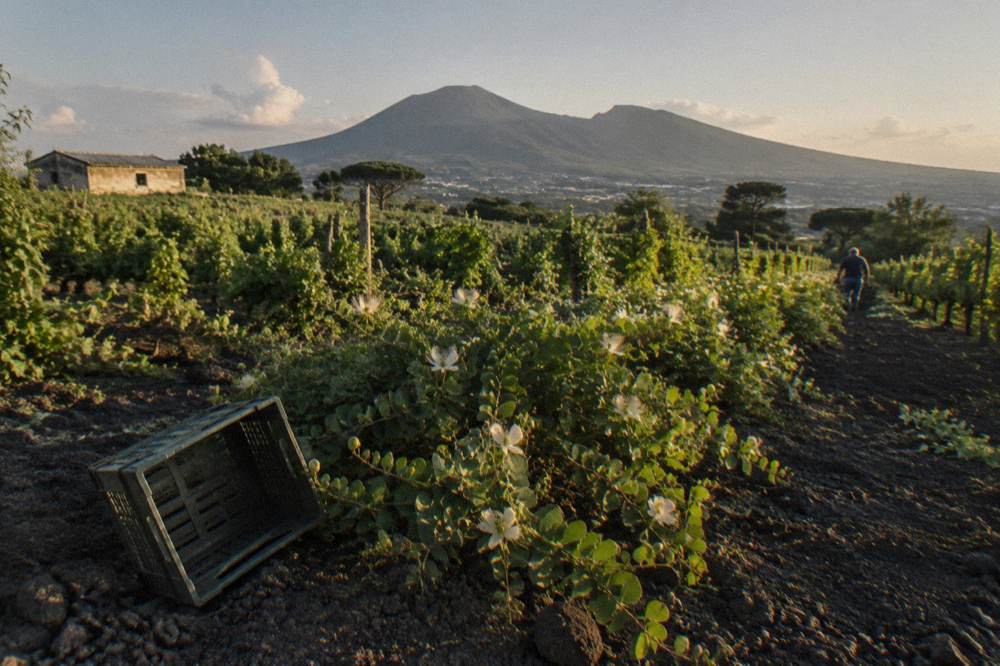
The park is unusual among European national parks because it is not wilderness. Around 700,000 people live inside the red zone across 25 municipalities in the provinces of Naples and Salerno, and the park boundary itself threads through towns like Ercolano, Torre del Greco, Boscotrecase and Terzigno. The volcano's flanks are farmed, the Lacryma Christi DOC wine appellation covers 15 municipalities on its slopes, and the lower park is a patchwork of hazel groves, vineyards and Mediterranean scrub regrown over old lava fields.
Geologically the mountain is a double structure: Monte Somma, the eroded rim of an older, larger edifice, and Vesuvius proper, the cone that grew inside it after the AD 79 eruption. That eruption buried Pompeii and Herculaneum, traditionally dated August 24, though a 2018 find at Pompeii, a charcoal graffito reading 17 October, points to an autumn date. The park's monitoring is run by the INGV Osservatorio Vesuviano, which publishes the alert level; it currently stands at green, with the September bulletin recording 121 small earthquakes of maximum magnitude 1.7. You can read the live status on the observatory's current-status page.
For planning purposes the practical takeaway is simple: the park is a half-day or full-day destination, easily combined with Pompeii or Herculaneum, and almost everything a visitor does inside it happens on the Ercolano side where the Gran Cono trailhead sits.
How Is The Park Laid Out?
The park has two broad faces. The western and southern side, reached from Ercolano and Torre del Greco, holds the Gran Cono trailhead at the Quota 1000 plaza and the main visitor flow. The northern and eastern side around Monte Somma holds most of the quieter trails, wineries and trailheads like Terzigno and Somma Vesuviana. Everything ticketed and time-slotted happens at Trail 5.
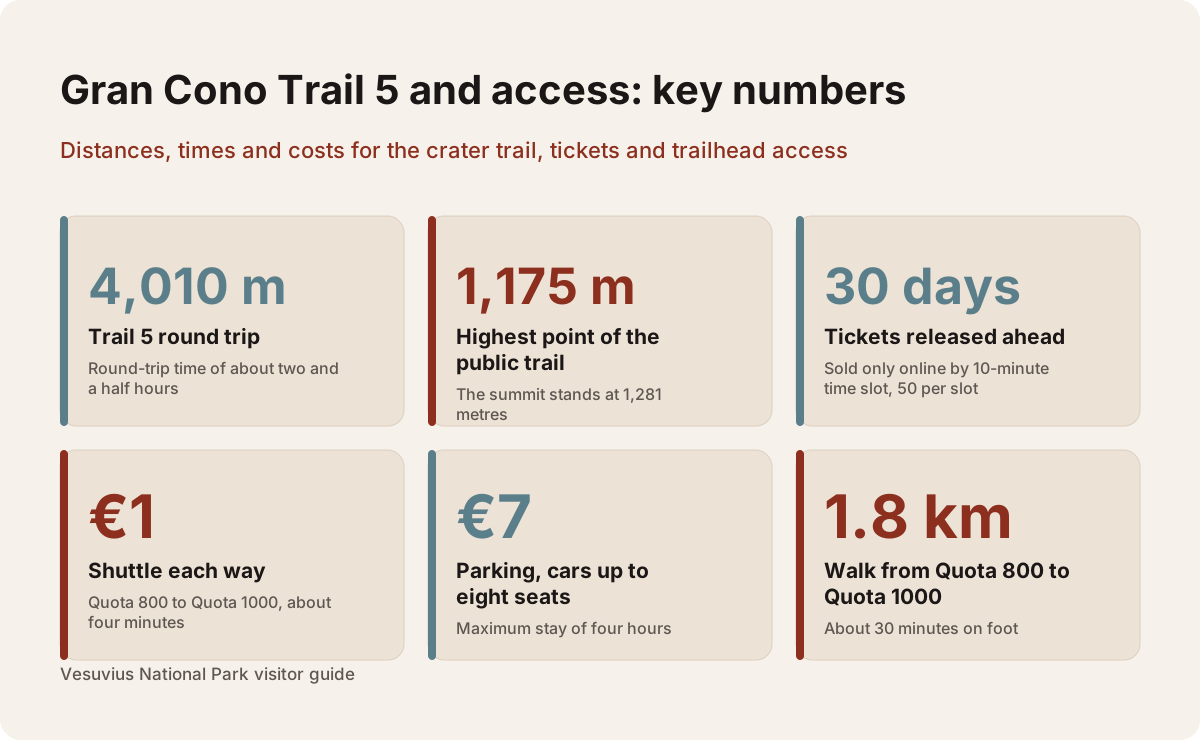
Think of the mountain as a clock face. At roughly nine o'clock is Ercolano, gateway to the crater: you drive up the SP144 from the A3 motorway exit at Torre del Greco to the Quota 800 car park, then cover the last 1.8 km to Quota 1000 on foot in about 30 minutes or on the municipal shuttle for €1 each way, a ride of about four minutes. At six o'clock are Pompei and the archaeological park, connected to the volcano by the EAV 808 bus. Around the top of the clock, the Somma side, sits the bulk of the park's forest, its holm oak woodlands, and trailheads served by small towns far less touristy than Ercolano.
The Quota 1000 plaza itself is functional rather than scenic: no parking is allowed there, and there are no public toilets there temporarily, so plan around that. Parking along the provincial road is run by the Comune di Ercolano with a maximum stay of four hours, and cars up to eight seats pay €7. The park advises buying parking only after you have secured a Gran Cono ticket, a sensible ordering given tickets sell by time slot.
Because the two faces of the mountain differ so much, tour products differ too. Crater-focused hiking products leave from Naples, Pompei and Ercolano, and a good benchmark is the guided Vesuvius hike from Pompeii with transfer, while rides, wine visits and small-group days spread across the gentler slopes.
If you are weighing the crater walk against the alternatives, the honest question to ask first is the one our Is It Worth Going Up Mount Vesuvius? article answers in detail.
What Are The 11 Numbered Trails?
The park maintains eleven numbered trails, called sentieri, ranging from the ticketed Gran Cono crater route to flat woodland paths on the Somma side. Trail 5 is the only one with online, time-slotted tickets and the only one reaching the crater rim viewpoint. Several others are free or registration-based, and trail statuses change, so treat any single trail's condition as something to confirm before you set out.
The full official list names eleven routes. Their character varies enormously, from the 4,010-metre round-trip Gran Cono climb to almost flat reserve paths. Here is the park's own inventory:
| Trail | Name | Character |
|---|---|---|
| 1 | Valle dell'Inferno | Somma-side valley route, wooded terrain |
| 2 | Lungo i Cognoli | Ridge path along the Somma horseshoe, partly closed toward Somma Vesuviana |
| 3 | Monte Somma | Summit-area route on the old edifice, partly closed from Somma Vesuviana |
| 4 | Riserva Tirone | Flat reserve path of about 2.6 km, bikes permitted at walking-pace limits, no dogs |
| 5 | Gran Cono | The crater trail, 4,010 m round trip, online ticket required |
| 6 | Strada Matrone | Old pilgrim road up the southern flank |
| 7 | Vallone della Profica | Quiet valley route on the north side |
| 8 | Trenino a Cremagliera | Route of a former funicular bed, not open |
| 9 | Il Fiume di Lava | Path across the 1944 lava flow |
| 10 | L'Olivella | Low-difficulty route near Sant'Anastasia, not open pending works |
| 11 | Pineta di Terzigno | Forest route on the Terzigno side |
Two things matter about this table. First, most visitors will only ever walk Trail 5, because it is the one that delivers the crater. Second, the free and low-key alternatives are genuinely pleasant: Trail 4 through the Riserva Tirone integral reserve is a flat, easy walk where bicycles are allowed at a maximum of 20 km/h and dogs are prohibited because of the protected habitat. Trail 9 across the lava flow gives you volcanic terrain without a ticket or a climb.
The park publishes trail conditions on its own pages, and statuses change with weather and maintenance. The trail inventory and the Gran Cono rules are on the park's official Gran Cono page. The closure logic that matters most: the ticket office and trail close automatically on any day with an orange regional weather alert or higher, with automatic refunds for slots inside a closure. We explain the full ticket mechanics in Mount Vesuvius Tickets: What You Buy And Where.
How Does Trail 5, The Gran Cono, Work?
Trail 5 runs 4,010 metres round trip from the Quota 1000 plaza to the crater viewpoint and back, officially rated low difficulty, with a round-trip time of about two and a half hours. Tickets are sold only online by 10-minute time slot, 50 per slot, released 30 days ahead, and the park's volcanological guides accompany every group above 1,000 metres. The public trail tops out at 1,175 metres, below the 1,281 m summit.
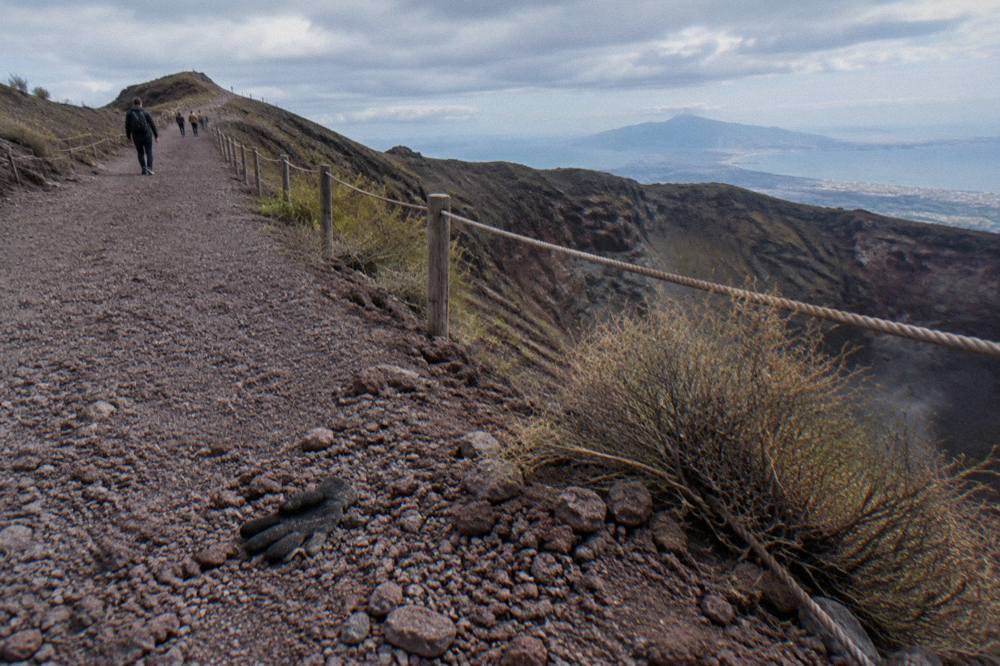
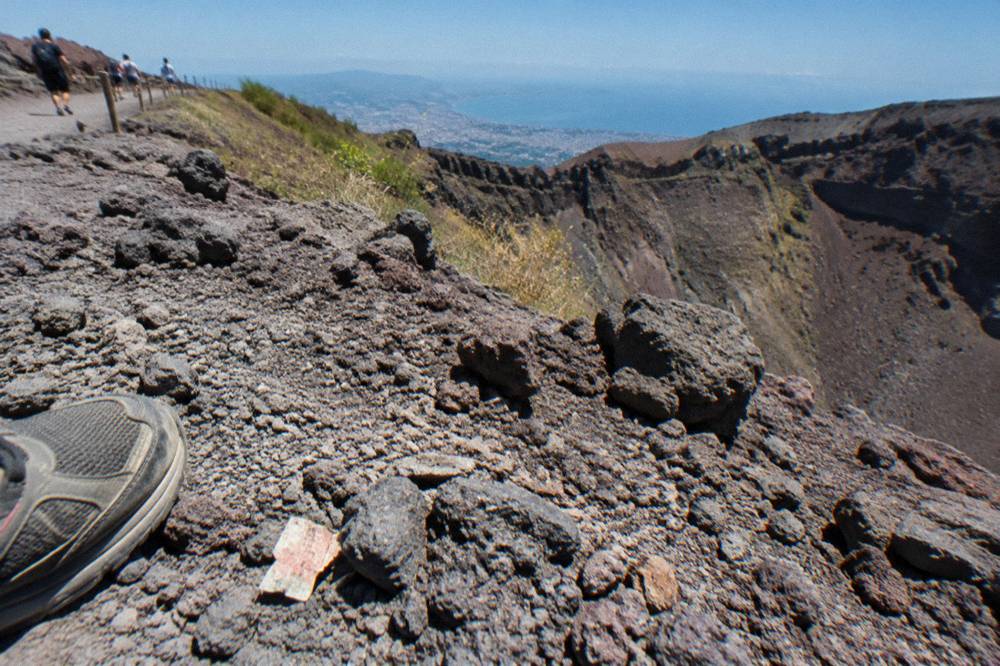
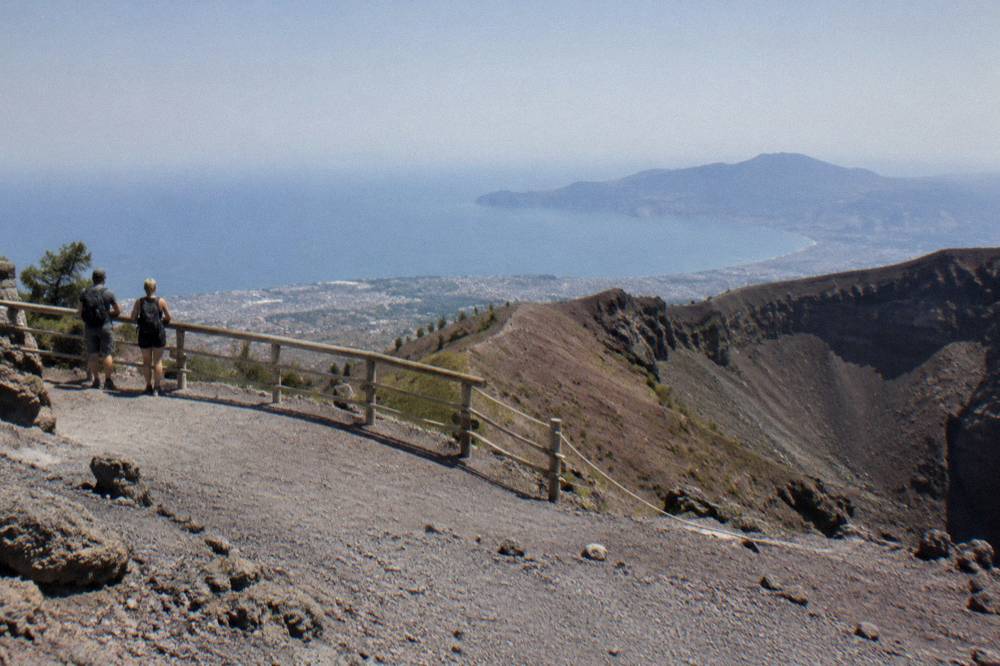
The walk itself is a wide, dusty path of volcanic gravel climbing about 160 metres from the ticket hut at 1,118 m to the turnaround at 1,170 m, which sits at 1,175 m at its highest point. The park rates the difficulty "bassa", meaning pending, easy and short, though the loose surface and the gradient catch out plenty of visitors in sandals. The crater above you is elliptical, up to 580 metres across, with fumaroles steaming on its inner walls; the upper rim route is closed to the public and reserved for researchers.
Access is governed by a 2026 protocol that changed several things at once. Capacity is capped at 360 hikers per hour, admitted as 60 people every 10 minutes in three groups of 20. Daily caps vary by season, from 3,240 in July and August down to 2,160 in the winter months. A normal ticket is surprisingly forgiving on timing: it is valid from 120 minutes before to 120 minutes after the printed slot, within opening hours. If a slot sells out, a last-minute release of 10 tickets per slot appears 30 minutes before the slot, buyable only via the wifi near the entrance, with a maximum of 5 per email address; those last-minute tickets are nominative, so the name must match your ID.
The mandatory guide rule surprises many visitors: accompaniment above 1,000 m by the park's volcanological guides is required for every group. In practice you join the park's own guide presence on the trail, keep to the right side of the walkway, and get a running commentary on the volcano's structure and history. A commercial tour cannot extend your time beyond the protocol's limits either: tours may not exceed two hours on the shortest route and three on the longest.
What Rules And Tickets Apply Inside The Park?
The park's adult ticket is €10 under its ticketing rules; the park's authorised online seller shows €11.68. Reduced entry is €8 (€9.55 online) for under-25s and residents of the 13 park municipalities with ID, and children under 6 with an adult go free. Sales are exclusively online, by named ticket and time slot, with a 20 percent last-minute allocation held back for the day itself.
Because sales are online only, there is no box office to queue at for a standard ticket, and the park explicitly warns against unauthorised resellers. Vesuviopark.vivaticket.it is the only authorised seller. If you arrive without a ticket, your only route in is the last-minute release described above, which is nominative and capped, so it is a gamble in peak months. The full purchase workflow, including the flexibility window and refund rules for weather closures, is covered in our dedicated tickets guide.
Beyond ticketing, the park's published rules are lighter than many visitors expect. There are no published regulations on drones, dogs, smoking or bags on the official Gran Cono page, so do not rely on third-party claims about any of those; the park simply asks visitors to take care, check the weather, and wear suitable shoes. What is firmly regulated is behaviour on the trail: stay with your group, keep to the right of the walkway, and finish the visit within one hour of the last access time for your month. Closure is automatic at orange weather alert or higher, with refunds for affected tickets issued automatically and within 60 days.
One genuinely useful planning note: tours that bundle entry. Several roster products state that park entry is included, for example the bus transfer to Vesuvius with park entry fee, from €35.10 per person with a 4.3 rating from 1,923 reviews, and the Mount Vesuvius Transfer with Entry Tickets, from €35.10 per person rated 4.4 from 1,785 reviews. Where a listing does not say entry is included, check the listing for what entry is included, because the €10 to €11.68 park ticket is otherwise yours to buy separately.
For many visitors the cleanest comparison is not tour versus DIY but tour format versus tour format. The decision logic is laid out in our guide on guided versus self-guided Vesuvius visits.
How Do You Get Into The Park?
By car, take the A3 Napoli-Salerno to the Torre del Greco exit, then the SP144 to the Quota 800 car park, a 15-minute, 7.3 km drive; from Quota 800 you walk 1.8 km to the trailhead or take the €1 municipal shuttle. By public transport, the Circumvesuviana train to Ercolano Scavi or Pompei-Villa dei Misteri connects to shuttles and the EAV 808 bus respectively.
The public transport option from the Pompei side deserves more attention than it gets. EAV bus 808 runs from Pompei Piazza Anfiteatro to Quota 1000 nine times a day in each direction, taking 55 minutes, with departures up the mountain between 8:30 and 14:30 and a last return at 16:50. The fare is €3.80 for a single trip bought on board, or €2.80 as an AC3 ticket bought in advance. The timetable in force is published on the EAV timetable page for line 808. One caution: the last bus up arrives at 15:25, which is after the last winter entry time of 15:00, so in the November-to-February window an early departure is not optional, it is the whole plan.
| Access route | Time to trailhead | Cost per person |
|---|---|---|
| Car to Quota 800 plus walk | 15 min drive plus 30 min walk from motorway exit | €7 parking (car, up to 4 h) |
| Car to Quota 800 plus shuttle | 15 min drive plus 4 min shuttle | €7 parking plus €1 each way |
| EAV bus 808 from Pompei | 55 min | €3.80 on board, €2.80 pre-bought AC3 |
| Private shuttle from Ercolano Scavi station | Not stated; operators quote the transfer | Check the listing |
| Guided tour with pickup | Included in tour timing | From €35.10 for transfer plus entry products |
Parking detail worth knowing: the Quota 1000 plaza itself has no visitor parking, parking along the provincial road is limited to four hours, and there is a traffic ban on Via Osservatorio between Quota 800 and Quota 1000 at set hours for everything except scheduled buses, taxis and similar vehicles. Parking permits are handled through the municipal parking operator's site. If your visit is built around the Circumvesuviana, the Vesuvius crater transfer with ticket from Pompeii is a good example of a product that starts where the train drops you.
Can You Ride Horses Or Taste Wine Inside The Park?
Yes, and both are among the best ways to see the park beyond the crater crowd. Horse riding products operate on the volcano's slopes, from a two-hour ride rated 5.0 from 151 reviews at from €69 per person to full days pairing a Pompeii guided tour with riding and a wine-tasting lunch. Wine tourism centres on Lacryma Christi DOC wineries inside the park's 15-municipality appellation zone, with tastings and lunches from €43 per person.
The riding products deserve a special mention because they reach parts of the park the crater trail never touches. The two-hour Horseback Riding on Vesuvius listing, from €69 per person with a perfect 5.0 rating from 151 reviews, includes pickup, and evening versions pair the ride with wine tasting and dinner, from €143 per person rated 5.0 from a small pool of 24 reviews. The full-day combination of a Pompeii guided tour with horse riding and lunch runs from €165 per person, rated 4.9 from 460 reviews. One guest review from Amanda C. sums up the format: "This was such an amazing experience! Pompeii, to lunch, to horse back on Vesuvius is the way to go!!"
Wine is the park's other signature. Lacryma Christi del Vesuvio DOC covers 15 municipalities on the slopes; the bianco must be at least 80 percent Coda di Volpe and/or Verdeca, the rosso at least 80 percent Piedirosso and/or Sciascinoso, both with a minimum 12 percent alcohol. Cantina del Vesuvio in Trecase and Cantine Villa Dora in Terzigno are the named estates inside the appellation, and a vineyard tour with tasting and lunch at Cantina del Vesuvio lists from €55 per person, rated 4.8 from 212 reviews. Which winery any combined tour actually visits is not stated unless the roster names it, so check the listing before assuming.
When Should You Visit The Park?
Crater access hours shift by month: 09:00 to 15:00 in January, February, November and December, 09:00 to 16:00 in March and October, 09:00 to 17:00 from April to June and in September, and 09:00 to 18:00 in July and August. Daily caps move with the hours, from 2,160 winter visitors to 3,240 in high summer. Summit temperatures run about 6 to 7 degrees cooler than Naples every month.
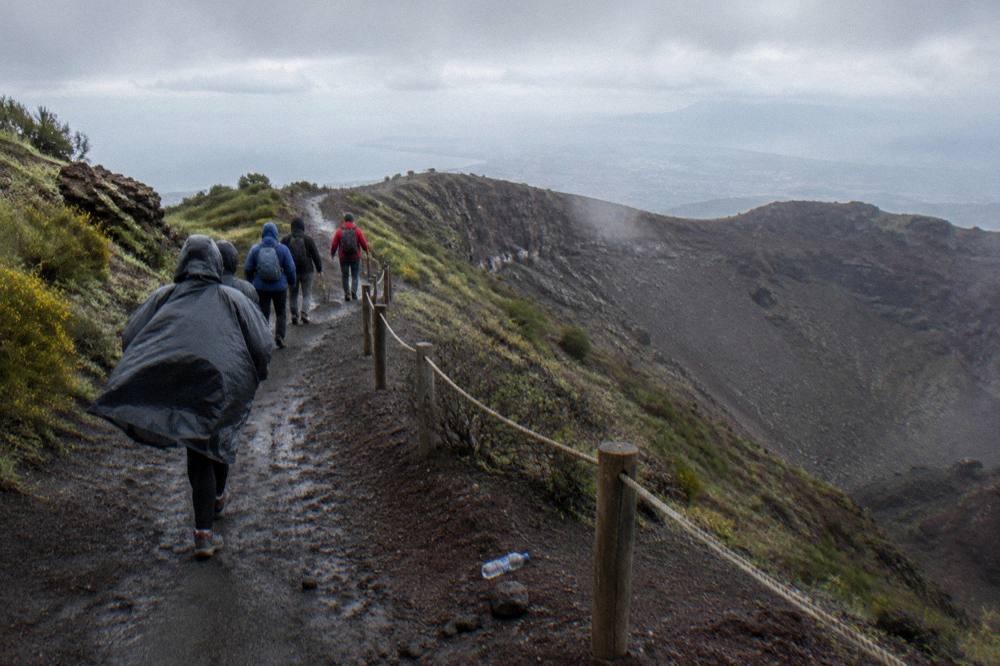
Those two facts together should shape your timing more than anything else. In July and August, Naples averages a high of 29.3 degrees while the summit level averages 22.8, and the crater path holds no shade whatsoever; Millie from the United Kingdom, reviewing a Pompeii-and-Vesuvius day tour, flagged exactly this: "Very uneven surfaces and very hot in summer so trainers and water bottles." In November, the wettest summit month with a modelled average of 180 mm of rain, the last access is 15:00 and the weather-alert closure rule bites more often.
| Month | Crater access | Daily cap | Summit high/low C | Summit rain mm |
|---|---|---|---|---|
| January | 09:00-15:00 | 2,160 | 5.6/0.0 | 119 |
| March | 09:00-16:00 | 2,520 | 8.3/1.5 | 104 |
| May | 09:00-17:00 | 2,880 | 15.1/7.5 | 59 |
| July | 09:00-18:00 | 3,240 | 22.1/14.5 | 16 |
| October | 09:00-16:00 | 2,520 | 14.8/8.5 | 129 |
| November | 09:00-15:00 | 2,160 | 10.4/4.9 | 180 |
Climate figures are modelled 1991-2020 climate averages for the 1,000-metre level, not forecasts. One structural point worth internalizing: park access ends before sunset in every month, so no genuine sunset crater hike exists as a product. If a listing promises evening atmosphere, it is a slopes or winery experience, not the Gran Cono.
Which Tours Cover The Park Best?
Tours inside the park fall into four formats: transfer-plus-ticket products from €35.10 that get you to the trailhead with entry handled, guided crater hikes from €65 with a professional guide, full combination days pairing Pompeii with the volcano from €53.25 per person, and speciality days on horseback or at wineries from €43 per person. Ratings across the category run from 4.0 to 4.9 with review pools from under a hundred to over fourteen thousand.
| Format | Example listing | From price | Rating and reviews |
|---|---|---|---|
| Transfer plus entry | Bus Transfer to Vesuvius with Park Entry Fee | €35.10 per person | 4.3 from 1,923 reviews |
| Guided crater hike from Pompeii | Mount Vesuvius Guided Tour with Transfer | €65 per person | 4.8 from 282 reviews |
| Shared bus, self-guided hike | Mount Vesuvius Crater Transfer with Ticket | €49 per person | 4.1 from 551 reviews |
| Pompeii plus volcano day | Pompeii and Vesuvius Day Trip with Pizza Lunch | €53.25 per person | 4.8 from 9,744 reviews |
| Horse riding, two hours | Horseback Riding on Vesuvius | €69 per person | 5.0 from 151 reviews |
| Winery lunch and tasting | Vesuvius Wine Tasting Tour, Boscotrecase | €43 per person | 4.9 from a small pool of 45 reviews |
The cheapest options are not always the wisest. The pure transfer products leave you to absorb the timing rules yourself, and the ±120-minute ticket window only helps if your bus and your slot line up. Guided versions cost more but bake in the scheduling: the From Pompeii guided tour with transfer, from €65 per person rated 4.8 from 282 reviews, syncs the bus, the entry and a guide who meets the park's accompaniment requirement at the trailhead. Dan from the United Kingdom reviewed the pizza-lunch day tour in terms that apply to the whole category: "A great trip for anyone wanting to visit Pompei and Mount Vesuvius in one day."
How Much Time Should You Budget For The Park?
Plan on three to four hours inside the park itself: the Gran Cono walk takes about two and a half hours round trip at an honest pace, and the protocol caps guided itineraries at two to three hours on the trail. Add transport, and the realistic floor is a three-hour transfer-and-ticket product, while a full day covers the park plus Pompeii comfortably at eight hours.
The half-day versus full-day question comes down to what else is on your list. If Pompeii is on it, and it usually is, a combined day such as the Naples day tour with lunch included, from €67.20 per person rated 4.3 from 14,121 reviews, uses about seven hours and removes every logistical decision between the two sites. The independent route, train to Ercolano Scavi plus shuttle plus pre-booked crater slot, is cheaper but consumes a whole day of attention.
Time-of-day matters as much as total time. Morning slots get cooler air and clearer views across the bay before afternoon haze builds, and they leave a buffer if the last-minute ticket scramble becomes necessary. The closure rule is another reason to build slack: an orange weather alert closes the trail automatically, and while refunds are automatic, your day is not refundable.
Common Questions About Vesuvius National Park
How many trails does Vesuvius National Park have?
The park maintains eleven numbered trails. Trail 5, the Gran Cono, is the only one with ticketed crater access; several others, including Trail 4 through the Riserva Tirone, are free, and trail statuses change with weather and maintenance, so confirm conditions before setting out.
Do you need a guide to walk up Vesuvius?
Yes, above 1,000 metres accompaniment by the park's volcanological guides is mandatory for every group, and it is included in the access arrangements rather than an optional extra. Commercial tours add their own guide on top, which is why guided listings from Pompeii and Naples cost more than bare transfers.
Can you enter Vesuvius National Park without a ticket?
For the Gran Cono, no: tickets are sold exclusively online by time slot, and the only ticketless route is the last-minute release of 10 nominative tickets per slot, 30 minutes before each slot, buyable near the entrance. Other trails, such as Trail 4, are free with registration at the entrance.
Is Vesuvius National Park the same as visiting Pompeii?
No. Pompeii is a separate archaeological park at the foot of the volcano with its own tickets, from €20 for the ancient city, while Vesuvius National Park is the protected volcanic area above it. Many tours combine both in one day, typically over seven to eight hours from Naples.
Are there toilets at the park?
There are no public toilets at the Quota 1000 plaza temporarily, according to the park's own access page. Plan around this: use facilities in Ercolano or Pompei before ascending, and treat the crater walk as a dry two and a half hours.
What happens if the weather is bad on my visit day?
The ticket office and trail close automatically on any day with an orange regional weather alert or higher. Tickets for slots inside a closure are refunded automatically within 60 days, and tickets in adjacent slots are refundable on request within 30 days by emailing the park.
The park rewards a little planning: a pre-booked slot, an early start, sturdy shoes, and a sense of what the mountain is, a monitored, living volcano farmed to its shoulders. Whether you walk the Gran Cono on a bare transfer or ride the lower slopes toward a winery lunch, the structure above holds. Book the ticket first, everything else second, and check this site's Mount Vesuvius Tours roster for the format that matches your days in Campania.