How To Hike Mount Vesuvius
The walk to the crater of Vesuvius is short, steep in places and managed like a queue at a museum. Here is what the trail actually involves, what the park rules require, and how to decide between going alone and booking a hike.
Short answer
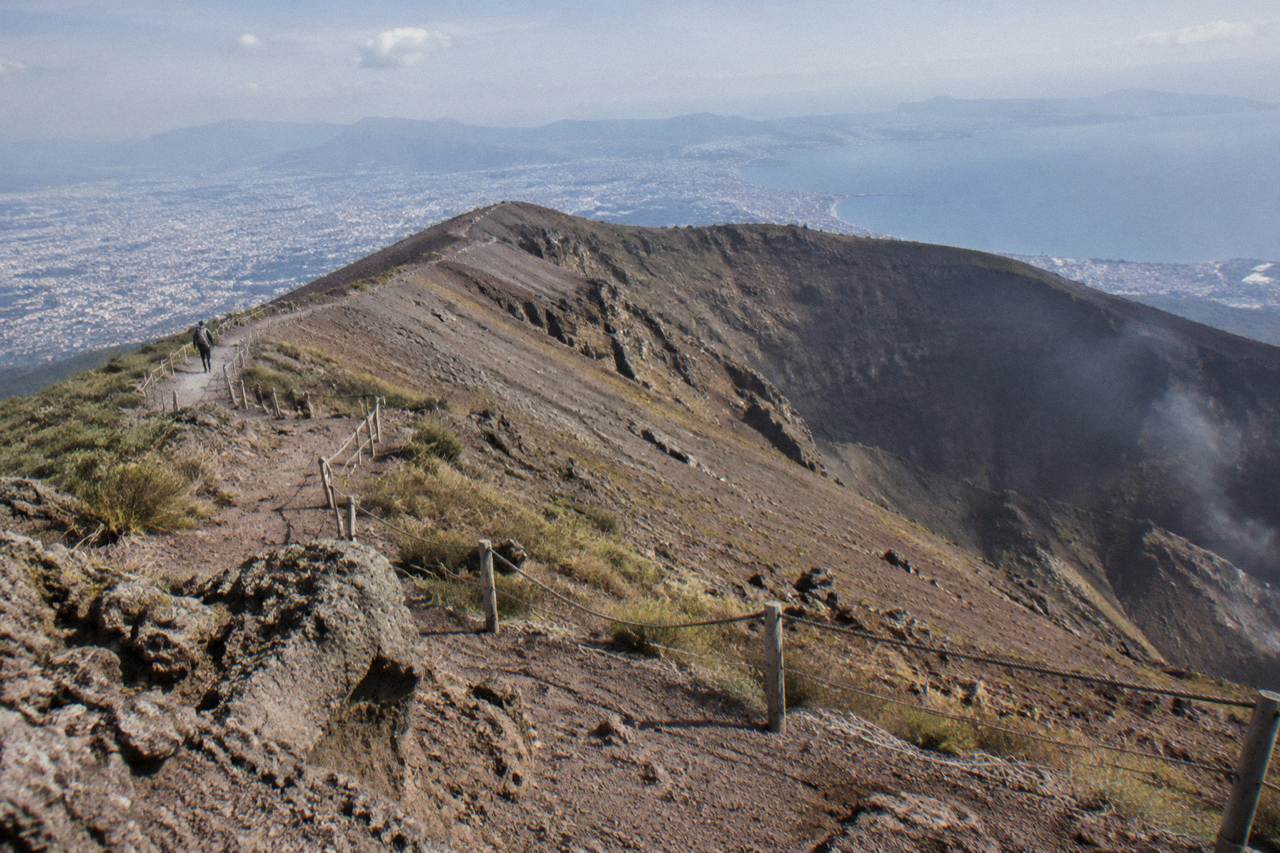
The Gran Cono trail (Trail 5) is 4,010 m round trip, tops out at 1,175 m and takes about 2 h 30 round trip, with official difficulty rated low. It starts at the Quota 1000 plaza, and above 1,000 m every visitor is accompanied by the park's volcanological guides, so no hike is truly self-guided.
The Gran Cono is the only trail on Vesuvius that reaches the crater, and the park runs it with a precision most museums would envy. Tickets are sold online in ten-minute slots, capacity is capped at 360 hikers per hour, and above 1,000 m nobody walks unaccompanied: the park's own volcanological guides take every group up. The trail itself is 4,010 metres round trip, the turnaround sits at 1,170 metres, and the park rates the difficulty low, which surprises people expecting an alpine slog and disappoints people who wanted one.
This guide covers the trail in detail: what the climb actually feels like, what the park guide requirement means for the "self-guided" idea, how tickets and time slots work, how to reach the trailhead, and when a booked tour earns its price. Along the way it points to the site's Mount Vesuvius hiking tours collection, where the guided options are gathered, and to deeper reads such as Inside The Mount Vesuvius Crater for what you see at the top.
What Is The Gran Cono Trail Really Like?
The Gran Cono, Trail 5, is Vesuvius's crater path: 4,010 m round trip, about 2 h 30 for the loop, starting and finishing at the Quota 1000 plaza above Ercolano. The park's own infobox rates the difficulty low, describing it as flat-leaning, easy and short. The highest point the public reaches is 1,175 m, well below the 1,281 m summit that only researchers visit.
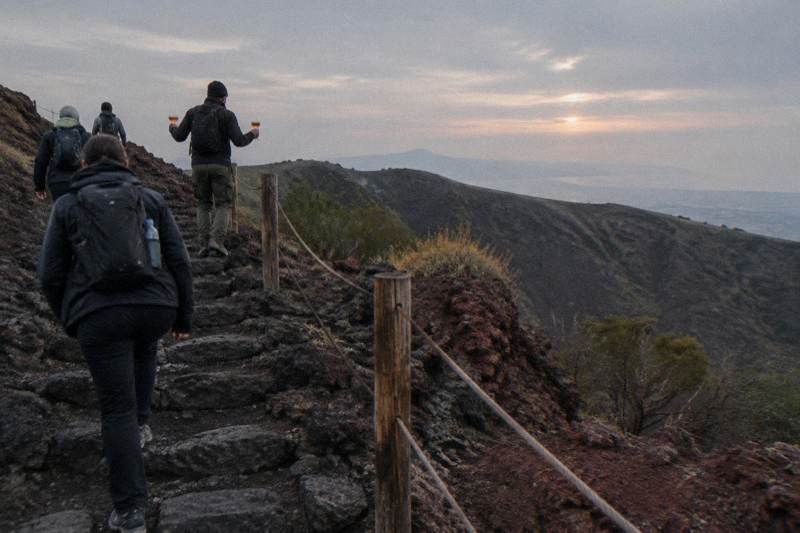
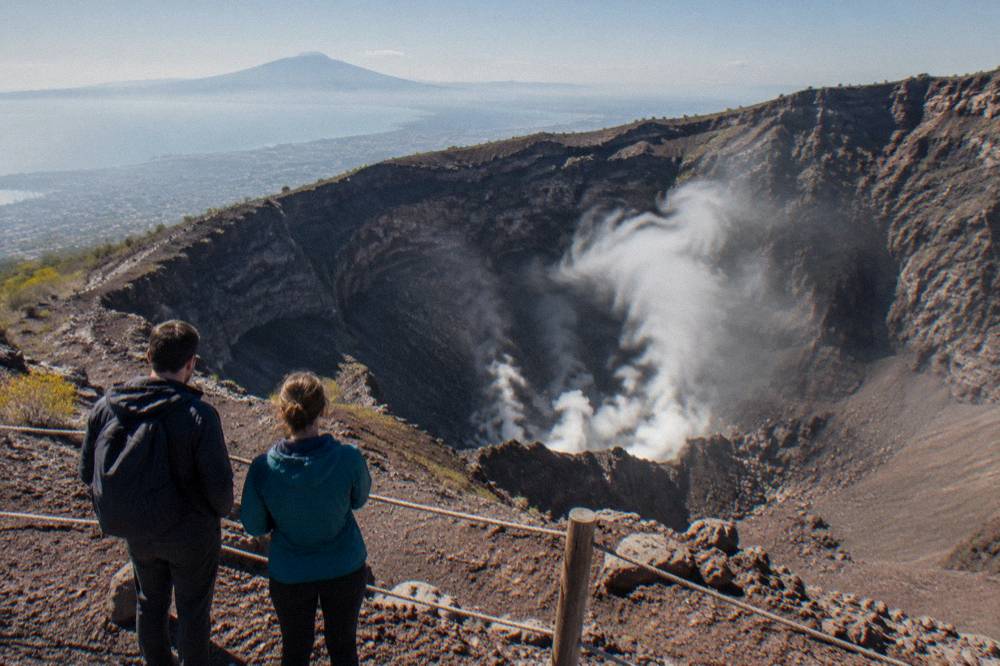
The trail climbs volcanic ash and loose gravel through spare, regenerating vegetation, with the Bay of Naples opening behind you almost from the first bend. The route is not a wilderness hike. It is a managed path with a ticket hut at 1,118 m, a turnaround point the park calls the Capannuccia at 1,170 m, and a one-way flow: visitors keep to the right side of the walkway, per the park's protocol, so uphill and downhill traffic stay separated. The crater itself is elliptical, up to 580 m across, with fumaroles steaming on the inner walls, a visible reminder that the volcano last erupted in March 1944.
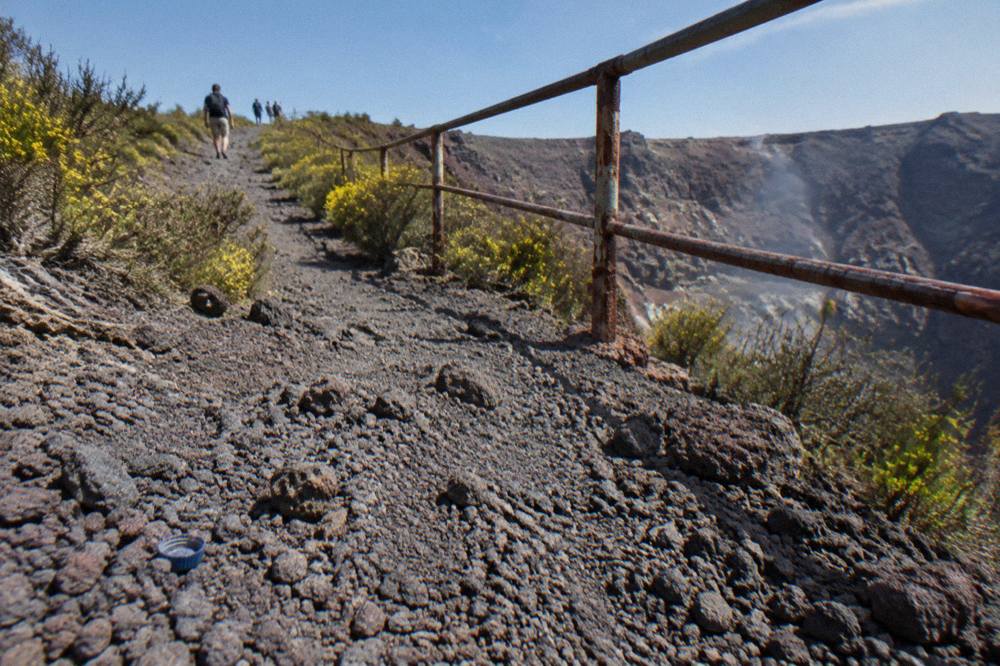
Two rules shape every visit. First, the protocol caps a guided outing at 2 hours on the shortest route and 3 hours on the longest, so nobody lingers indefinitely at the rim. Second, the upper rim route is closed to the public entirely; researchers only. What you get at the top is the Capannuccia viewpoint, and it is a good one, taking in the crater, Naples, and on clear days the Sorrento peninsula. For a fuller picture of the summit experience, read Is It Worth Going Up Mount Vesuvius?.
The park has ten other numbered trails across the massif, from the Valle dell'Inferno to the Pineta di Terzigno, but none of them reach the crater, and their statuses change with maintenance and weather. The Gran Cono is the walk people mean when they say "hiking Vesuvius", and the routes are mapped in the Mount Vesuvius Trail Map And Routes guide.
How Hard Is The Walk Up Vesuvius?
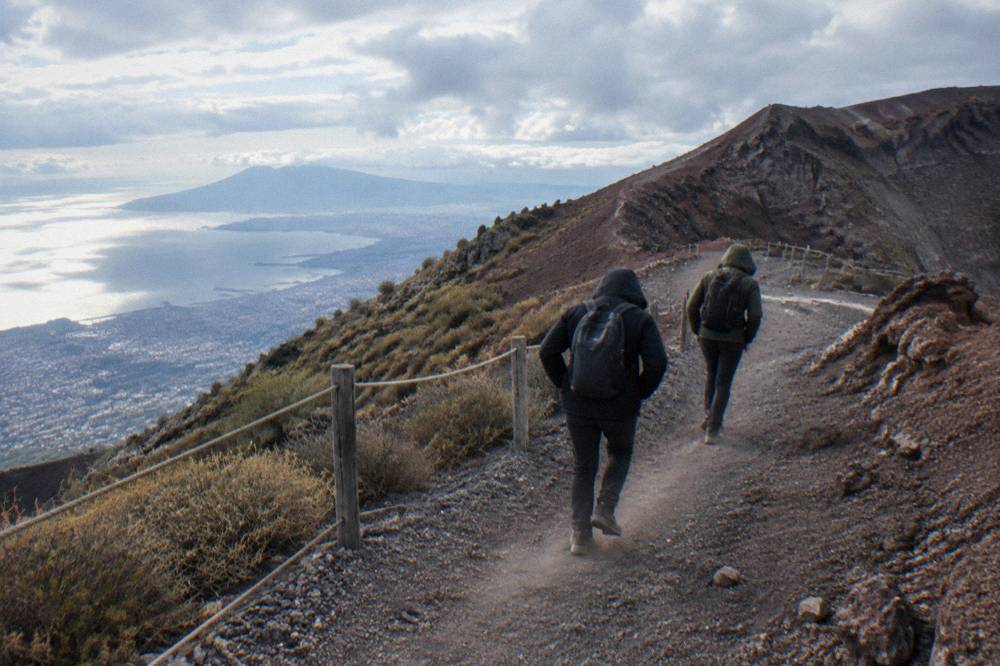
Officially the difficulty is low: the park calls the trail easy, pending, flat-leaning and brief. In practice it is a steady 20 to 30 minute climb on loose volcanic gravel, around 200 m of vertical gain from the ticket hut to the turnaround, with no scrambling and no exposure. Most reasonably fit adults and supervised children manage it; sturdy shoes matter more than fitness.
The gradient is the honest challenge. The path rises from the Quota 1000 plaza to the turnaround in short switchbacks, and the surface is ash and scree that slide a little underfoot on the descent. Trainers with grip work in dry weather; sandals and smooth-soled city shoes do not. One guest on the big Naples day tour put it plainly in a review: "Very uneven surfaces and very hot in summer so trainers and water bottles", advice from Millie in the United Kingdom that holds for every month of the season.
Weather swings the difficulty more than the terrain does. Summit temperatures run about 6 to 7 C below Naples every month in the modelled 1991-2020 climate average, so a 29 C day on the bay is a 22.8 C day at the crater, and a mild Naples December at 12.7 C means about 6.7 C at the trailhead, with wind. November is the wettest summit month at 180 mm of rain over 13.6 days; July the driest at 16 mm. The Mount Vesuvius Hike Difficulty guide breaks this down for less confident walkers, and there is a dedicated read on What To Wear Hiking Mount Vesuvius.
If the climb sounds like too much, the honest alternatives are on the roster rather than on the mountain: wine tastings on the lower slopes, such as the Mount Vesuvius vineyard tours that stay below the trailhead entirely, and the flat coastal archaeology at Pompeii and Herculaneum.
Do You Need A Guide To Hike Mount Vesuvius?
Above 1,000 m, yes, everyone does, and the guide comes with the terrain: the park's protocol requires each group on the Gran Cono to be accompanied by guides of the Permanent Vesuvius Volcano Unit. You cannot walk the crater path independently. What you can choose is whether to add a commercial guide below that line for the ride up, the commentary and the logistics.
This is the point most first-time visitors get wrong, so it is worth being precise. The park volcanological guides handle the crater section itself; their accompaniment is mandatory and it is not something you pay extra for at the gate. A booked tour guide, by contrast, is the person who meets you in Naples or Pompeii, manages the transport, times your arrival into a workable ticket slot, and adds archaeological and geological context on the way. The Guided Tour Or Self-Guided Vesuvius? guide compares the two models in full.
For visitors already at Pompeii, the transfer-plus-ticket products are the leanest way to close the gap. The From Pompeii or Naples easy transfer and entry ticket covers the shuttle and the crater entry, from €39 per person, rated 4.3 from 1,121 reviews, and it is the featured option on this page's 4x4 and shuttle category. A similar direct transfer from Naples with guaranteed entry runs from €35.10 per person, 4.4 from 1,785 reviews. Both leave the crater experience to the park guides, which is exactly what the protocol intends.
A review from Mia in the United Kingdom on the direct-transfer product captures the appeal: "Was great and being able to explore and walk up in our own time was amazing! The staff on both ends in Pompeii and on the volcano are friendly." That is the model in one sentence: transport and tickets handled, pace your own, park guides at the top.
How Long Does The Hike Take And When Should You Go?
The park's figure is 2 h 30 round trip on the Gran Cono, and the protocol caps any guided outing at 2 hours on the shortest route and 3 hours on the longest. Add queueing at the ticket hut, photo stops at the rim and the shuttle leg from the car park, and the whole trailhead-to-trailhead visit runs about three hours in practice.
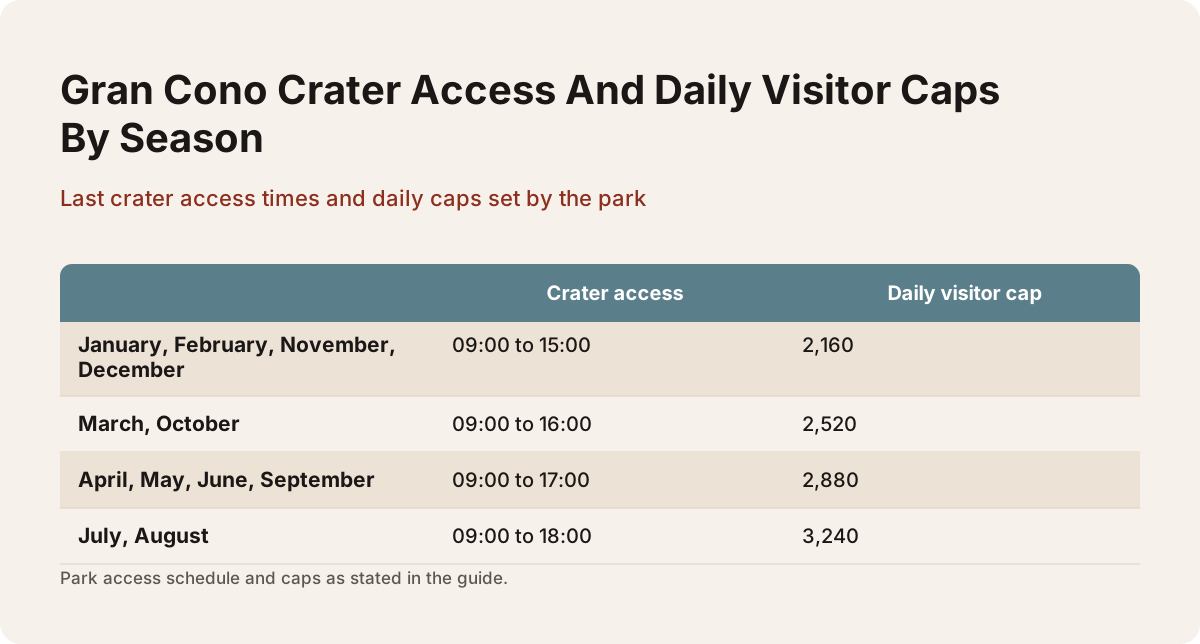
Timing around the calendar matters more than timing around the clock, because the closing hours are last-access times and the visit must end within one hour of them. The seasonal pattern, straight from the park's page, looks like this:
| Months | Crater access (last access) | Daily visitor cap |
|---|---|---|
| January, February, November, December | 09:00 to 15:00 | 2,160 |
| March, October | 09:00 to 16:00 | 2,520 |
| April, May, June, September | 09:00 to 17:00 | 2,880 |
| July, August | 09:00 to 18:00 | 3,240 |
Flow of visitors is capped at 60 people every 10 minutes, in three groups of 20, which is why the trail never feels crushed even on a 3,240-capacity August day. Morning slots carry the thinnest queues and the clearest air; the summit's wettest months, November at 180 mm and October at 129 mm in the modelled 1991-2020 climate average, are when afternoon cloud most often swallows the view. The site's month-by-month pages, starting from Mount Vesuvius by month, carry the detail for each season. If the uphill walk sounds like more effort than you fancy, our guide to reaching Vesuvius by 4x4 or e-bike explains how to see the crater with far less climbing.
One hard rule closes days early without warning: the ticket office and the path shut automatically whenever the regional Civil Protection authority issues an orange weather alert or higher. Slots inside a closure are refunded automatically; slots adjacent to one are refundable on request within 30 days. Check the live listing for your chosen date rather than trusting any standing status.
How Do You Get To The Trailhead At Quota 1000?
The Gran Cono starts at the Quota 1000 plaza above Ercolano. By car, take the A3 to the Torre del Greco exit and the SP144 to the Quota 800 car park, 7.3 km and about 15 minutes, then either walk the 1.8 km to Quota 1000 in about 30 minutes or ride the municipal shuttle for €1 each way, about 4 minutes.
Parking is its own small system. The Quota 1000 plaza itself has no parking, and no public toilets there for now; the municipal car parks along the provincial road, run by the Comune di Ercolano, cap stays at 4 hours and charge €7 for cars up to 8 seats. The park's advice is blunt: secure your crater ticket before you buy parking. Traffic limits also apply to private cars on Via Osservatorio between Quota 800 and Quota 1000 at set hours, which is why the shuttle leg exists. Other pages covering the same trip are gathered on Mount Vesuvius Tours.
Public transport works from two directions. From Naples, the Circumvesuviana from Napoli Centrale or Piazza Garibaldi toward Sorrento or Poggiomarino-Via Pompei stops at Ercolano Scavi, where taxis and private shuttles cover the climb. From the Pompeii side, EAV bus 808 runs from Pompei Piazza Anfiteatro to Quota 1000 nine times a day in each direction, 55 minutes, €3.80 on board, with the last uphill run arriving 15:25, after the winter last entry, so it cannot be the only plan in the short months. The full timetable is published by EAV. Train fares are not stated on the official pages, so check before you travel.
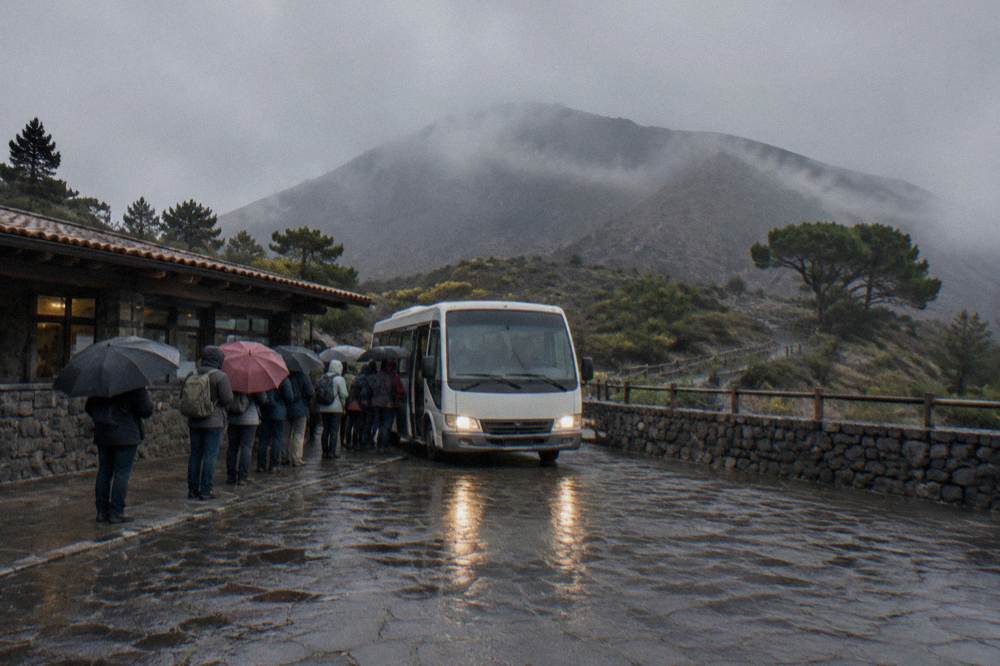
The simplest workaround is a product that folds transport and entry together. The featured easy transfer from Pompeii or Naples, discussed above, does precisely this, and the dedicated Mount Vesuvius Shuttle Bus And Parking guide compares every transfer option on the roster.
What Tickets Do You Need And How Do Time Slots Work?
Crater entry is online-only, sold by the park's authorised seller in 10-minute slots of 50 tickets, released 30 days ahead. The park's adult ticket is €10 under its ticketing rules; the park's authorised online seller shows €11.68. A normal ticket is valid from 120 minutes before to 120 minutes after the printed slot, within opening hours.
There is no cash desk. If a slot sells out, a last-minute release of 10 tickets per slot happens 30 minutes before the slot, buyable only via the wifi near the entrance, capped at 5 per email address, and since 11 April 2026 those last-minute tickets are named, so the name must match your ID. Twenty percent of each day's tickets are held back for this last-minute pool. Reduced entry is €8, €9.55 online, for under-25s and residents of the 13 park municipalities with ID; children under 6 with an adult go free. The full mechanics, including the refund rules, live in the Mount Vesuvius Tickets Guide.
Booked tours change this arithmetic in one way: where the listing says entry is included, the operator holds the ticket and the slot for you. The Mount Vesuvius excursion with skip-line ticket and digital guide, from €16 per person and rated 4.2 from 3,756 reviews, is the cheapest such product on the roster, and it pairs the crater entry with an audio commentary for the ride. The dedicated hub for entry-inclusive products, Vesuvius tickets with tour, is worth scanning if your dates are inside the 30-day release window and slots are moving fast.
For the volcano's current standing, the authoritative source is the INGV Osservatorio Vesuviano, which publishes the alert level and monthly bulletin.
What Should You Wear And Bring On The Vesuvius Hike?
Wear closed shoes with grip and dress about 6 to 7 C cooler than Naples feels on the bay, adding a wind layer year-round. Bring water, sun protection and your ID for the ticket check. The surface is loose volcanic gravel, the rim is exposed, and there are no public toilets at the Quota 1000 plaza, so plan around that before you ride up.
The temperature gap is the number people forget. In August, Naples averages 29.3 C against 22.8 C at the summit level; in April, 17.4 C against 11.1 C, and the wind on an open crater rim takes more off that. The modelled 1991-2020 climate average for the 1,000 m level shows the driest stretch in July at 16 mm of rain over 3.3 days, and the wettest in November at 180 mm over 13.6 days, which maps neatly onto the crowd calendar too.
| Month | Summit high/low C | Rain mm (days) | What it means on the trail |
|---|---|---|---|
| April | 11.1/3.8 | 87 (11.1) | Layers; wind at the rim; green slopes |
| July | 22.1/14.5 | 16 (3.3) | Sun hat and water; busiest caps |
| October | 14.8/8.5 | 129 (10.5) | Waterproof in the pack; earlier last access |
| December | 6.7/1.4 | 147 (13.1) | Warm layers; last access 15:00 |
A light daypack is enough. The park publishes no rules on bags beyond ordinary care, and its stated guidance is simple: check the weather, wear suitable shoes, take care on the path. The full packing breakdown, including what to skip, is in What To Bring On A Mount Vesuvius Tour, and families walking with children should read Vesuvius Hike With Kids for the age and pace realities. Once your bag is sorted, the guide to how hard the Vesuvius trail actually is will tell you what those sturdy shoes are in for.
Should You Hike Independently Or Book A Vesuvius Tour?
Hike "independently" only in the narrow sense: you buy your own slot and ride up yourself, then join the park's guided flow above 1,000 m. Book a tour when you want Pompeii folded into the same day, transport from a distant base, or a meal on the slopes. The price gap between the cheapest transfer-only product and a full guided day is about €30 per person.
The pure-DIY route costs the crater ticket plus your transport: the EAV bus at €3.80 from Pompeii, or the Circumvesuviana plus a shuttle from Ercolano. The leanest booked version, the €16 skip-line ticket with digital guide, removes the box-office uncertainty. One step up, the guided 3-hour hike from Pompeii with transfer, from €65 per person and rated 4.8 from 282 reviews, adds a professional hiking guide for the whole outing rather than only the crater section.
| Option | From price | What it covers | Rating and pool |
|---|---|---|---|
| Skip-line ticket and digital guide | €16 per person | Entry, audio commentary | 4.2 from 3,756 reviews |
| Bus transfer with park entry fee | €35.10 per person | Shuttle from Naples or Pompeii, entry | 4.3 from 1,923 reviews |
| Guided tour with transfer from Pompeii | €65 per person | Guide, transfer, hike | 4.8 from 282 reviews |
| Naples day tour with lunch | €67.20 per person | Pompeii, Vesuvius, meal, pickup | 4.3 from 14,121 reviews |
The full-day products answer a different question. The Naples day tour that bundles Pompeii, the crater and lunch, from €67.20 per person with a 4.3 rating across 14,121 reviews, is the volume favourite on the roster, and a review from Melanie in the United States sums up the format: "She explained the history of Pompeii very well. Mount Vesuvius was good as well." If your day has room for ruins as well as the rim, Pompeii And Vesuvius In One Day sequences it properly.
Is The Vesuvius Hike Safe, And Is The Volcano Watching You?
Yes, in the sense that matters: Vesuvius is monitored continuously, the alert level is published as green with parameters within base values, and the September 2026 bulletin recorded 121 small earthquakes with a maximum magnitude of 1.7. The trail's real hazards are mundane: loose gravel, heat, and wind, managed by slot caps, mandatory guides and automatic weather closures.
The volcano's standing is a matter of record rather than reassurance. INGV gives the height as 1,281 m and dates the last eruption to March 1944, with lava reaching the towns on 21 March. Since then the mountain has been quiet, with a long-term decline in hydrothermal activity in the crater recorded by the observatory. The science and history are covered in Is Mount Vesuvius Active? and Mount Vesuvius Last Eruption.
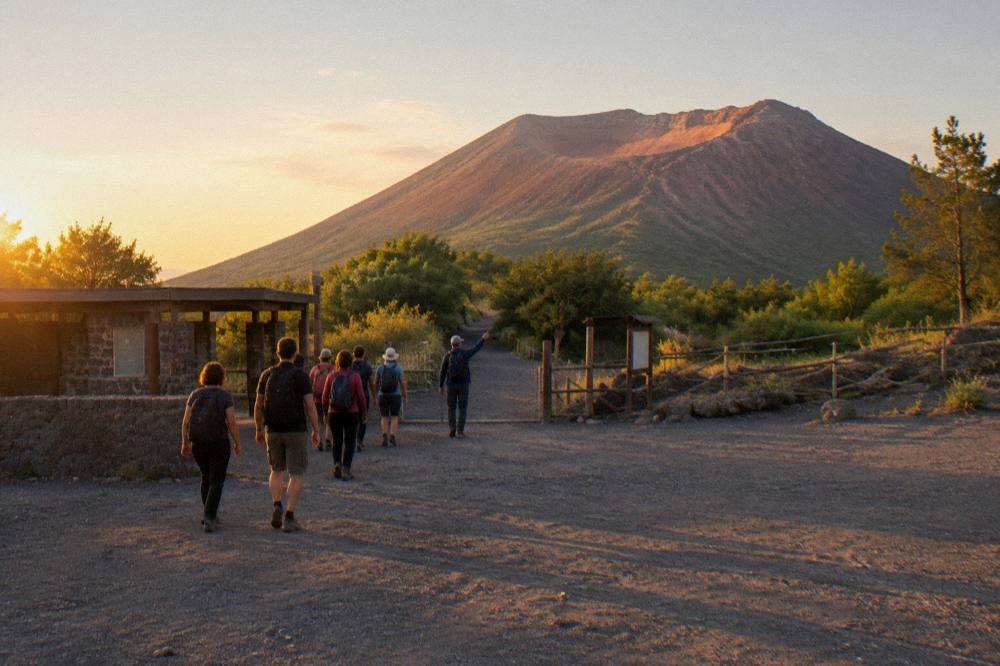
What the safety system looks like from the trail: capped flow, groups of 20, guides from the park's permanent volcano unit, and an automatic shutdown at orange weather alerts or higher, with automatic refunds for affected slots. The upper rim is closed to the public, and visitors stay on the right of the walkway. For live conditions rather than standing facts, this site's Vesuvius Webcam And Current Conditions page collects the view, and the authoritative reference is the park's own Gran Cono page for hours, tickets and rules.
What Kind Of Hiker Is The Gran Cono Right For?
Almost everyone, honestly: the trail is short, guided, capped and well surfaced, rated low difficulty by the park itself. It suits first-time hikers, families with school-age children, cruise visitors with a half day, and fit walkers who pair it with Pompeii. It does not suit anyone after solitude, summit-bagging or a long mountain day; the turnaround is 1,175 m and the clock stops at 3 hours.
Match the product to your energy budget. Half-day visitors from Naples have a compact all-inclusive option from €44.80 per person, 4.5 from 891 reviews, which handles pickup, transfer and entry in about four hours. Visitors with more time and an interest in the slopes rather than the rim can trade the climb for a vineyard lunch: the wine tastings on the Vesuvius slopes from €90 per person include lunch and run about four hours, and they are gathered on the site's hub for Mount Vesuvius wine tours.
For anyone planning around weather windows or short daylight, the season pages are the practical companion: Mount Vesuvius in spring and Mount Vesuvius in autumn carry the month-level detail, while Mount Vesuvius in winter covers the 15:00 last-access months when the bus timetable and the clock matter most.
Common Questions About Hiking Mount Vesuvius
How hard is the hike up Mount Vesuvius?
The park rates Trail 5 difficulty low, calling it easy, flat-leaning and brief. It is about 200 m of climbing on loose gravel from the ticket hut to the 1,170 m turnaround, manageable for most fit adults and children, with sturdy shoes doing most of the work.
Do I need a guide to hike Mount Vesuvius?
Above 1,000 m, yes, for everyone: park protocol requires accompaniment by the park's volcanological guides. You can still organise your own ticket and transport, but the crater section is always with the park's guides.
How long does the Vesuvius crater hike take?
The park's figure is 2 h 30 round trip. Protocol caps guided outings at 2 hours on the shortest route and 3 hours on the longest, and the visit must end within one hour of the last access time.
Can I buy a Vesuvius trail ticket on the day?
Only online, even last minute: if your slot is sold out, 10 named tickets per slot are released 30 minutes before it, buyable via the wifi near the entrance, up to 5 per email address. Twenty percent of daily tickets are held back for this.
What happens if the weather turns bad?
The ticket office and trail close automatically on any orange weather alert or higher. Slots inside a closure are refunded automatically; adjacent slots are refundable on request within 30 days, with refunds processed within 60 days.
What shoes should I wear on the Gran Cono?
Closed shoes with real grip. The path is volcanic ash and gravel that slides underfoot, especially descending, and reviewers consistently recommend trainers and water, with the summer surface heating up through the middle of the day.