What To Wear Hiking Mount Vesuvius
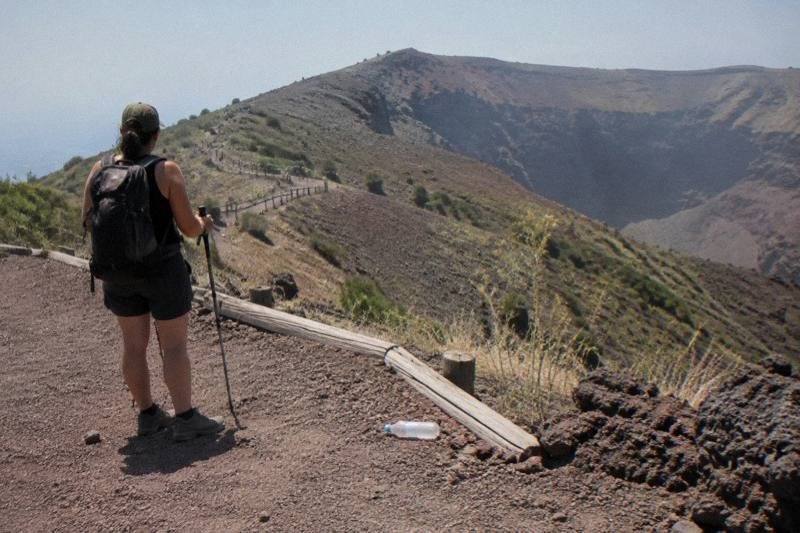
The Gran Cono trail is short, steep in places and completely exposed. What you wear decides whether the day feels like a stroll or an ordeal.
Short answer
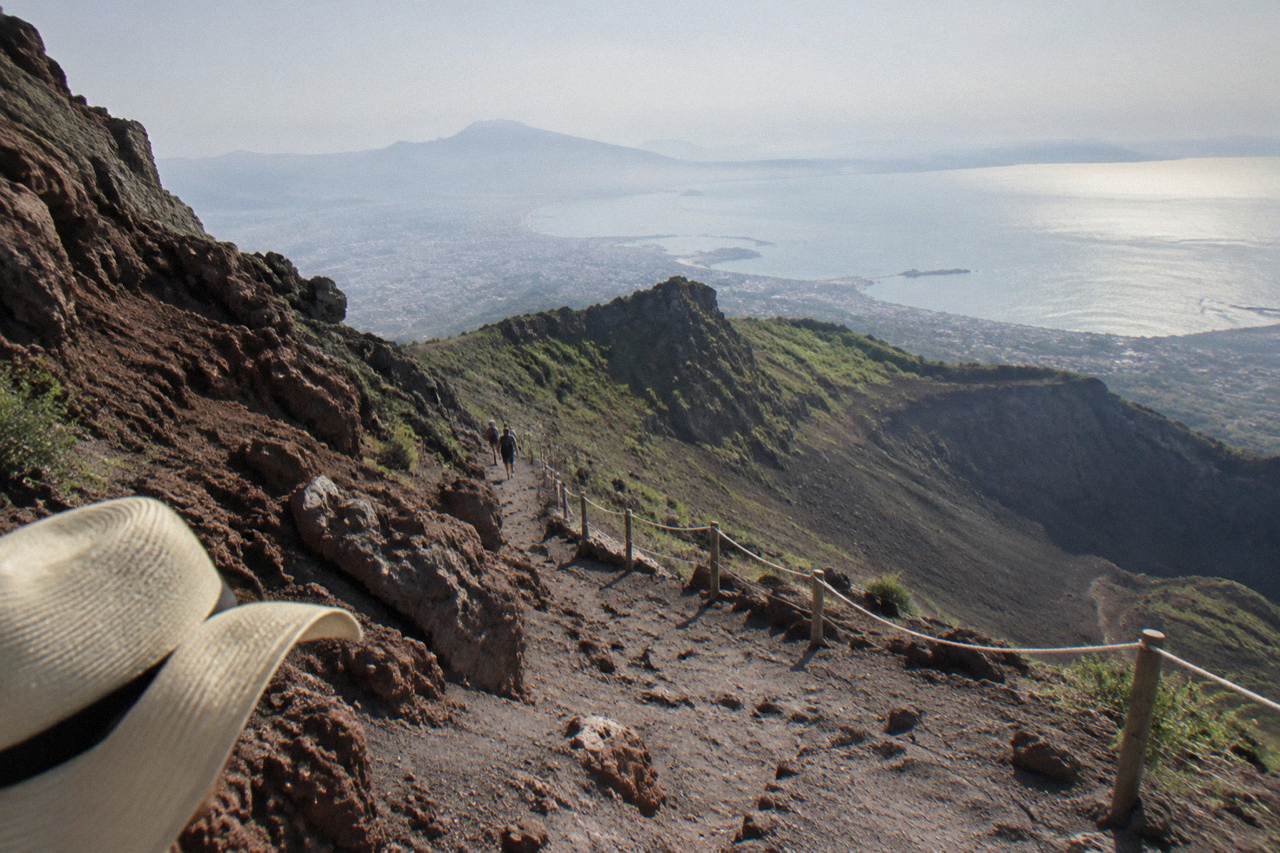
Wear broken-in trainers or light hiking shoes with grip, because the trail surface is loose volcanic gravel and ash. Dress in layers you can shed: summit highs run about 6 to 7 C below Naples every month (modelled 1991-2020 climate average), the crater rim has no shade, and wind is constant. Bring sun protection, water and a windproof layer in every season.
The park's own description of Trail 5, the Gran Cono, calls the route low difficulty: 4,010 metres round trip, roughly two and a half hours walking, topping out at 1,175 m. None of that is strenuous on paper. What the infobox does not mention is the surface, the wind and the total absence of shade, and those three things, not distance, are what your clothing has to answer for. One guest review of the Naples Day Tour, Lunch Included puts it plainly: "Very uneven surfaces and very hot in summer so trainers and water bottles." Those same hazards weigh double on smaller feet, so families should read our guide to hiking Mount Vesuvius with children before packing a single bag.
This guide is the full kit answer. It works through footwear first, because that is the one item that can end the day early, then layers, sun, wind and the small things that matter at altitude. All temperatures below are the modelled 1991-2020 climate average from reanalysis data, not a forecast. For the walk itself and how the trail is organised, read How To Hike Mount Vesuvius; for what you actually see at the top, see the site's crater guide, Inside The Mount Vesuvius Crater.
What Shoes Should You Wear On Mount Vesuvius?
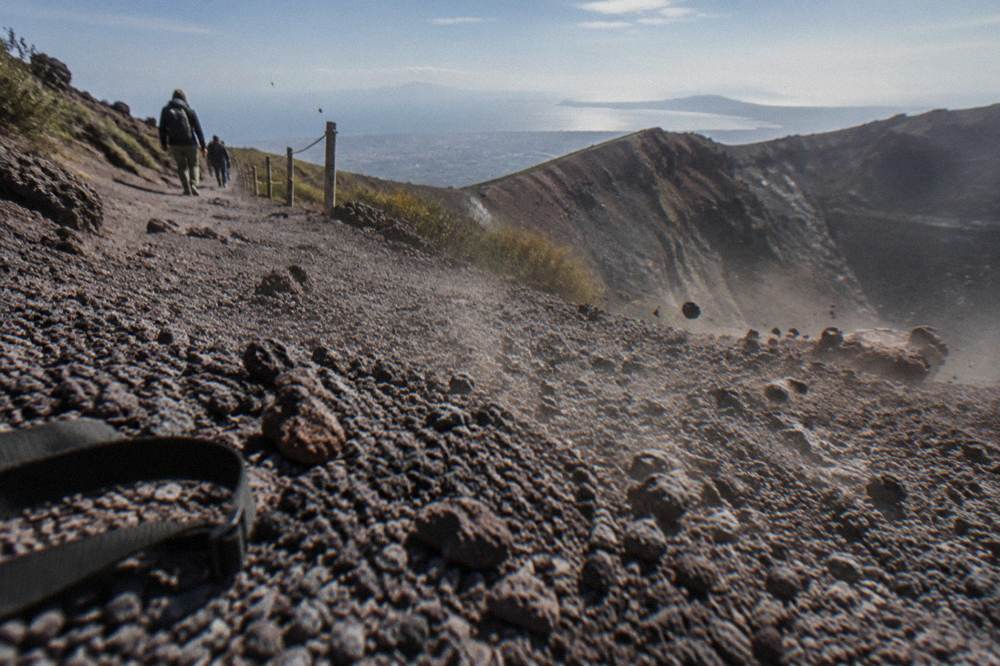
Broken-in trainers with real tread, trail runners or light hiking shoes are the right choice for the Gran Cono. The path is loose volcanic gravel over bare rock, pitched steeply for the final stretch to the turnaround at 1,170 m, and smooth-soled shoes slide on the descent. Sandals, flip-flops, dress shoes and new unworn boots all fail here in different ways. Grip matters more than ankle support on this trail.
The route starts at the Quota 1000 plaza, passes the ticket hut at 1,118 m and turns around at the "Capannuccia" at 1,170 m. The outbound climb is on a wide dirt-and-ash track; the upper section is where the footing gets loose. Millie, a United Kingdom guest on the Naples day tour quoted above, flagged the uneven surfaces and heat in the same breath, which is the honest summary: the trail punishes bad shoes and punishes them faster in summer.
Ankle-height boots are not necessary. The official difficulty rating is low, the walk is short, and every visitor above 1,000 m is accompanied by the park's volcanological guides along a managed path where you are asked to keep to the right side of the walkway. What you want is a sole with lugs, a shoe you have already walked ten kilometres in, and socks that will not give you a blister an hour from the crater. If your only options are fashion trainers with flat soles, this is the one purchase worth making before the trip.
| Footwear type | Verdict for the Gran Cono | Why |
|---|---|---|
| Trail runners | Best all-round choice | Grippy, light, breathable in summer heat |
| Worn-in trainers | Fine | Adequate tread, comfortable from the first step |
| Light hiking boots | Fine, warm in summer | More ankle stiffness than the trail demands |
| New boots | Poor | Blisters on a 4 km round trip with no shade |
| Sandals or flip-flops | No | Loose gravel, hot ash dust, sliding soles |
| Smooth city sneakers | Poor | Slip on the descent, no bite in gravel |
One clothing-adjacent note: volcanic dust works into every mesh panel and seam, so wear socks you do not mind staining grey-brown. That is cosmetic, but it surprises people.
How Much Colder Is The Top Of Vesuvius Than Naples?
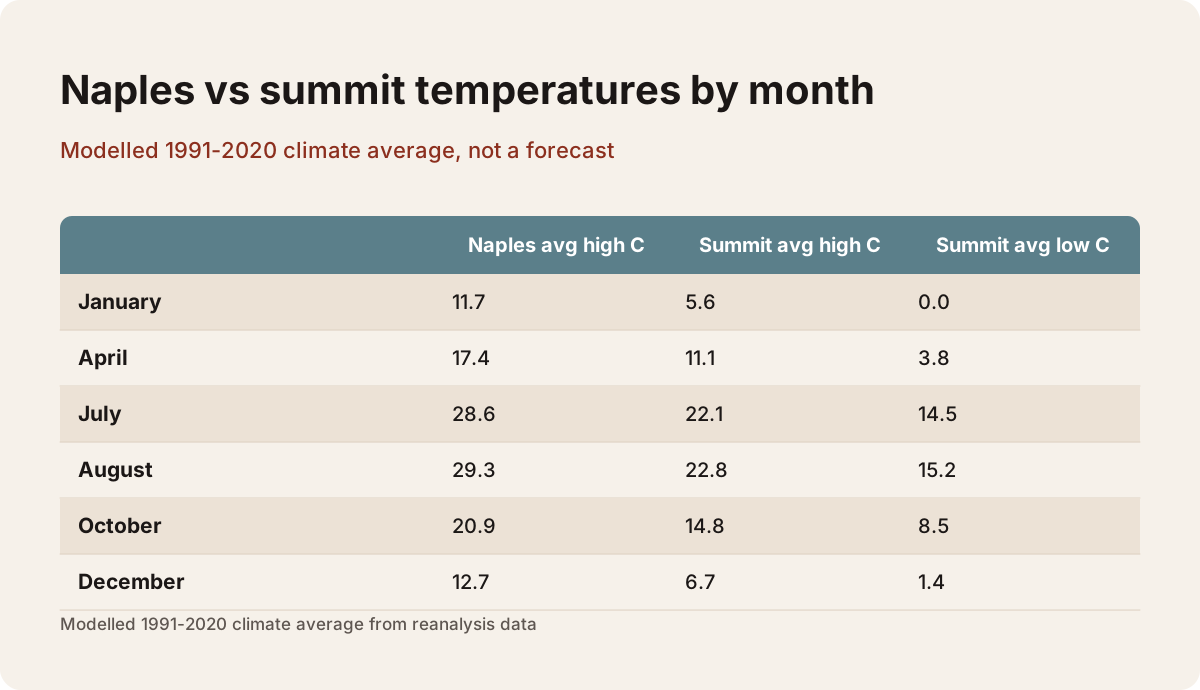
Expect the summit level to feel dramatically colder than the city you left, and plan for a swing of roughly 6 to 7 C between sea-level Naples and the trailhead. In a modelled 1991-2020 climate average, Naples averages 29.3 C highs in August while the 1,000 m level averages 22.8 C; in December the gap is 12.7 C against 6.7 C. Add wind chill at the rim and the difference grows.
That gap is the single most under-armed part of most visitors' packing. You board a coach in 30-degree heat at the port or a Naples hotel, and ninety minutes later you are standing in an open wind on ash at altitude. The numbers below are the modelled 1991-2020 climate average, not a forecast, so treat them as planning ranges and check the actual forecast the night before.
| Month | Naples avg high C | Summit-level avg high C | Summit avg low C |
|---|---|---|---|
| January | 11.7 | 5.6 | 0.0 |
| April | 17.4 | 11.1 | 3.8 |
| July | 28.6 | 22.1 | 14.5 |
| August | 29.3 | 22.8 | 15.2 |
| October | 20.9 | 14.8 | 8.5 |
| December | 12.7 | 6.7 | 1.4 |
Rain matters too, mostly as a warning: the wettest summit month in the averages is November with 180 mm, and July the driest with 16 mm. Rain on ash turns the track slippery fast, and the trail and box office close automatically on days with an orange weather alert or higher, with automatic refunds for slots inside a closure. If you are planning a specific month, the season pages break this down in detail, starting with Mount Vesuvius in winter and Mount Vesuvius in summer.
The practical translation is simple: whatever the season, carry one more layer than you think you need. A light fleece or midlayer plus a packable windbreaker weighs under a kilogram together and covers every realistic condition on this trail.
If you would rather not manage your own kit timing against bus schedules, a tour handles the window: the Naples or Sorrento Departure full-day tour, rated 4.7 from 5,038 reviews, from €97.75 per person with pickup, pairs Pompeii and the crater in eight hours with free cancellation flagged on the listing. It is a long day, so the layering advice in this guide applies doubly.
What Should You Wear On The Trail In Summer?
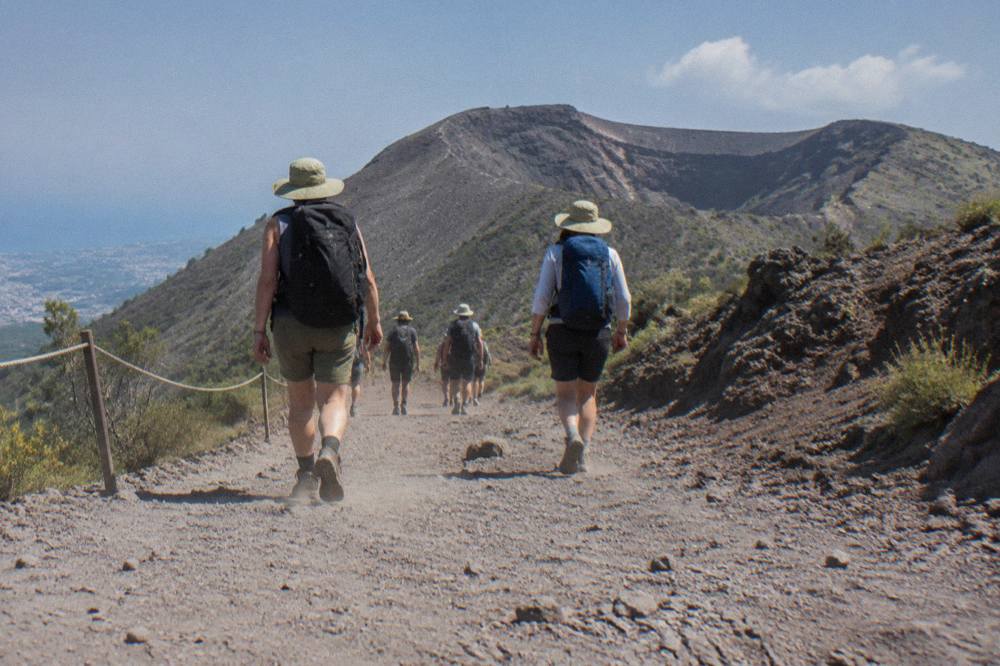
In July and August, dress for heat with zero shade and add a wind layer for the rim: breathable t-shirt, capri or hiking trousers, a wide-brim or baseball cap, sunglasses and sunscreen reapplied on the crater. The modelled 1991-2020 climate average puts summit highs at 22.1 C in July and 22.8 C in August, but the sun is direct and there is nowhere to hide.
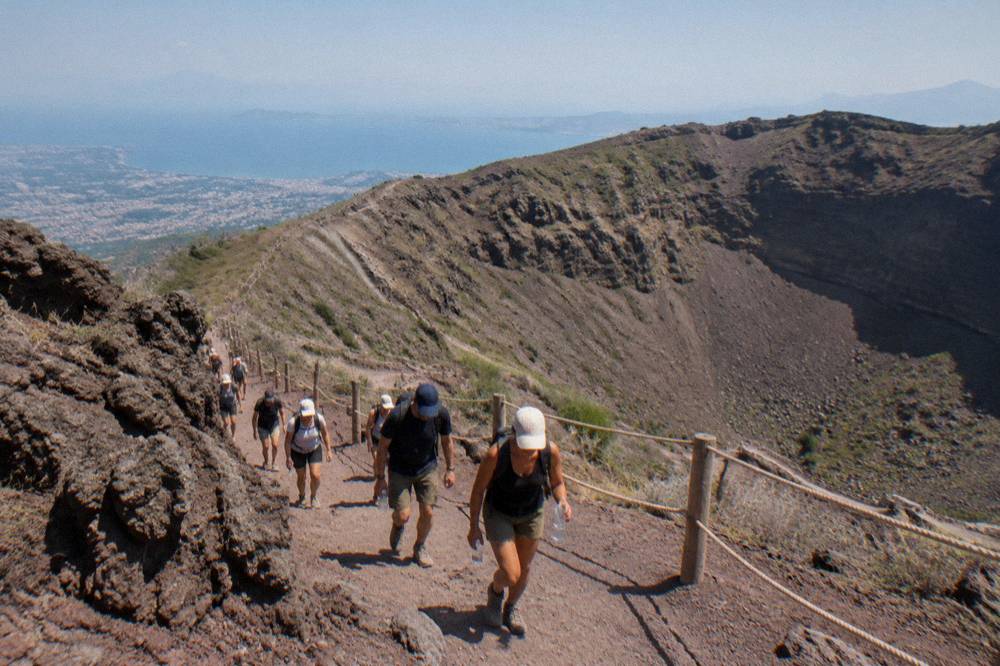
There is no tree, shelter or shade structure anywhere on the Gran Cono. The surface is dark ash and gravel that radiates heat back at you, and the reflected glare off the rock is real. Crater access runs 09:00 to 18:00 in July and August with a daily cap of 3,240 visitors, so midday departures are common and the hottest hours are exactly when most tours arrive.
Clothing that works against this is loose, light-coloured and covering. A light long-sleeve shirt with a collar often beats a tank top, because it shades your shoulders while breathing. A cap with a brim keeps the sun off your face for the whole climb; sunglasses are not optional, the light off the caldera is harsh in every direction. Sunscreen belongs in a pocket, not a bag on the coach, because you will want a second application at the turnaround. Water: carry more than feels reasonable, at least a litre per person, because there are no shops, fountains or kiosks on the trail, and the park notes there are no public toilets at the Quota 1000 plaza temporarily.
Even on a hot day, keep a packable windbreaker in your bag. The rim is an open saddle of ash between the crater wall and the slope below, and a fresh breeze at 20-odd degrees on sweat-soaked clothing chills fast. That wind layer is the difference between lingering at the crater view and leaving early. The Pizza on the Volcano Slopes day trip from Naples, 4.8 from 9,744 reviews and from €53.25 per person with a pizza lunch included, is one of the most-booked summer options, and its reviews repeat the same two warnings: heat and surfaces.
What Should You Wear In Winter, Spring And Autumn?
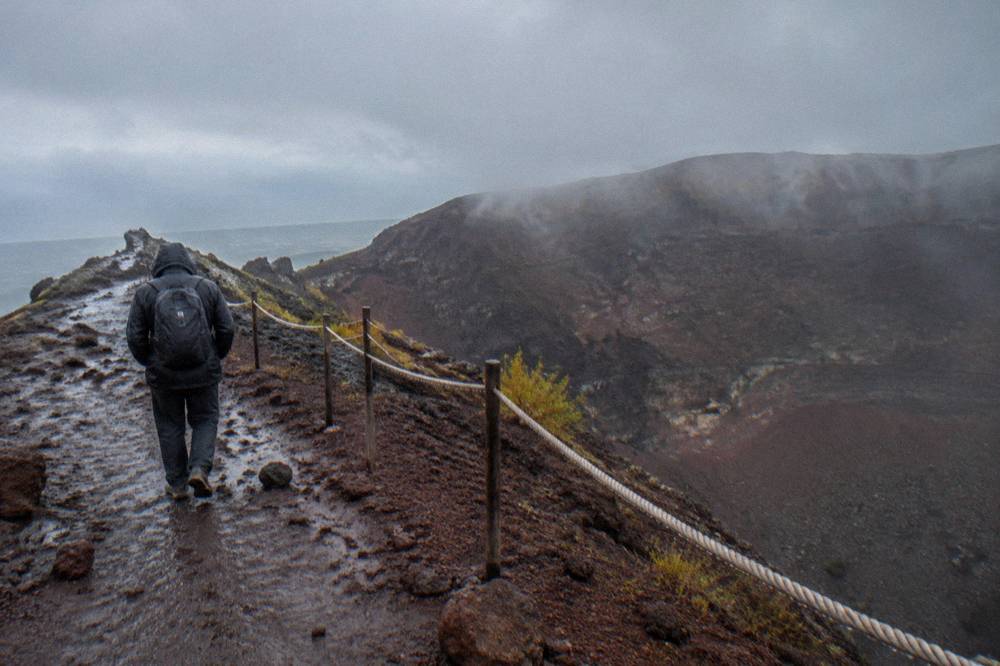
From October through March, plan for summit highs between 5.6 and 14.8 C in the modelled 1991-2020 climate average, with lows that touch freezing in January and February. Wear a warm midlayer, a windproof and ideally waterproof outer layer, long trousers, a hat and gloves. The wind on the exposed rim does more damage than the thermometer suggests.
Winter numbers first: January averages 5.6/0.0 C at the summit level, February 6.0/-0.1 C, December 6.7/1.4 C. These are averages, not extremes, and the wind chill at the turnaround can push the felt temperature several degrees lower. The crater access hours shorten to 09:00 to 15:00 in January, February, November and December, and the daily cap drops to 2,160, so winter visits are compact morning affairs, often in the coldest part of the day.
Spring and autumn are the deceptive seasons. April averages 11.1/3.8 C and October 14.8/8.5 C at the summit level, which sounds gentle, but both are wet months in the averages: 87 mm across 11.1 rain days in April, 129 mm across 10.5 days in October. Wet ash is slick ash, which loops straight back to the footwear section. March sits at 8.3/1.5 C with a 09:00 to 16:00 access window and a 2,520 daily cap.
| Season | Base layer | Mid layer | Outer layer | Extras |
|---|---|---|---|---|
| Winter (Nov-Feb) | Thermal or long-sleeve base | Fleece or light down | Windproof, water-resistant shell | Hat, gloves, warm socks |
| Spring (Mar-May) | T-shirt or light base | Light fleece | Packable windbreaker | Cap, light gloves for March |
| Summer (Jun-Aug) | Breathable t-shirt | None or ultra-light | Packable windbreaker | Cap, sunscreen, sunglasses |
| Autumn (Sep-Oct) | T-shirt or light base | Fleece | Wind and light rain shell | Cap, extra socks |
The honest rule for all four seasons: a windproof outer layer earns its place in your bag every single month. Even in August the rim breeze on a sweaty shirt is cold; in January it is the difference between comfort and a shortened visit.
Why Is Sun Protection Non-Negotiable On The Trail?
Because there is no shade anywhere on the Gran Cono, the surface is reflective dark ash, and the whole walk takes place above 1,000 m, where the sun hits harder than at sea level. Sunscreen SPF 30 or higher, sunglasses and a brimmed hat belong on the trail in every season, including winter, when low sun off the pale crater walls and glare off any frost can be intense.
The climb takes most people the better part of an hour up and slightly less down, plus time at the turnaround, and the whole of it is in the open. There is no water point, no kiosk and no shelter on the trail, and the park notes no public toilets at the Quota 1000 plaza temporarily, so everything you need must be on your body or in a small daypack. Sunburn on the scalp, the nose and the back of the neck is the most common souvenir people do not want.
Lip balm with SPF is the item almost everyone forgets and almost everyone needs by the end of the descent. Sunglasses also do double duty against wind-blown ash dust on breezy days, when grit lifts off the path in gusts. If you wear contact lenses, bring drops: dust plus dry wind is rough on eyes.
Should You Pack For Wind, Rain Or Both?
Both, in a small daypack, in every season. A packable windbreaker is the single most useful item on this trail year-round, because the rim funnels wind even on cloudless days. Rain protection matters from October through April, when the modelled averages show 87 to 180 mm per month at the summit level, and wet gravel is the trail's main hazard.
The closure rule is worth knowing before you pack. The trail and the box office close automatically on days with an orange regional weather alert or higher, with automatic refunds for tickets inside a closure; slots adjacent to a closure are refundable on request within 30 days. So genuinely severe weather usually means no walk at all rather than a heroic wet one. What you actually face is the ordinary kind of bad day: drizzle, wind, low cloud that kills the view and makes the ash greasy.
A cheap packable rain shell answers both wind and drizzle in one garment weighing a few hundred grams. Rain trousers are overkill for a two-and-a-half-hour walk; an umbrella is worse than useless because the wind will fight you the whole way. If rain is in the forecast, add a dry base layer in a plastic bag for after, and accept that shoes will get dusty or damp no matter what. The park's own guidance is to take care, check the weather and wear suitable shoes, per its Gran Cono trail page.
What Should You Not Wear On A Vesuvius Tour?
Skip heels, sandals, smooth-soled sneakers, new unworn boots, heavy jeans in summer and anything you cannot bear to coat in fine grey ash dust. Do not rely on a single warm layer in winter or a single t-shirt at the rim, and leave the umbrella at the hotel. The trail is short but exposed, and every clothing failure here is a comfort failure, not a safety drama.
Denim deserves a specific word. Heavy jeans are hot and slow-drying in summer, and cold and stiff when damp in winter. Light hiking trousers, sports leggings or shorts in the hot months all work better. Similarly, anything loose and flowing becomes a sail on the rim, and light-coloured fabrics will carry a permanent grey tint home from the dust, which is simply volcanic reality rather than a defect in your washing.
Jewellery and accessories are a minor point but a real one: wind takes hats, so anything with a drawstring or a cord is smarter than anything without. A daypack of 15 to 20 litres is the right size, big enough for the extra layer, water and sunscreen, small enough to carry comfortably on the climb. If your day starts from a cruise port or a tight Naples schedule, the shore-excursion itineraries this site covers keep timing tight, so a pre-packed daybag saves real minutes (see Naples Cruise Port Day).
For walkers who want the full route context around the kit, Is It Worth Going Up Mount Vesuvius? covers the experience itself, and the site's Mount Vesuvius hiking tours hub lists guided options for every season.
Does What You Wear Change If You Book A Tour?
Only in one direction: tours add Pompeii or Herculaneum walking on the same day, so your clothing has to work on hot stone streets as well as on the crater path. The kit stays the same, broken-in shoes, layers, sun protection, but you carry it all day, so a small comfortable daypack and blister plasters become more valuable on an eight-hour itinerary than on a three-hour transfer.
The typical combined day is long. The Naples Day Tour, Lunch Included runs 7 to 7.5 hours, from €67.20 per person, rated 4.3 from 14,121 reviews, with pickup, lunch and free cancellation flagged. Its reviews describe uneven surfaces and summer heat, the same pairing as every Vesuvius listing. Melanie from the United States praised her guide's Pompeii storytelling and called Mount Vesuvius "good as well", which is the shape of these days: a lot of standing and listening between walks, so comfortable shoes carry double duty.
For a shorter day that is only the volcano, the Half-Day Volcano Trip From Naples runs 3.5 to 4 hours from €44.80 per person, rated 4.5 from 891 reviews, which trims the Pompeii walking and keeps the crater exposure exactly the same. Ticket-only walkers considering the Skip-Line Ticket, Digital Guide option, from €16 per person, should note the park ticket itself is €10 under its ticketing rules while the park's authorised online seller shows €11.68, and check the listing for what entry is included.
One more packing note for tour days: leave the change of clothes at the hotel and keep the daypack light, because most coaches have limited storage and you will carry the bag through the ruins too. Whatever the format, the kit list below is the whole answer.
What Should Be In Your Daypack For Vesuvius?
Water, at least a litre per person; sunscreen and lip balm with SPF; sunglasses and a brimmed hat; the packable windbreaker; a spare base layer in cooler months; blister plasters; and a small bag for rubbish, because there are no bins or kiosks on the trail. Add a fully charged phone for photos, since there is no reason to carry more on a two-to-three-hour walk.
The short packing table below folds the whole guide into one list. Nothing on it is specialised hiking gear, and everything on it earns its weight on a trail with no shade, no water and no shelter.
| Item | Every season | Oct-Apr extra | Why it earns its place |
|---|---|---|---|
| Grippy shoes | Yes | Yes | Loose ash and gravel, slick when wet |
| Packable windbreaker | Yes | Yes | Open rim funnels wind all year |
| Fleece or midlayer | No | Yes | Summit lows touch 0 C in winter averages |
| Sunscreen SPF 30+ | Yes | Yes | No shade, reflective dark rock, altitude |
| Cap with brim | Yes | Warm hat instead | Sun in summer, heat loss in winter |
| Water, 1 L+ | Yes | Yes | No fountains or kiosks on the trail |
| Blister plasters | Yes | Yes | New shoes and long tour days |
| Light gloves | No | Yes | Wind chill at the turnaround |
Where Can You Buy Or Replace Kit Locally?
In Naples and Pompei town, sports shops and even supermarkets sell adequate trainers, caps, sunscreen and water bottles, so a forgotten item is fixable on the morning of the walk, but proper hiking shoes are the one thing worth buying before you travel. Ercolano and the Quota 800 area are not shopping destinations, and there is nothing for sale on the trail itself.
The honest hierarchy: shoes matter most and are hardest to buy well in a hurry, so source those at home. Everything else, hat, sunscreen, water, a cheap rain shell, can be picked up in Naples the day before, often for less than the airport version of the same item. If you are driving, note the practical detail that parking along the provincial road is run by the Comune di Ercolano with a maximum stay of 4 hours, cars up to 8 seats €7, per the official parking operator's site, so a last-minute shop is better done in town than on the mountain.
Ticket-first logic applies to the whole morning, not just parking: the park advises securing the Gran Cono ticket before anything else, because tickets are sold only online by time slot, 50 per 10-minute slot released 30 days ahead, with a last-minute release of 10 named tickets per slot 30 minutes before each slot. The full ticket mechanics, including what tours bundle entry, are covered on the site's Vesuvius tickets with tour hub, and the timings by month live in the opening-hours guide.
Planning across a whole year is covered in the site's month-by-month season pages, and Mount Vesuvius Tours carries the full planning layer from transport to wine.
Common Questions About What To Wear Hiking Mount Vesuvius
Can you hike Vesuvius in trainers?
Yes. Broken-in trainers with real tread are one of the best choices for the Gran Cono, which is officially rated low difficulty at 4,010 m round trip. Grip matters more than ankle support because the surface is loose volcanic gravel that slides under smooth soles, especially on the descent.
Do you need hiking boots for Mount Vesuvius?
No. Light hiking boots are fine but not necessary. The trail is short, managed and accompanied above 1,000 m by the park's volcanological guides. New unworn boots are the worst option, because blisters on a shadeless two-to-three-hour walk will cut the visit short.
Is it cold at the top of Vesuvius?
It is colder than wherever you started. Summit-level highs run about 6 to 7 C below Naples every month in the modelled 1991-2020 climate average, averaging 22.8 C in August and 6.7 C in December, and wind at the open rim lowers the felt temperature further. Carry a wind layer in every season.
What should I wear to Vesuvius in summer?
Breathable, loose, light-coloured clothing, grippy shoes, a brimmed hat, sunglasses and sunscreen, plus a packable windbreaker for the rim. There is no shade anywhere on the trail and no water for sale, so carry at least a litre per person and reapply sunscreen at the crater.
Is there shade or water on the Vesuvius trail?
No. The Gran Cono has no trees, shelters, kiosks or fountains, and the park notes there are temporarily no public toilets at the Quota 1000 plaza. Everything you need, water, sun protection and the extra layer, must be on you in a small daypack.
Does it rain on Vesuvius, and what happens if it does?
Yes, especially from October through April, with the modelled averages peaking at 180 mm in November at the summit level. Wet gravel is slippery, so tread matters more. On days with an orange weather alert or higher the trail and box office close automatically, with automatic refunds for slots inside the closure.