Are There Toilets At Mount Vesuvius?
Are there toilets at Mount Vesuvius? The honest answer for the crater trail, the Quota 1000 plaza, and every stop on the way up, with what to do before you climb.
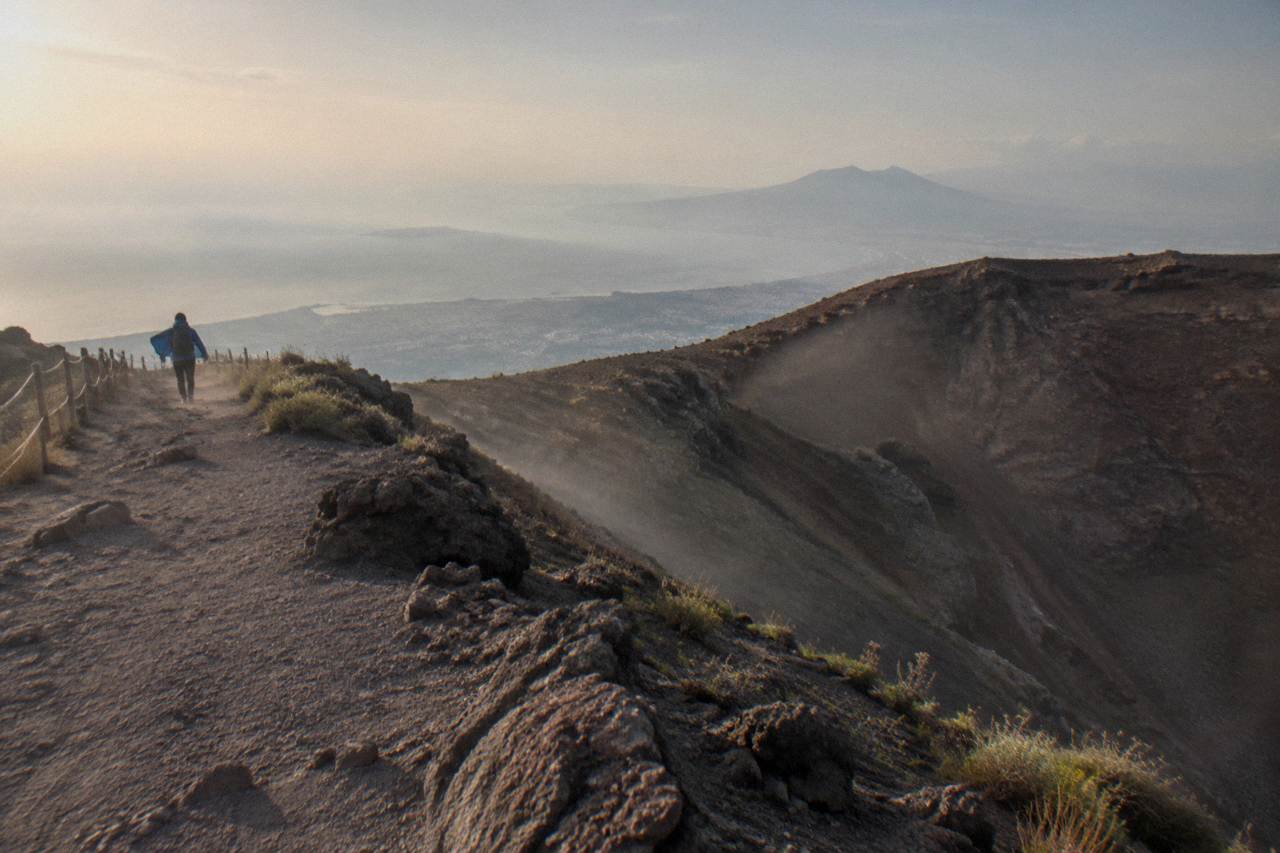
No. The park itself states there are no public toilets at the Quota 1000 plaza, the square where every Gran Cono crater walk starts, and the situation is described as temporary but has no announced end date. There are no facilities on the trail either, which is 4,010 metres round trip and takes about two and a half hours. Use a toilet before you arrive, and treat the crater walk as a no-facility hike. That single fact shapes more itineraries than you might think, because Vesuvius is not a quick roadside stop. You park or are dropped at Quota 800, walk or shuttle 1.8 km up to the plaza, then climb the trail to 1,175 m and come back down. Add a bus queue, a ticket check and a volcano guide briefing, and the gap between your last comfortable toilet and your next one can easily stretch past three hours. Since you'll be out on the crater trail with no shelter and no facilities for hours, check the guide to Vesuvius summit temperatures before you pack.
The park's own Gran Cono page is the source for the plaza situation, and it pairs the no-toilet note with practical advice about shoes, weather and care on the path, which you can read alongside the official trail information. Everything below builds on that: where the last reliable facilities actually are, what each arrival route offers, and how tour products handle the problem for you.
Where Exactly Are The Toilets On The Vesuvius Route?
The route splits into four zones, and only two of them normally have facilities. Naples and the departure towns have cafes, stations and museums. The Ercolano or Pompei transit points have station or site facilities with opening hours. Quota 800 has a car park and a shuttle stop with no guaranteed public toilet. Quota 1000, the trailhead plaza, officially has none at all, and the trail above it has never had any. Plan around that structure rather than hoping for a kiosk at the top. Most visitors arrive through Ercolano Scavi station or Pompei, and both towns give you a real last chance: Herculaneum's own site has full visitor facilities during its opening hours, and Pompeii's ticket-office areas at Porta Marina, Piazza Esedra and Piazza Anfiteatro do too. Once you board a shuttle or bus toward the mountain, you are committed to the window before the plaza.
A visitor on a typical day should budget like this: toilet at the station or archaeological site, transport up, buffer for the ticket check at 1,118 m, the walk itself, and transport back down. The park caps the flow at 60 people every 10 minutes in three groups of 20, so even with a booked slot you may wait behind other groups at the ticket hut. The volcanological guides who accompany every visitor above 1,000 m run a short briefing before the group moves. None of that is long, but none of it has a toilet in it either.
What Does The Walk Itself Involve, Toilet-Wise?
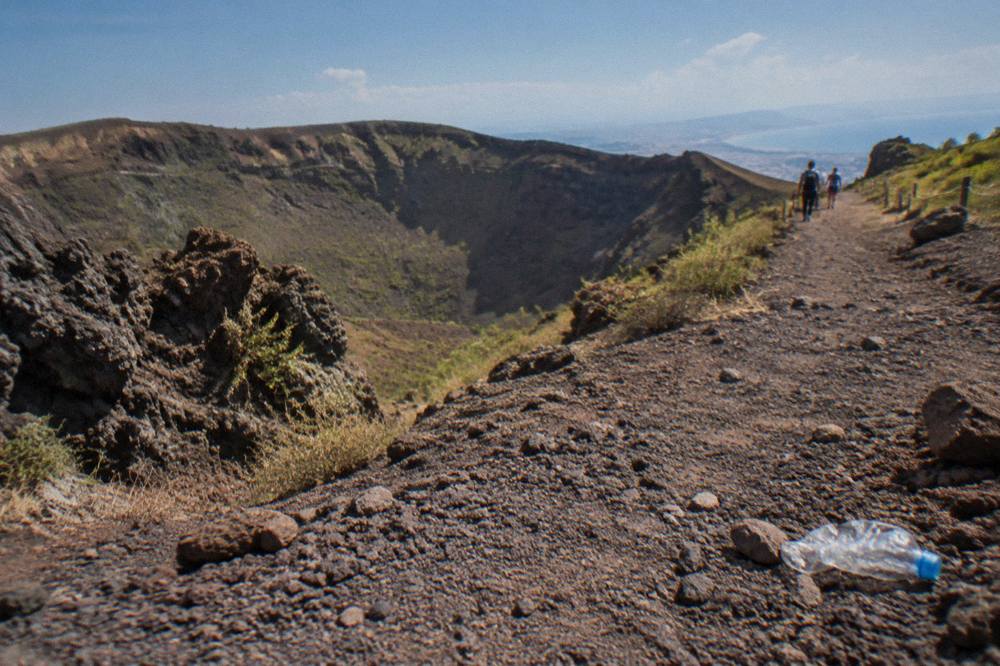
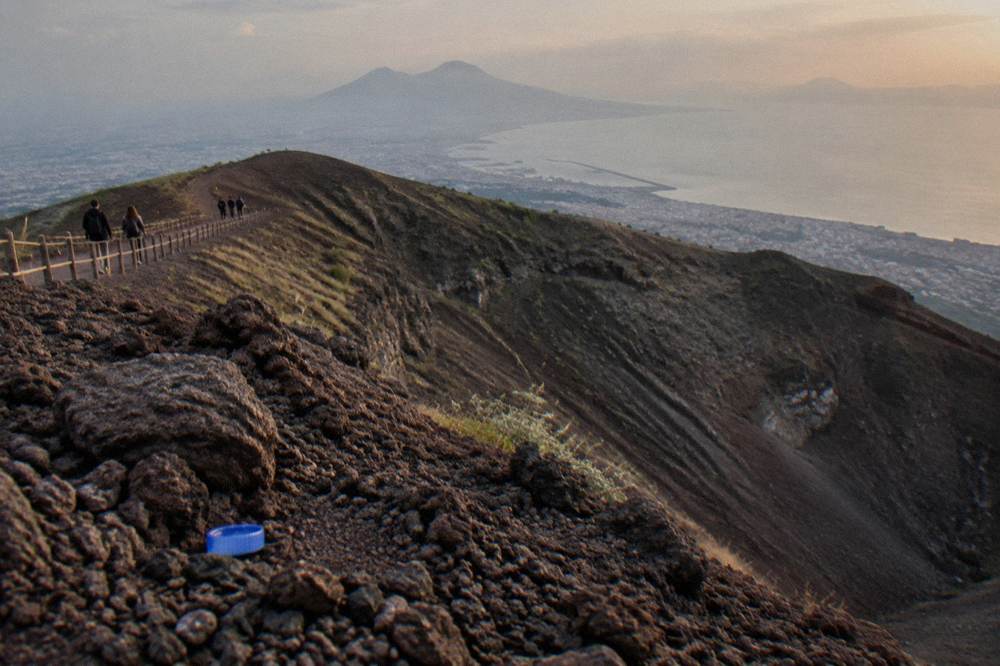
Trail 5, the Gran Cono, is a 4,010 metre round trip on a single out-and-back path with a top altitude of 1,175 m, an official difficulty rating of low, and a typical time of two and a half hours. There are no toilets, no water fountains, no shelters and no buildings anywhere on it. The turnaround at 1,170 m is a marked high point, not a hut. The park's volcanological guides accompany every group above 1,000 m, and a tour on the shortest route may not exceed two hours, on the longest route three hours, under the park protocol. So the maximum commitment is bounded, but it is bounded around a walk with zero facilities.
The surface is volcanic gravel and loose rock, uneven underfoot, and in summer it is exposed and hot. Millie from the United Kingdom, reviewing a Naples day tour that includes the crater, put it plainly: "Very uneven surfaces and very hot in summer so trainers and water bottles." That advice doubles as toilet advice: the more water you correctly carry, the more you need the pre-walk planning to be right. There is nowhere to duck behind a rock discreetly either, because the path is busy in both directions through the whole access window and the guides keep groups together.
If that sounds like more management than you want, the practical move is a tour that builds the day around comfort stops. A product such as the Vesuvius and Pompeii Signature Tour with wine and lunch sequences hotel pickup, the crater, the ruins and a winery lunch with proper facilities at the lunch stop, and you can Check availability if that structure appeals. It runs about eight hours from Naples, from €150 per person, with a 4.9 rating across 461 reviews.
Are There Toilets At Pompeii And Herculaneum Before You Go Up?
Yes, both archaeological parks have visitor toilets inside their ticketed areas, which is exactly why experienced visitors schedule the ruins before the crater rather than after. Pompeii has facilities near its main entrances at Porta Marina, Piazza Esedra and Piazza Anfiteatro, and Herculaneum has them within the site. Both open on fixed schedules: Pompeii from 9:00, and Herculaneum from 8:30, with seasonal last-entry times. Those hours matter because the crater has its own closing times, and the standard smart day runs the sites in the morning, lunch, then the volcano. This is also why the Pompeii and Vesuvius in one day sequence works so well in practice.
The ticketing at Pompeii is worth knowing before you plan the stop. Since 12 January 2026, Pompeii Express, the ancient city only, costs €20, with Pompeii+ at €25 and the three-day Pompeii Plus at €30, per the official park timetable and ticket page. Reduced tickets for EU citizens aged 18 to 24 are €2. Admission is nominative and capped at 20,000 entries a day. Herculaneum is simpler: €16 full, €2 reduced for ages 18 to 25, open every day except 25 December.
| Stop on the route | Toilet situation | Notes for planning |
|---|---|---|
| Naples departure point | Toilets at the station, hotels and cafes | Many tours pick up at hotels, so use facilities before boarding |
| Ercolano Scavi station area | Cafe and site facilities nearby | Last comfortable stop on the Ercolano side |
| Pompei, Piazza Anfiteatro | Toilets inside Pompeii's ticketed area near entrances | EAV bus 808 to the mountain leaves from this square |
| Quota 800 car park | No guaranteed public toilet | Car parking run by Comune di Ercolano, max stay 4 h, €7 for cars up to 8 seats |
| Quota 1000 plaza | No public toilets, per the park | The situation is described as temporary; no end date given |
| Gran Cono trail | No facilities at all | 4,010 m round trip, about 2 h 30 |
That table is the whole article in one glance, and it explains why the order of a Vesuvius day matters more than at a typical attraction. The two things you control are where your last toilet is and how long the no-facility window runs. A lunch-inclusive day tour removes even those decisions, handing the sequencing to an operator who runs it daily.
How Do Different Ways Of Getting Up Vesuvius Change The Picture?
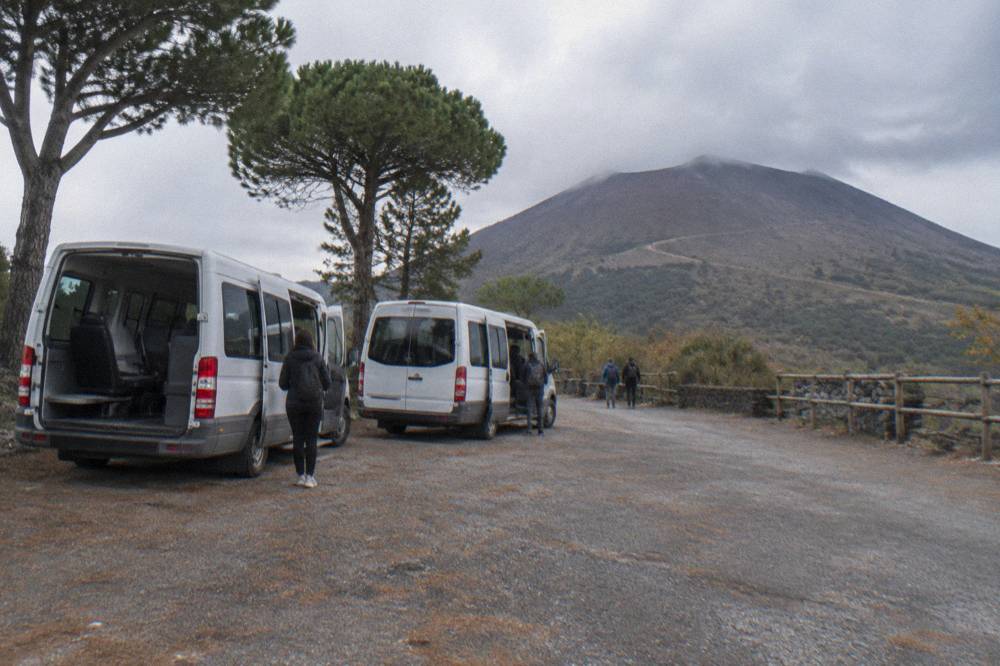
Your arrival route determines your last toilet. Driving yourself via the A3 and SP144 ends at Quota 800, where you park and then walk 30 minutes or take the €1 municipal shuttle, about four minutes, up to the plaza. The EAV bus 808 from Pompei takes 55 minutes and costs €3.80 on board. Private transfers and tour minibuses go up to the drop-off near the plaza. None of these has a toilet at the top end. The difference between them is only how long you spend in the no-facility zone, and how much control you have over timing.
Drivers should note that parking along the provincial road is run by the Comune di Ercolano, with a maximum stay of four hours and €7 for cars up to 8 seats, and the park advises buying parking only after you hold a crater ticket. There is no parking at the Quota 1000 plaza itself. Traffic limits on Via Osservatorio apply to private cars at set hours, which is another reason many visitors hand the driving to a tour operator and read up on Mount Vesuvius Tour Meeting Points And Pickups instead.
Bus riders have a harder constraint. Line 808's timetable, in force from 1 October 2026, has nine runs up a day between 8:30 and 14:30, with the last uphill arrival at 15:25, and the official EAV 808 timetable page carries the full schedule. That last arrival sits after the winter-season last entry, so in the colder half of the year the bus cannot be your only plan. Visitors coming by train should also know the Campania Express service is suspended, so the Circumvesuviana is the rail option.
Do Vesuvius Tours Solve The Toilet Problem For You?
Partly. Every rostered tour faces the same physical facts: no facilities at the plaza and none on the trail, so no operator can promise a toilet at the top. What tours change is everything around that window. Hotel pickup means you leave from a base with facilities. Lunch-inclusive products build in a restaurant or winery stop with real bathrooms. Small-group and private formats let you ask the driver for a brief stop en route. Read the tour listing for the exact sequence, because it varies by product, and check what entry is included.
A few concrete formats illustrate the spread. The Pompeii and Vesuvius Signature Tour with Wine and Lunch from Naples, about eight hours from €150 per person, rated 4.9 across 461 reviews, puts a winery lunch with full facilities between the crater and the return. The From Naples: Pompeii and Vesuvius Tour with Lunch Included, about 7.5 hours from €71 per person, rated 4.7 across 826 reviews, does the same with a lighter Italian lunch. The Mount Vesuvius Tour from Pompeii, three hours from €35.10 per person, rated 4.2 from 59 reviews, is the bare-bones version: transfer and entry ticket, no meal stop, so the no-facility window is short but unsupported.
Families and anyone with a medical need should weight this heavily. Reviews of the lunch-inclusive day tours consistently praise the pacing, and Dan from the United Kingdom, reviewing the pizza-lunch day trip, called it "a great trip for anyone wanting to visit Pompei and Mount Vesuvius in one day" with "first class" organisation. Comfort stops are part of that organisation.
What Should You Do Before You Head Up, Practically?
Build a simple routine: use facilities at your hotel or station, use them again at the last town stop, carry a modest amount of water rather than a lake of it, and time your crater slot so the walk sits inside your own tolerance. A normal ticket is valid from 120 minutes before to 120 minutes after the printed slot within opening hours, which gives you real flexibility to delay your ascent if a queue eats time. That entry window, set out in the park's ticketing rules, is the most underused planning tool on the mountain.
Tickets themselves are online-only, sold by 10-minute time slot, 50 per slot, released 30 days ahead, through the park's authorised online seller at €10 full price for adults, shown at €11.68 with presale on the seller's page, and €8 reduced, €9.55 online, for under-25s and residents of the 13 park municipalities. Children under 6 with an adult go free. If a slot sells out, a last-minute release of 10 named tickets per slot opens 30 minutes before, buyable only via the wifi near the entrance, with a maximum of 5 per email. The crater access window shifts by season: 9:00 to 15:00 in January, February, November and December, to 16:00 in March and October, to 17:00 in April, May, June and September, and to 18:00 in July and August. If you were hoping the walk up might cost nothing at all, our guide to who can hike Vesuvius for free covers the exceptions and the cheapest alternatives.
One rule deserves its own sentence: the trail and ticket office close automatically on any day with an orange regional weather alert or higher, with automatic refunds for slots inside a closure. So check the alert forecast the evening before and the morning of, not just the sky. If a closure hits, the refunds are processed within 60 days and adjacent slots are refundable on request within 30 days.
Is The Lack Of Toilets A Reason To Skip Vesuvius?
No, and the visitor record is emphatic on this. Reviewers who mention the heat, the uneven ground and the effort still rate their days highly, because the crater view across the Bay of Naples, the fumaroles on the inner walls and the strangeness of standing on an active volcano outweigh the rough edges. The honest framing is that Vesuvius is a short wilderness hike with visitor numbers, not a theme-park attraction. The question of whether the whole experience justifies the logistics has its own answer in Is It Worth Going Up Mount Vesuvius?, and the verdict there is a clear yes with caveats.
The caveats are worth naming. Comfortable closed shoes, water, sun protection and a realistic sense of the two-and-a-half-hour round trip are the standard kit. Melanie from the United States, reviewing the Naples day tour with lunch, praised a guide who "explained the history of Pompeii very well" and summed up the crater simply as "good as well". That is the shape of most reviews: enthusiasm, with practical notes attached. The full picture lives on Mount Vesuvius Tours, this site's home page, where every product type is laid out side by side.
There is a smaller etiquette point that the no-facility situation raises. Some visitors wonder what they may take from the park, and the answer is nothing: souvenir lava collecting is a separate question, covered in Can I Take A Rock From Mount Vesuvius?. The same respect applies to leaving things behind, and the absence of toilets is part of why the park asks visitors to plan rather than improvise.
What About Toilets For Cruise Passengers And Day-Trippers?
Cruise passengers have the best facilities situation of any visitor group, because the ship is a floating hotel with unlimited bathrooms, and shore-excursion timing usually returns you there before dinner. The Naples port area also has station and cafe facilities near tour departure points. The trade-off is a fixed clock: most shore products run about seven hours, so the crater, the ruins and the meal stops are tightly sequenced. If your ship docks at Naples, the shore-excursion products with lunch included run from €129.73 per person and handle the whole sequence for you.
Day-trippers from Rome face the longest day and should be the most deliberate. The Rome departures in the roster run 9 to 12 hours, from €56 per person, and the ride down and back leaves few spontaneous stops. Lunch-inclusive Rome products at least guarantee a scheduled restaurant break; the optional-add-on formats leave lunch to you, which means planning your own facility stops around the crater slot. Whatever the format, the sequence advice is identical: use every real stop, and treat the plaza as what it is, the last dry stretch before the trail and the first after it.
| Visitor type | Best last toilet | No-facility window | Best tour format |
|---|---|---|---|
| Self-drive visitor | Ercolano cafe or Pompei before the climb | Park, shuttle or walk, plaza, trail: 2 to 4 h | Transfer plus entry ticket from €35.10 per person |
| Public transport visitor | Pompei Piazza Anfiteatro area | Bus 808 ride, plaza, trail: about 3.5 h | Guided volcano walk with transfer from €65 per person |
| Naples day-tripper | Hotel or station before pickup | Drive, plaza, trail: about 2 to 3 h | Lunch-inclusive day tour from €71 per person |
| Cruise passenger | Ship before disembarkation | Excursion drive, plaza, trail: about 2 h | Shore excursion with lunch from €129.73 per person |
| Rome day-tripper | Rome station or coach stop | Coach ride, plaza, trail: 3 to 4 h inside a 9 to 12 h day | Lunch-inclusive Rome departure from €56 per person |
Common Questions About Toilets At Mount Vesuvius
Are There Toilets At Mount Vesuvius?
No. The park states there are no public toilets at the Quota 1000 plaza where the crater trail starts, describing the situation as temporary with no announced end date, and there are no facilities anywhere on the 4,010 m Gran Cono trail. Use toilets in Naples, Ercolano or Pompei before you go up.
Are There Toilets At The Top Of The Crater Trail?
No. The turnaround point at 1,170 m, known as the Capannuccia, is a marked spot on the rim, not a building or hut. The walk is about two and a half hours round trip with nothing on it, accompanied by the park's volcanological guides above 1,000 m.
Where Is The Last Toilet Before The Vesuvius Trail?
For most visitors it is in Pompei or Ercolano: the archaeological sites have visitor facilities, and the towns have cafes. From there it is the bus, shuttle or drive to Quota 800, then the shuttle or 30-minute walk to the plaza, none of which has a guaranteed public toilet.
Can I Use Toilets At Pompeii Or Herculaneum On The Way?
Yes, if you hold a ticket to the sites, since both have visitor toilets inside their areas. Pompeii opens at 9:00 and Herculaneum at 8:30, with seasonal last-entry times. Many visitors deliberately schedule the ruins in the morning and the crater in the afternoon partly for this reason.
Do Vesuvius Tours Include Toilet Stops?
Tours cannot provide facilities at the plaza or on the trail, but lunch-inclusive products build in restaurant or winery stops with bathrooms, and small-group and private formats can usually accommodate a brief en-route stop. Read the operator's listing for the exact day sequence.
How Long Is The Walk With No Facilities?
The Gran Cono trail is 4,010 m round trip, typically two and a half hours, and the park protocol caps guided tours at two hours on the shortest route and three on the longest. Add the shuttle or walk from Quota 800 and the ticket check, and the realistic no-facility window is two to four hours.