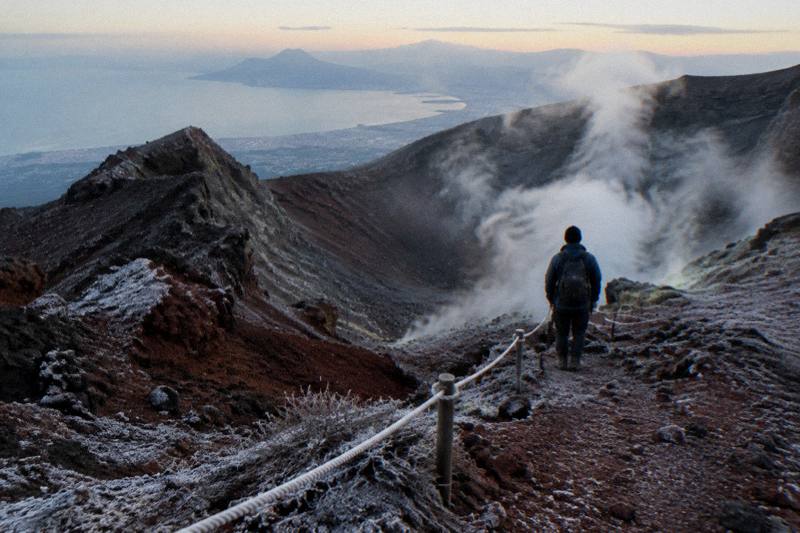
Is It Cold At The Top Of Vesuvius?
How cold the Vesuvius crater rim really gets, month by month, with modelled summit temperatures, wind chill on the trail and what to pack for the hike.
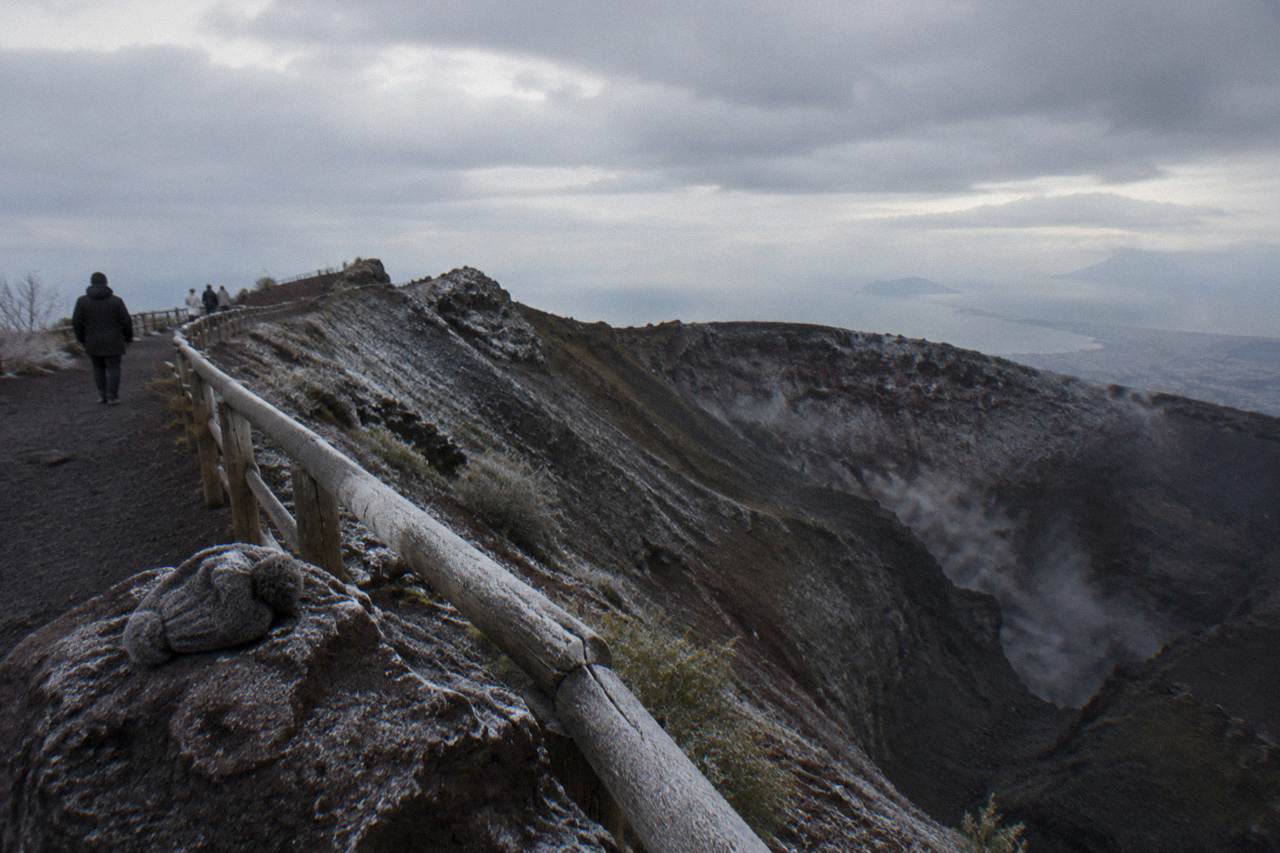
Yes, it is cold at the top of Vesuvius for much of the year, and colder than Naples in every month. The trail ends at 1,175 m, and the modelled 1991-2020 climate average for the 1,000 m level shows summit highs of 5.6 C in January against 11.7 C in the city, and even August peaks at 22.8 C against 29.3 C in Naples. Wind on the exposed rim makes it feel several degrees colder than the number suggests.
That gap never closes. In every single month of the year, the modelled average high at the summit level runs about 6 to 7 C below the same figure for Naples, because you are climbing more than a kilometre into cooler air while leaving behind the heat trapped in the city and the bay. Visitors who set off from a sweltering seafront in July regularly reach the crater rim in a brisk wind and regret the sleeveless top. The rim itself is bare, shadeless volcanic rock and ash: nothing blocks the wind, and nothing holds warmth once the sun drops behind cloud.
The distinction that matters is between the car park at Quota 1000, where most transfers drop you, and the crater turnaround at 1,170 m. Both sit above 1,000 m, where the park requires every visitor to be accompanied by its volcanological guides, so you spend the whole visit in this cooler air. The trail is short, 4,010 m round trip with an official time of 2 h 30, but it rises about 150 m from the ticket hut to the turnaround, and the effort warms you on the way up while the wind chills you the moment you stop. If you are still weighing whether the climb earns its view, the Is It Worth Going Up Mount Vesuvius? walkthrough covers the trade-off in detail.
For the full year, month by month, the Mount Vesuvius by month pages break down hours, caps and climate for each season.
What Are The Temperatures At The Summit Month By Month?
The modelled 1991-2020 climate average for the summit level runs from a high of 5.6 C and a low of 0.0 C in January to a high of 22.8 C and low of 15.2 C in August. October, one of the busiest months, averages a 14.8 C high but drops to 8.5 C overnight. These are climate averages at the 1,000 m level, not a forecast.
The figures come from the ERA5 reanalysis dataset, aggregated over three decades at a grid cell whose elevation is about 1,020 m, close to where the trail starts. The crater rim you actually reach is a little higher still, so treat the table as the warm end of your day. Rain matters as much as temperature here: November is the wettest summit month in the model with 180 mm across 13.6 rain days, while July is the driest at 16 mm across 3.3 days. A wet winter day at 6 C with wind feels far worse than the numbers imply.
| Month | Summit average high/low (C) | Summit rain mm (days) | Naples average high/low (C) |
|---|---|---|---|
| January | 5.6 / 0.0 | 119 (11.7) | 11.7 / 5.5 |
| February | 6.0 / -0.1 | 103 (11.2) | 12.2 / 5.4 |
| March | 8.3 / 1.5 | 104 (10.5) | 14.6 / 7.1 |
| April | 11.1 / 3.8 | 87 (11.1) | 17.4 / 9.4 |
| May | 15.1 / 7.5 | 59 (8.0) | 21.5 / 13.3 |
| June | 19.2 / 11.6 | 30 (5.3) | 25.7 / 17.5 |
| July | 22.1 / 14.5 | 16 (3.3) | 28.6 / 20.3 |
| August | 22.8 / 15.2 | 22 (3.9) | 29.3 / 21.0 |
| September | 18.7 / 12.0 | 90 (8.7) | 25.1 / 17.7 |
| October | 14.8 / 8.5 | 129 (10.5) | 20.9 / 14.1 |
| November | 10.4 / 4.9 | 180 (13.6) | 16.4 / 10.4 |
| December | 6.7 / 1.4 | 147 (13.1) | 12.7 / 6.8 |
Read the Naples column as your departure-point reality check. On an August morning you leave a city heading for 29.3 C and top out at 22.8 C, a drop most people welcome. In January the same climb takes you from 11.7 C to 5.6 C, at or below freezing at night, and that difference decides your whole packing list. The deep-dive on Mount Vesuvius in winter and the month page for Mount Vesuvius in January carry the full cold-season picture.
One planning note that pairs directly with the temperature table: the crater's access hours change with the seasons, from 09:00 to 18:00 in July and August down to 09:00 to 15:00 in January, February, November and December, and the closing time is the last access. Colder months mean a shorter visiting window, so an early start matters more than in summer, both for warmth and for time.
Does The Wind Make It Feel Colder Than The Thermometer Says?
Yes, wind is the biggest reason visitors underestimate the cold. The rim is an exposed arc of ash and rock with no trees, walls or shelter, and the trail approaches it across open slopes. The practical rule is simple: whatever the stated temperature, plan for it to feel several degrees colder on the rim, and bring a layer you can zip on at the turnaround.
Wind chill on an open ridge works the way it always does: moving air strips the warm boundary layer from your skin, and the effect grows with wind speed. Vesuvius adds its own geometry. The crater is elliptical with a maximum diameter of 580 m, and the upper rim route is closed to the public, so everyone stands on the same short stretch of path near the turnaround at 1,170 m, facing whatever direction the wind blows from with no escape around the arc. Reviews from summer trips repeatedly mention this. One guest on the Naples day tour with lunch wrote: "Very uneven surfaces and very hot in summer so trainers and water bottles", and the same exposure that makes summer bearable makes spring and autumn cuts sharp.
Fumaroles steam quietly on the inner crater walls, a reminder that the volcano is active but in a quiescent phase, with the observatory's alert level published as green and the September bulletin recording 121 small earthquakes of maximum magnitude 1.7. The steam is warm; the air around it is not. Millie's review is the honest summer baseline, and every month away from July and August shifts the whole experience colder.
If a windy day is forecast, the practical answer is a windproof outer layer rather than a thick jumper: a shell over a fleece blocks the wind, while the fleece alone just soaks it through. The question of conditions more broadly, fog included, is covered in the guide to Mount Vesuvius Weather And Summit Visibility, which explains what the crater view actually looks like on marginal days.
Should You Book A Tour Or Go Independently For Cold Days? On cold or windy days a tour adds comfort in ways that go beyond the guide's commentary. Most transfer-and-ticket products drop you at Quota 1000 close to your timed slot, cutting the waiting around in the wind that independent visitors build into their margins. The park's rules make the decision partly for you anyway: above 1,000 m every visitor is accompanied by the park's volcanological guides, so even a "self-guided" crater visit is guided on the path itself.
The independent option still exists below that threshold, and it is the cheapest way up. The Mount Vesuvius Transfer with Entry Tickets, 4.4 across 1,785 reviews from €35.10 per person, includes the transfer from Naples and guaranteed entry, so you are not standing in the cold sorting out a ticket. A review from Mia in the United Kingdom captures the appeal: "being able to explore and walk up in our own time was amazing! The staff on both ends in Pompeii and on the volcano are friendly."
Is It Ever Freezing Or Snowy At The Top?
Yes. The modelled average lows at the summit level sit at or below freezing from December through February, bottoming at -0.1 C, and the grid cell records about 1.7 days of snow a year on the 1991-2020 average. Cold snaps push below those averages easily. Snow at the rim is occasional rather than routine, but icy mornings in midwinter are normal, and the trail surface is compacted ash that holds frost.
The 1.7 day snow figure belongs to the 1,020 m grid cell, not the summit itself, and the site deliberately prints no summit snow number because none has been verified. What the data does support is the pattern: snow chances concentrate in January through March, with January at 0.4 snow days, February at 0.6 and March at 0.2 on the long-run average, and a scatter in the shoulder months. None of this closes the trail by itself.
What does close it is weather alerts. The park's rule is automatic: on any day when the regional Civil Protection issues an orange weather alert or higher, the ticket office and the trail close, with automatic refunds for slots inside the closure and refunds on request for adjacent slots. That rule matters most in exactly the months when it is coldest, November through March, when rain days at the summit run 10.5 to 13.6 a month in the model. Bookable products remain bookable for future dates; confirm the operator's current schedule, and check the alert before you travel.
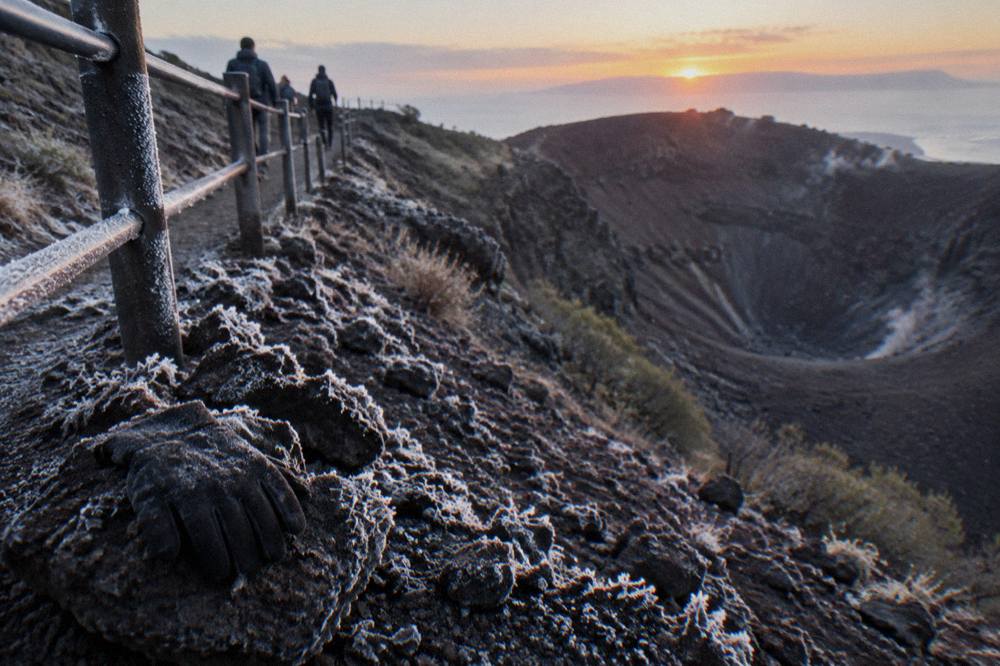
Footwear is the second half of the winter answer. The path is loose in places and polished in others, and frozen ash is slick. The physical demands are modest, which the How Hard Is The Walk Up Vesuvius? article breaks down slope by slope, but shoes with grip stop a cold day becoming a painful one. The park lists the trail's difficulty as low, and the official round trip time of 2 h 30 holds in winter for anyone steady on their feet.
What Should You Wear On The Vesuvius Trail?
Dress in layers you can shed, with a windproof outer layer as the non-negotiable item. From November to March plan for 0 to 10 C with wind: hat, gloves, fleece and shell. In July and August still carry a light layer, since summit lows average 14.5 to 15.2 C and the wind turns a warm afternoon quickly once the sun drops behind cloud.
The mistake that recurs in guest reviews is dressing for Naples. The city and the rim are an hour apart by road but a season apart in feel. A workable formula for most of the year is three layers on top: a base layer, a warm mid layer, and a windproof shell, plus long trousers and closed shoes with grip on any date. In the depths of winter add a hat and gloves, because the rim offers nowhere to shelter while you take in the Bay of Naples.
| Season | Typical summit daytime feel | Core layers | Extras |
|---|---|---|---|
| Winter (Dec-Feb) | 0 to 8 C, wind likely | Base layer, fleece, windproof shell | Hat, gloves, warm socks |
| Spring (Mar-May) | 8 to 15 C, changeable | Long sleeve, fleece, shell | Packable rain layer |
| Summer (Jun-Aug) | 18 to 23 C, windy rim | T-shirt plus light fleece to carry | Sun hat, water for the climb |
| Autumn (Sep-Nov) | 10 to 18 C, cooling fast | Long sleeve, fleece, shell | Rain layer from October |
The ranges in the table are planning guidance built from the modelled climate averages above, not promises: check the forecast for the day, and treat any figure within a few degrees either side as normal. One more clothing note specific to this trail: volcanic ash is fine and pale, and it works into light-coloured fabric and shoes, so dark trousers age better. The site's packing rundown for the climb sits alongside the guided options on the all-inclusive half-day Vesuvius tour page.
Does The Time Of Day Change How Cold It Feels?
Yes, and more than most visitors expect. Crater access runs from 09:00 to a last access between 15:00 and 18:00 depending on the month, and the visit must end within an hour of that closing time, so you never hike at dawn or dusk. Still, the first slots of the day run colder than mid-afternoon slots in every season, because the summit warms slowly after sunrise and the rim is coldest in the morning wind.
Sunrise in January is around 07:25 and sunset 16:57 on the 15th of the month, which means a 09:00 start on a winter day happens barely ninety minutes after the sun clears the horizon, with the ground still shedding overnight cold. The same geometry favours late-morning and early-afternoon slots in the cold half of the year: the air has had time to warm, and you descend before the light goes flat. In July and August the logic partly reverses, since summit highs average 22.1 to 22.8 C and an earlier slot beats both the crowd caps and the warmest hours of the walk up. The wider set of guides lives on Mount Vesuvius Tours.
The slot system makes this a real choice rather than a hope. Tickets are sold online only, by 10-minute time slot, 50 tickets per slot, released 30 days ahead, and a normal ticket is valid from 120 minutes before to 120 minutes after the printed slot within opening hours, so you hold some flexibility even after choosing. A last-minute release of 10 named tickets per slot happens 30 minutes before each slot near the entrance, capped at 5 per email address. The mechanics are laid out in full on the park's official Gran Cono page.
Is It Worth Going To The Top Of Vesuvius?
For most visitors, yes, cold included. The rim delivers a view across the Bay of Naples toward Capri and Sorrento, a look into a steaming 580 m crater, and a walk on an active volcano no photograph quite replaces. The cold is manageable with the layers described above, measured in minutes at the turnaround rather than hours. The honest caveat is weather: on a fogged or alert day the payoff shrinks, so flexibility matters.
The verdict scales with what you pair it with. A crater-only half day is a fine, quick win from Naples; the From Naples All-Inclusive Mount Vesuvius Half Day Tour, 4.5 across 891 reviews from €44.80 per person, runs 3.5 to 4 hours with pickup, which suits a cold day nicely since you minimize exposed waiting. The richer version bundles the volcano with the ruins it famously buried in AD 79, traditionally dated August 24, though a 2018 find at Pompeii, a charcoal graffito reading 17 October, points to an autumn eruption as highly probable.
The strongest all-round option for a first visit is the three-site day: the From Naples: Herculaneum, Mount Vesuvius and Pompeii Day Trip, 4.4 across 169 reviews from €120 per person, with hotel pickup and free cancellation flagged on the listing. It sequences all three sites in about 8 hours, and its Pompeii, Herculaneum and Vesuvius tours category page carries the alternatives. A review from Jody in the United States sums up the day: "We had a good hike to the crater of Mt. Vesuvius with a beautiful view of Naples, the crater, the country side, Sorrento and Capri."
How Does The Cold Affect Kids And Less Steady Hikers?
Children and less confident walkers feel the summit cold faster than fit adults, because they move slower on the climb and stand still longer at the rim. The trail is short and officially rated low difficulty, 4,010 m round trip in about 2 h 30, which keeps exposure manageable. The adjustments are earlier winter slots, an extra warm layer per person, and a plan to start descending as soon as the group stops moving.
Age limits vary by product rather than by the park, so the listing is the source of truth: one small-group Naples tour bars children under 6, a guided hike from Pompeii sets a minimum of 4, and the park itself admits children under 6 free with an adult, on a free online ticket with ID. On cold days the children who do best are the ones with gloves and a hat, the two items parents most often leave behind in Naples, and a snack for the rim, because eating gives everyone a reason to pause warmly.
Do Tours Run Differently In The Cold Months?
The products keep running, but the day reshapes around shorter access hours and earlier last entries. From November through February the crater's last access is 15:00, so itineraries flip: volcano first, ruins after, because Pompeii's last entrance in the same season is 15:30 and its closing 17:00. Free cancellation is flagged on nearly every listing in the roster, which is the flexibility worth having in a volatile season.
The pairing logic is worth understanding before you book anything. In July, a tour can climb at 16:00 and still make last access at 18:00 with daylight to spare. In January, that same climb must start by early afternoon at the latest, and the smart money goes even earlier to leave margin for the EAV bus or shuttle timing. This is also why the question of sequencing matters more in winter, and the Is It Worth Going Up Mount Vesuvius? companion piece weighs the value question against season and crowd levels.
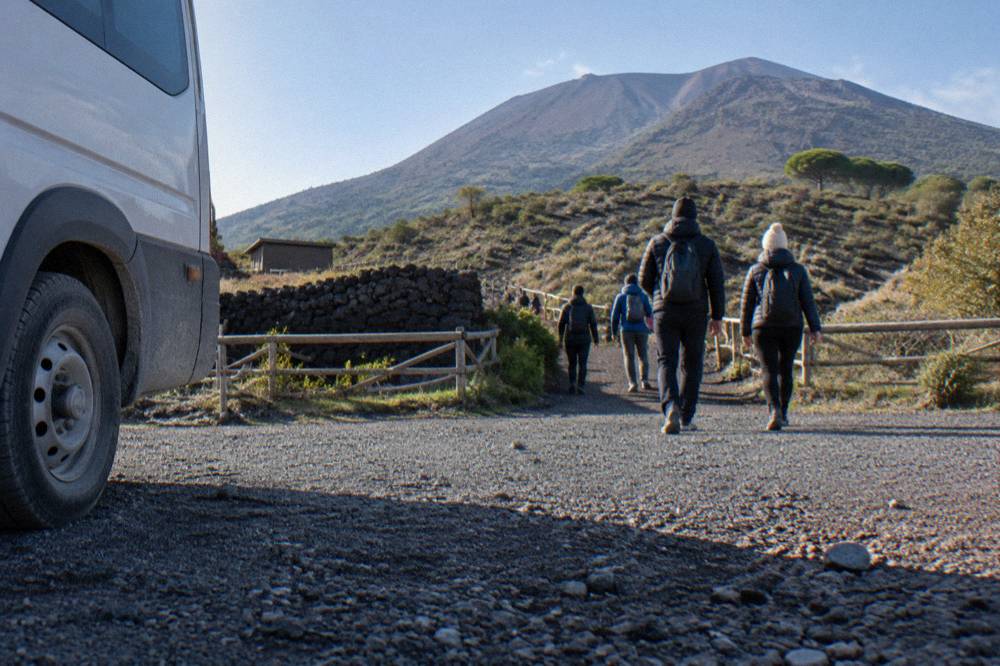
One hard transport fact shapes late plans: the EAV bus 808 from Pompei to Quota 1000 makes nine runs up a day between 08:30 and 14:30 under the timetable in force from 1 October 2026, with the last upward arrival at 15:25, after the winter last entry, and its last return down at 16:50. The fare is €3.80 on board per single leg. In the cold half of the year that bus cannot be your only plan; a morning run or a transfer tour is the reliable shape. Full timetable detail sits with EAV.
What Is The Coldest Part Of The Whole Trip?
For most people the coldest minutes are not on the trail at all but at the Quota 1000 plaza before and after it, standing in the wind while groups form, tickets are checked and the park's volcanological guides organize the walk. The plaza has no public toilets and no shelter, and parking there is not allowed, so there is nowhere to wait indoors. Layer up before you leave the vehicle, not at the trailhead.
The queue at the ticket hut at 1,118 m moves steadily but slowly in peak season, and a summer ascent can still hand you ten chilly standing minutes if cloud crosses the sun, because the wind never pauses. On winter mornings the same plaza at 5 C with wind is genuinely cold, and the shuffle to warm up starts immediately. The fix is procedural: keep the shell in your day bag until the plaza, put it on as you arrive, and keep it on through the checkpoint, the climb and the rim stop, shedding layers only once you are walking uphill and warm.
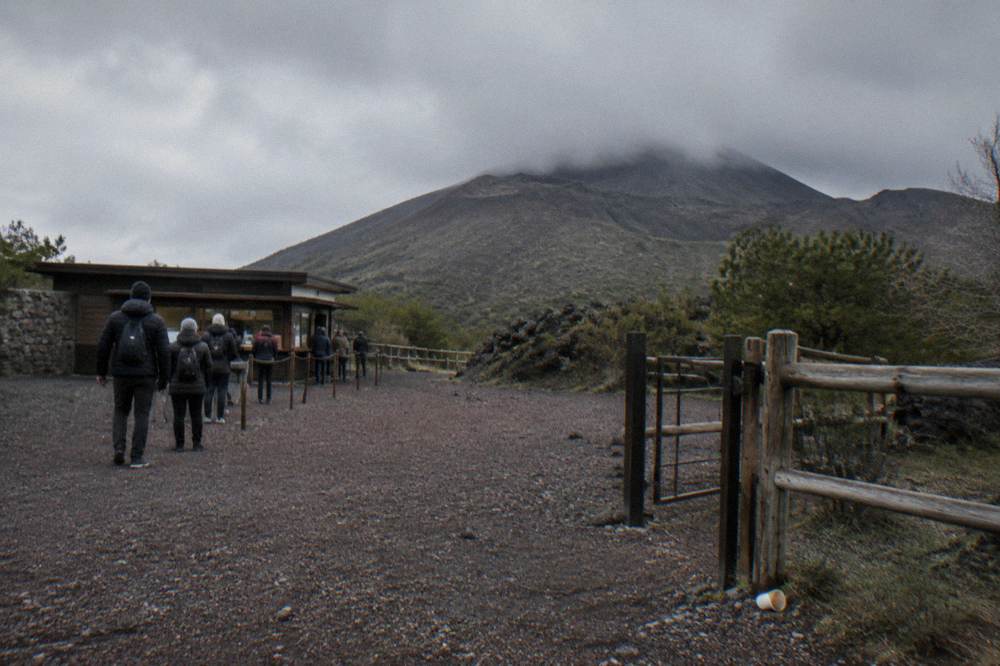
The climb back down is the other sneaky cold spot. Descending generates less heat than ascending, the wind at your back feels weaker so people undress, and then the plaza stop lands on a sweaty base layer. The old hillwalking rule applies on Vesuvius exactly as it does anywhere above 1,000 m: put a layer back on before you feel cold on the descent, not after. For anyone weighing the effort against the reward with fitness in mind, the How Hard Is The Walk Up Vesuvius? breakdown covers gradient, surface and stops in detail.
The last word belongs to perspective. Vesuvius is the only active volcano on mainland Europe to have erupted within living memory, with its last eruption in March 1944, when lava reached the surrounding towns on 21 March, as the Osservatorio Vesuviano records. Standing on its rim in a cold wind is part of the point: this is a mountain with weather, not a theme park. Pack for it and the cold becomes a detail in the story rather than the story.
Common Questions About The Cold At The Top Of Vesuvius
Is It Cold At The Top Of Vesuvius?
Yes, in every month the summit level is colder than Naples, by about 6 to 7 C on the modelled 1991-2020 climate average. Winter highs average 5.6 C with lows at freezing; even August highs average 22.8 C, and wind on the exposed rim makes it feel colder than the number.
How much colder is the summit than Naples?
About 6 to 7 C below the city in every month of the modelled average. The trailhead sits above 1,000 m and the turnaround at 1,170 m, high enough that the gap holds from January through December.
Does it snow on Mount Vesuvius?
Occasionally. The long-run modelled average records about 1.7 snow days a year at the 1,020 m level, concentrated from December to March. No summit snow figure is published, so treat snow as a possibility in cold snaps rather than an event to plan around.
Can cold weather close the Vesuvius trail?
Cold alone does not, but weather alerts do. On any day with an orange regional weather alert or higher, the ticket office and trail close automatically, with automatic refunds for slots inside the closure and refunds on request for adjacent slots within 30 days.
What should I wear for the crater hike in winter?
A base layer, warm fleece and windproof shell, plus hat, gloves, long trousers and grippy shoes. The rim is fully exposed with no shelter, and the coldest standing time is usually at the Quota 1000 plaza before the walk begins.
Is It Worth Going To The Top Of Vesuvius?
For most visitors, yes. The rim gives a 580 m crater with active fumaroles and a panorama across the bay to Capri and Sorrento, and the cold is manageable with layers. The honest caveat is visibility: on a fogged or alert day the payoff shrinks, so build flexibility into your plans.