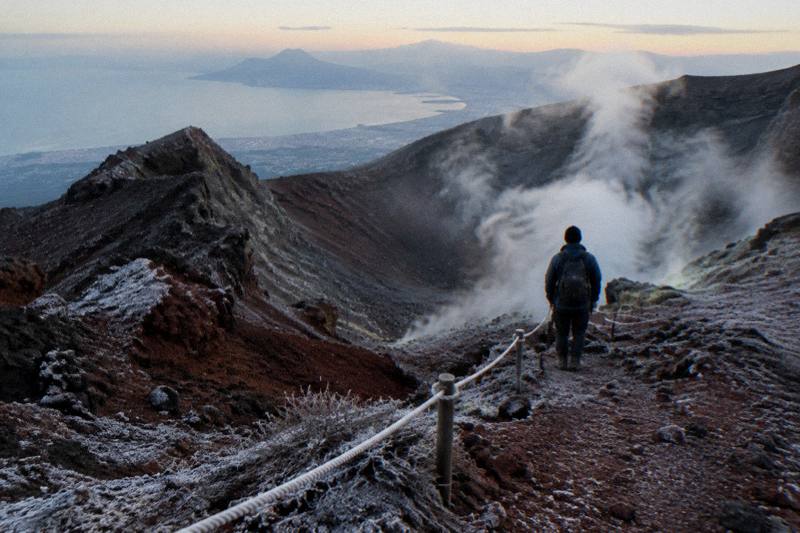
How Hard Is The Walk Up Vesuvius?
The Vesuvius crater walk explained: distance, gradient, surface, time and who manages it, with official park figures and honest fitness advice.
Mount Vesuvius is 1,281 m at its summit according to INGV, and the public crater trail stops at 1,175 m, yet thousands of visitors of every age complete it every day in the summer season. The park's own trail infobox calls the difficulty "low", which surprises people who have seen dramatic photos of the crater. The gap between the photo and the rating is the story of this page, because the walk is genuinely easy in distance and genuinely awkward underfoot. The surface, the exposure and the pacing, not the climbing, are what decide whether you find it easy or draining. For everything beyond the trail itself, our full guide to visiting Vesuvius National Park covers tickets, access and the other practical details.
How Hard Is The Walk Up Vesuvius?
The walk up Vesuvius is officially rated low difficulty: Trail 5, the Gran Cono, is a 4,010 m round trip from the Quota 1000 plaza to the crater viewpoint at 1,175 m, taking about 2 hours 30 minutes there and back. There is no scrambling, no exposure and no summit push; the difficulty comes from loose volcanic gravel, a steady gradient from the plaza up to the turnaround and total exposure to sun or wind. For a fuller picture of how the timing works out, including how tour formats stretch well beyond the crater trail itself, see our guide on how long the walk up Vesuvius takes.
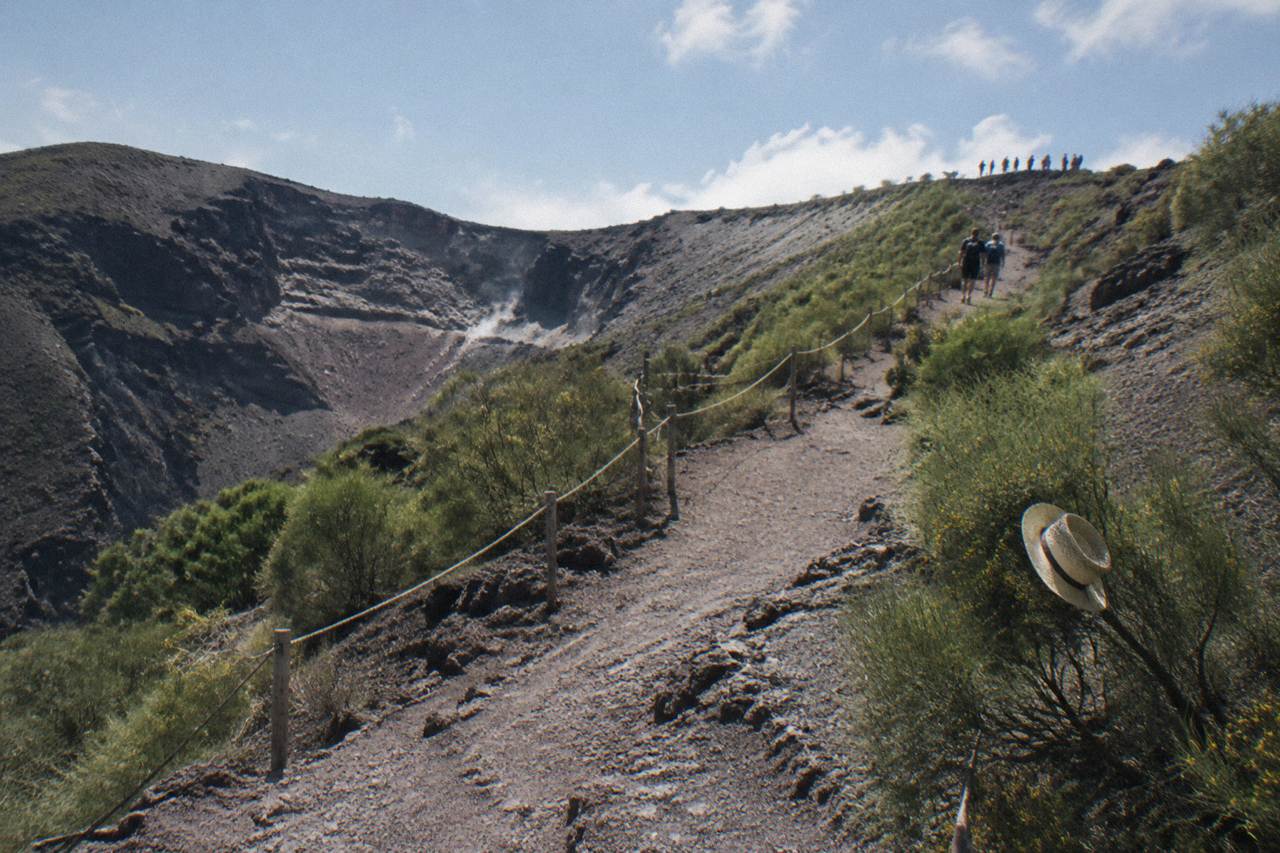
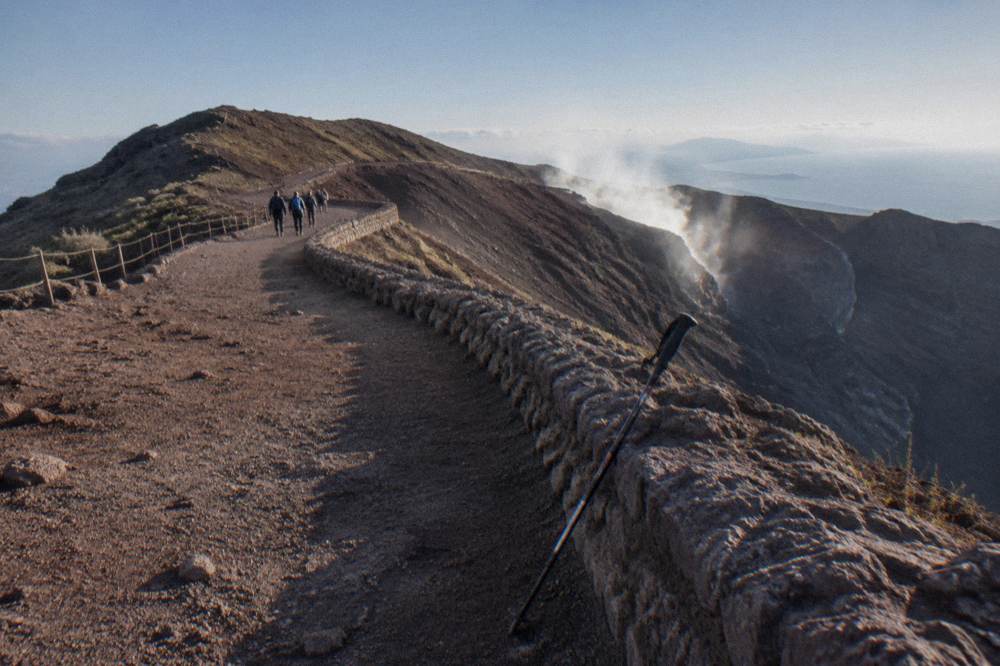
The park publishes the headline numbers on its Gran Cono page, and they are more reassuring than most visitors expect. The path starts at the Quota 1000 plaza in Ercolano, where the shuttle buses and transfers drop you, and ends at the "Capannuccia" turnaround at 1,170 m. Between those two points there is a ticket hut at 1,118 m, which is roughly the halfway psychological marker, and beyond it the path steepens for the final stretch to the rim. Nothing on the route requires hands, and nothing is narrower than a wide track.
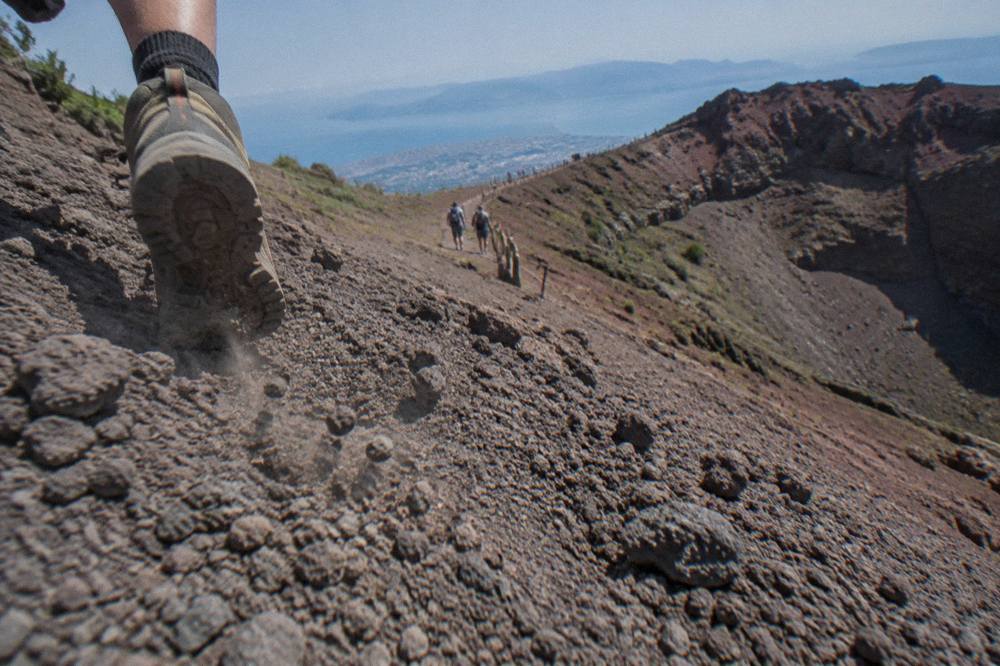
What the word "low" hides is the surface. The path is compacted ash and loose pumice in places, and walking downhill on it feels like walking down a steep beach: your feet slide a few centimetres with each step, and the calves work twice as hard as on firm ground. Uphill is slower but steadier. Visitors in trainers manage it; visitors in smooth-soled shoes or sandals regret them. One recent guest, Millie from the United Kingdom, reviewing the Pompeii and Vesuvius day tour on our roster, put it plainly: "Very uneven surfaces and very hot in summer so trainers and water bottles."
The heat matters as much as the surface. The trail is almost entirely above the tree line from the plaza upward, black ash absorbs the sun, and in July and August the modelled 1991-2020 climate average puts summit highs at 22.1 and 22.8 C, with Naples at 28.6 and 29.3 C in the same months. That sounds mild until you are climbing a dark slope at midday with no shade. Most difficulties reported on the walk are heat and footing difficulties, not cardiovascular ones.
If you are comparing ways to do the walk, guided options pair the climb with a volcanological guide at the rim, and the entry question of whether the effort repays itself is covered in our existing piece on whether it is worth going up.
How Difficult Is The Walk Up Mount Vesuvius?
For a normally healthy adult the Gran Cono is a moderate stroll, not a hike: a climb from the Quota 1000 plaza to the turnaround at 1,170 m spread over two kilometres each way, on a wide path with no hazards beyond loose ground. It is harder than a pavement walk and easier than any mountain trail, and the park's protocol caps any guided tour at two hours on the shortest route and three hours on the longest.
Breaking the trail into thirds is the clearest way to see where the effort sits. The first third, from the plaza to the ticket hut at 1,118 m, is a gentle slope on the best-compacted surface, and most groups cover it in 20 to 25 minutes. The second third steepens and the footing loosens. The final third to the turnaround at 1,170 m is the steepest section, with the loosest gravel, and it is where you see people pausing, which is entirely normal and expected.
Fitness doubt should rarely stop anyone from booking. The route is an out-and-back, so turning around early costs nothing but the view from the rim: you still walk the lower path, still see the crater amphitheatre from a lower angle, and still rejoin your group at the plaza. Guides on the roster's small-group products, such as the Pompeii and Mount Vesuvius Small Group Tour run by Askos Tours, are used to mixed-pace groups, and the park's volcanological guides accompany every group above 1,000 m as a matter of rule, not courtesy.
Two groups should think twice, and honestly. Anyone with knee pain should know that the descent on loose gravel is the highest-impact part of the day, and poles help more than fitness does. And anyone who struggles on stairs at home should plan the full 2 hours 30, not the optimistic 90 minutes, and go in the first morning slot. The full mechanics of the trail, transport up to the plaza and what to carry are laid out in our guide on how to hike Mount Vesuvius.
Should you book a guided version or just get yourself to the top? It is a fair question at this point in the decision.
Should You Take A Guided Walk Or Go Independently?
The walk itself is impossible to get lost on, so the argument for a guide is not navigation. It is geology and logistics. The park's volcanological guides explain the 1944 eruption, the fumaroles steaming on the inner walls and the red zone of 25 municipalities around you, which turns a gravel climb into the most vivid geography lesson in Italy. The argument for independent is cost and pace: a transfer-and-ticket product is cheaper and lets you linger or turn back as you please.
How Long Is The Walk Up Vesuvius?
The round trip is 4,010 m, about four kilometres, of which each direction is roughly two kilometres, and the official time is 2 hours 30 minutes there and back. That is walking time only, and it excludes the time at the rim, the queue at the ticket hut at 1,118 m and the transfer from Naples or Pompeii to the Quota 1000 plaza where the trail begins.
The number that matters more than distance is elevation. You start at the Quota 1000 plaza, because every bus, shuttle and tour vehicle delivers you there, and you finish at the turnaround at 1,170 m. The park's stated maximum altitude for the trail is 1,175 m, and the public route ends just below it so visitors never reach the true summit at 1,281 m. Most of the mountain's height is gained by vehicle before you take a single step, which is the single biggest reason the walk is easier than its reputation.
| Trail measurement | Official figure | What it means for you |
|---|---|---|
| Length, round trip | 4,010 m | Two kilometres each way |
| Starting point | Quota 1000 plaza | All transport delivers you here |
| Ticket hut | 1,118 m | Roughly the halfway psychological marker |
| Turnaround point | 1,170 m | The rim viewpoint and rest stop |
| Maximum trail altitude | 1,175 m | The public path ends below the summit |
| Official time | 2 h 30 round trip | Walking only, no rim stop |
| Official difficulty | Low | Flat comparison: a hilly park walk |
If four kilometres sounds long, remember that half of it is downhill. Most walkers do the ascent in 45 to 60 minutes, spend 20 to 30 minutes at the rim, and come down faster than they went up, which is exactly why footing, not lungs, is the recurring theme in guest reviews. The park's own protocol allows a guided tour a maximum of two hours on the shortest route and three on the longest, a loop variant to Rifugio Imbo, which tells you the authorities regard even the slowest interpretation as a half-day outing at most.
For a walk of exactly this shape, a shuttle-and-ticket product from Pompeii is the cheapest way to do it. From Pompeii: Mount Vesuvius Hike & Tour by Bus, run by Around Vesuvio, is a three-hour product from €35.10 per person, rated 4.1 from 213 reviews, and it exists precisely for people who want the walk without the ruins attached.
How Long Does It Take To Walk Up Mount Vesuvius?
Plan 2 hours 30 minutes for the walk itself and 3 to 4 hours total on the mountain including the rim stop and ticket check, plus your transfer time. From Naples the shortest tours run about 3.5 to 4 hours door to door; from Pompeii about 3 hours; combined Pompeii-and-Vesuvius days run 7 to 8 hours, which is why they feel long, not because the climb itself does.
Pacing advice matters more than averages here. The morning slots from 9:00 onward are cooler and clearer, and the crater access window itself changes with the seasons, which changes how much margin a late booking leaves you. The modelled 1991-2020 climate average gives a useful picture of what each stretch of the year feels like on the trail.
| Months | Crater access hours | Daily cap | Summit avg high/low C | Summit rain mm (days) |
|---|---|---|---|---|
| January, February | 09:00 to 15:00 | 2,160 | 5.6 to 6.0 / 0.0 to -0.1 | 119 and 103 (11.7 and 11.2 days) |
| March, October | 09:00 to 16:00 | 2,520 | 8.3 and 14.8 / 1.5 and 8.5 | 104 and 129 (10.5 days each) |
| April to June, September | 09:00 to 17:00 | 2,880 | 11.1 to 19.2 / 3.8 to 11.6 | 30 to 90 (5.3 to 11.1 days) |
| July, August | 09:00 to 18:00 | 3,240 | 22.1 and 22.8 / 14.5 and 15.2 | 16 and 22 (3.3 and 3.9 days) |
| November, December | 09:00 to 15:00 | 2,160 | 10.4 and 6.7 / 4.9 and 1.4 | 180 and 147 (13.6 and 13.1 days) |
The visit must end within an hour of the last access time, so booking a late slot in October means climbing with less margin and colder air, roughly 14.8 C as the modelled average high at the summit, against 20.9 C in Naples the same month.
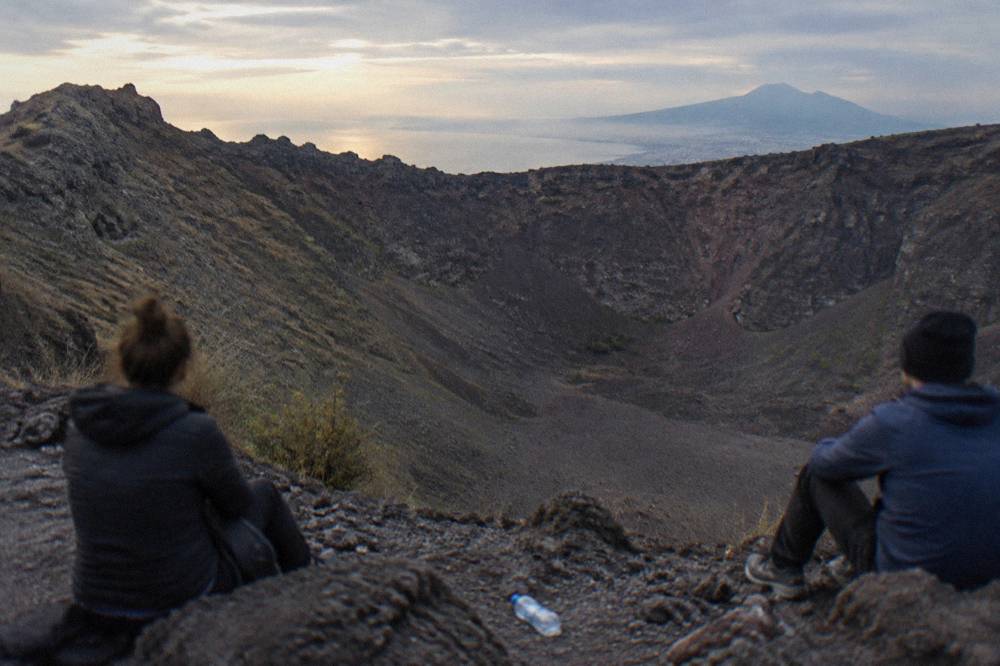
Time at the rim is not dead time, and it should be budgeted. The crater is elliptical with a maximum diameter of 580 m, fumaroles steam from the inner walls, and the view spans Naples, the whole bay and, on clear days, Capri. Photographing it properly takes 15 to 20 minutes, and the walkway rule is to keep to the right, so faster walkers pass on the left in a slow, orderly queue rather than a scramble.
The honest warning about timing is the return journey, not the trail. Shuttle and bus products run to fixed timetables, the municipal parking along the provincial road has a four-hour maximum stay, and the public EAV 808 bus from Pompei makes nine uphill runs a day with a last downhill departure in the late afternoon. If your plan is self-made, check the last return before you commit to a late rim sunset. Timetable detail and the closures question live in our longer answer about how long the walk up Vesuvius is.
Can You Walk From Pompeii To Mount Vesuvius?
No, and it is not a reasonable plan. Pompeii lies about nine kilometres from the Quota 1000 trailhead by road, the final stretch is a winding provincial mountain road with no footpath, and the park directs all visitors to reach the plaza by shuttle, bus or vehicle. Nobody walks from Pompeii to the crater, and the practical question is only which transfer from Pompeii you take.
The roads explain why. Drivers approach on the A3 to the Torre del Greco exit and then the SP144 to the Quota 800 car park, and from Quota 800 to Quota 1000 it is 1.8 km, about 30 minutes on foot, on a road where the park advises traffic limits apply to private cars at set hours. A municipal shuttle covers that 1.8 km stretch for €1 each way in about four minutes. That final leg alone is a road walk, not a trail walk, and it comes before your 4 km crater round trip, so piecing the whole thing together on foot would double your day for no scenery.
The cheap and simple options from Pompeii are transfers that bundle the park ticket. The park's adult ticket is €10 under its ticketing rules; the park's authorised online seller shows €11.68. From Pompeii: Vesuvius Entry with Transfer and Audioguide, from €42.30 per person, rated 4.2 from a small pool of 88 reviews, covers the ride up and the entry, and leaves you to walk at your own pace with the audioguide as company.
Anyone set on combining the ruins and the walk should let a tour sequence them instead. Doing Pompeii first and the crater second is the usual order, and a small-group day like Askos Tours' Pompeii and Mount Vesuvius Small Group Tour, 8 hours from €99 per person, 4.7 from 282 reviews, handles the timing so you are not calculating the last shuttle while standing in the Forum.
Can You Just Walk Up Vesuvius?
No, you cannot walk up independently beyond the turnaround: access above 1,000 m is accompanied by the park's volcanological guides for every group, entry is by online timed ticket only, sold in 10-minute slots of 50, released 30 days ahead, and the upper crater rim route is closed to the public entirely. Independent walking is allowed on the trail below the turnaround, but the ticket and the guide rules are not optional.
This is the rule that surprises independent travellers most. There is no walk-up box office at all; the park states that tickets are purchasable exclusively online, and if a slot sells out, a last-minute release of 10 tickets per slot appears 30 minutes before entry, buyable only via the wifi near the entrance, with named tickets and a maximum of 5 per email address. The 2026 protocol formalised all of this, along with the hourly cap of 360 hikers. None of it makes the walk harder, but it makes arriving without a ticket the one genuinely unrecoverable mistake.
What the mandatory accompaniment adds, in practice, is a geologist at the rim. The guides of the Presidio Permanente Vulcano Vesuvio walk with each group above 1,000 m, point out the fumaroles, and explain that the volcano is in a quiescent phase with a green alert level. If you want more depth than the trail allows, the fuller picture of the volcano's current state is in our guide on whether Mount Vesuvius is active, and skip-line ticket products are the booking shortcut most independent walkers take.
For difficulty, the last word is honesty about who this walk suits and who it does not. It suits anyone who can manage a hilly 40-minute park walk, in trainers, with water. It does not suit anyone for whom loose gravel underfoot is a fall risk, and it rewards going early in every month. The walk itself, in the end, is the easy part of a Vesuvius day; the planning around it is where a site like Mount Vesuvius Tours earns its keep, and where the numbers above should decide your booking more than any photo of the crater.
Common Questions About The Walk Up Vesuvius
How Hard Is The Walk Up Vesuvius?
The Gran Cono trail is officially rated low difficulty: 4,010 m round trip, from the Quota 1000 plaza to the turnaround at 1,170 m, and roughly 2 hours 30 there and back. The challenge is loose volcanic gravel and sun exposure, not steepness or technical ground.
How Difficult Is The Walk Up Mount Vesuvius?
For a normally healthy adult it is a moderate walk rather than a hike: no scrambling, no exposure, wide path throughout. The loosest footing and the steepest pitch come in the final third above the ticket hut at 1,118 m. Bad knees feel it most on the downhill gravel.
How Long Is The Walk Up Vesuvius?
The round trip is 4,010 m, about two kilometres each way, with an official time of 2 hours 30 minutes. Budget another 20 to 30 minutes at the rim and time for the ticket check at 1,118 m, then your transfer time on top.
How Long Does It Take To Walk Up Mount Vesuvius?
Most walkers need 45 to 60 minutes up, 20 to 30 minutes at the rim, and less coming down, so about 2 hours 30 on the trail. A guided tour is capped at two hours on the shortest route and three on the longest under the park's protocol.
Can You Walk From Pompeii To Mount Vesuvius?
No. Pompeii is about nine kilometres from the trailhead by road, and the final approach is a mountain road without a footpath. Everyone reaches the Quota 1000 plaza by shuttle, bus or tour vehicle, then walks the crater trail from there.
Can You Just Walk Up Vesuvius?
You can walk the trail independently up to the turnaround, but you need an online timed ticket bought in advance, and every group above 1,000 m is accompanied by the park's volcanological guides. The upper crater rim route is closed to the public.