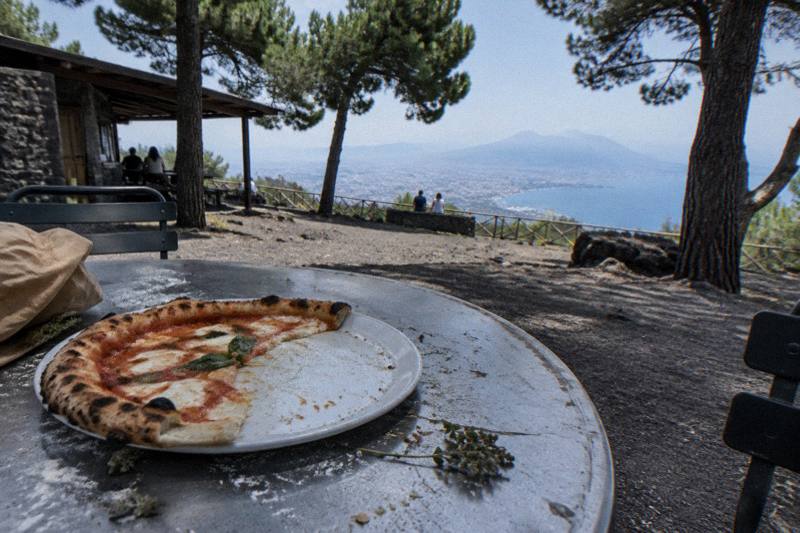
Mount Vesuvius Weather And Summit Visibility
The view from the Vesuvius crater rim is the reason to buy the ticket, and the weather decides whether you get it. This guide lays out what the summit climate actually does, month by month, what wind and cloud mean for visibility, and how the park's alert rules can close the trail on short notice.
Short answer
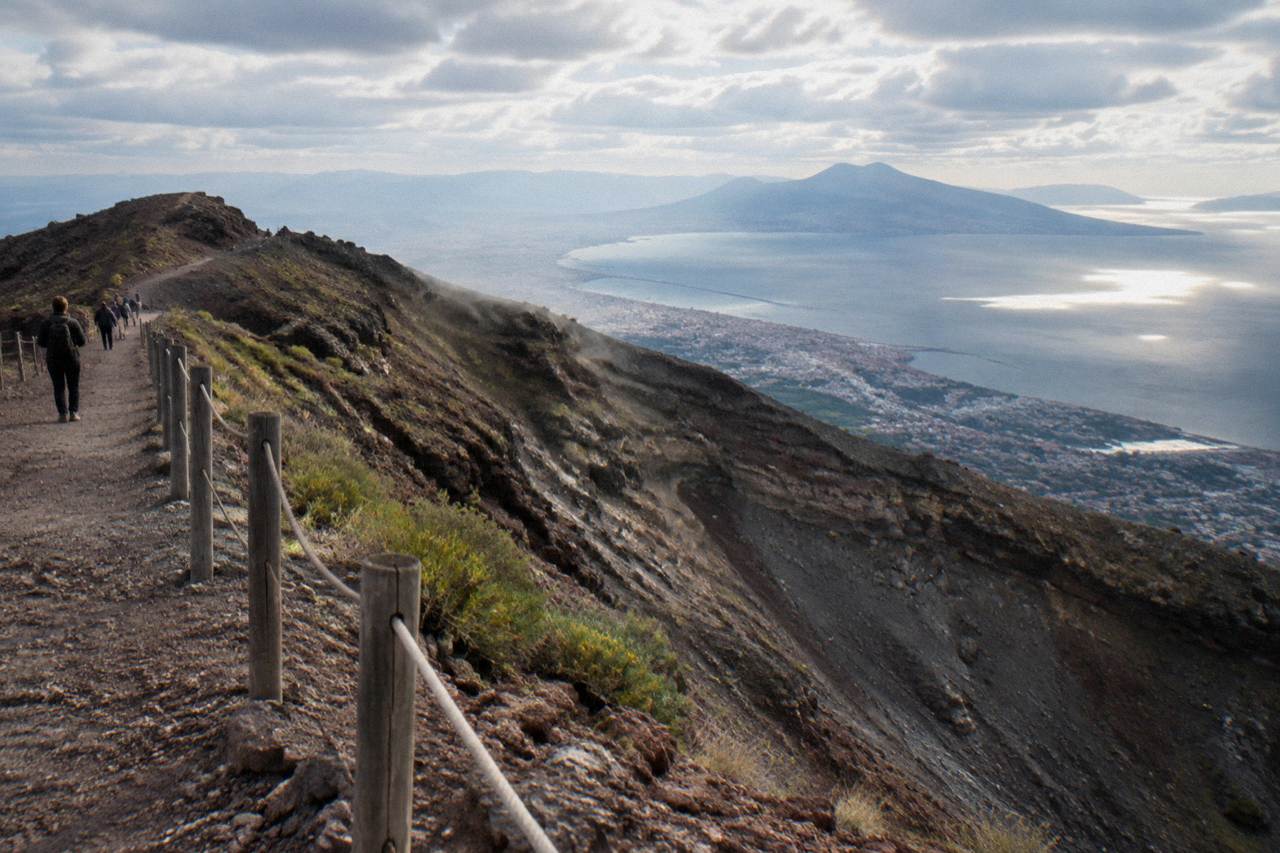
Summit weather on Vesuvius runs roughly 6 to 7 C cooler than Naples year round, on a modelled 1991-2020 climate average. Crater access runs 09:00 to 15:00 in winter and 09:00 to 18:00 in July and August. On days with an orange regional weather alert or higher, the trail and box office close automatically, with refunds for slots inside the closure.
Few mountains sell a view as hard as Vesuvius does, and few mountains take that view away as casually. The crater path ends at 1,175 m, high enough that the summit sits under its own weather, detached from the beach climate of Naples or Sorrento an hour below. A visitor can board a shuttle in 28 C heat and step out at the Quota 1000 plaza into wind, cloud and 15 C air. The park's own guidance tells visitors to check conditions and wear suitable shoes, and it closes the trail automatically when regional weather alerts hit orange or higher. In other words, weather is not a footnote to a Vesuvius trip. It is the single variable that decides whether your crater ticket buys a panorama across the Bay of Naples or a walk inside a cloud. This guide covers the summit climate month by month, what cloud base and wind do to visibility, when the trail can close, and how to pick a tour or a time slot that protects you against a bad-weather day. All climate figures below are a modelled 1991-2020 climate average from the ERA5 reanalysis at the 1,000 m level, which is a description of the norm, never a forecast for your date.
What Is The Weather Like At The Top Of Mount Vesuvius?
The summit runs about 6 to 7 C cooler than Naples in every month of the year, on the modelled 1991-2020 climate average, and it is wetter and windier than the city below. July averages a summit high of 22.1 C while Naples sits at 28.6 C; in January the summit high is 5.6 C. Rain roughly tracks the Naples pattern but lands on exposed volcanic gravel, so it feels sharper.
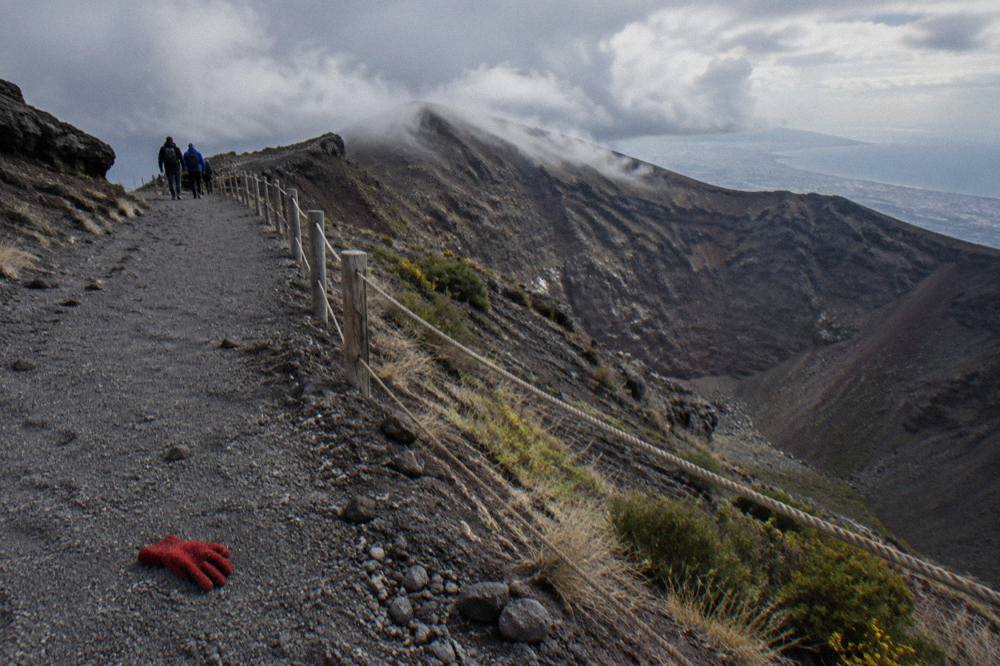
The gap between city and summit is remarkably consistent. In August the modelled summit high is 22.8 C against 29.3 C in Naples, and in December it is 6.7 C against 12.7 C. That consistency is useful for planning: whatever your phone says for Naples, subtracting six or seven degrees gives a fair estimate of the crater rim at midday. The trail surface is loose volcanic gravel the whole way, so rain does not just cool you, it changes the footing. Millie from the United Kingdom, reviewing the combined Pompeii and Vesuvius day tour, flagged exactly this combination: "very uneven surfaces and very hot in summer so trainers and water bottles."
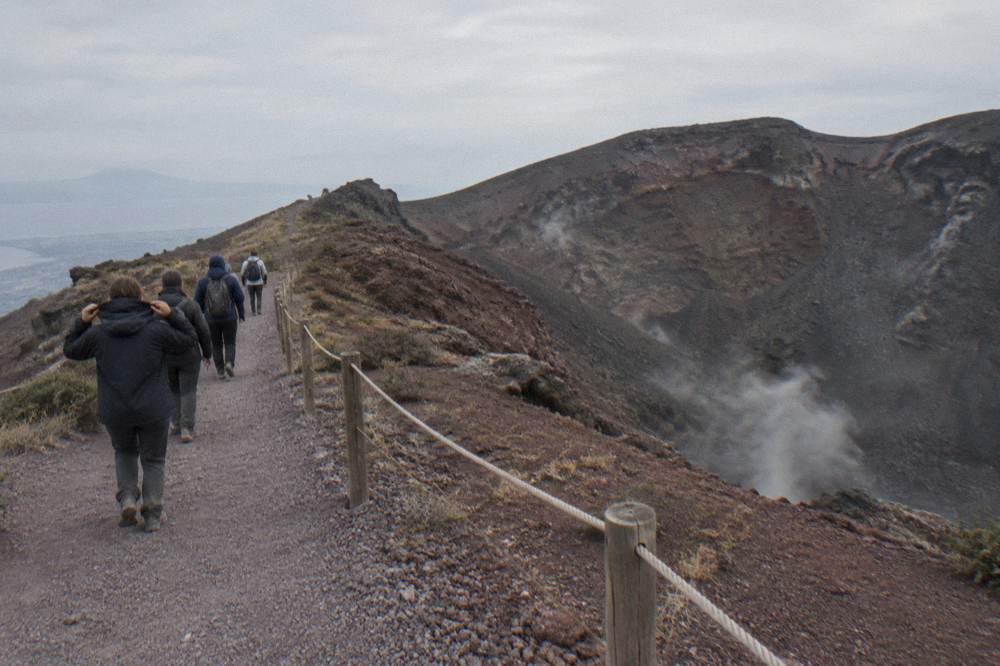
Wind is the factor the numbers cannot capture. There is no measured wind statistic for the summit in the verified record, and we will not invent one. Qualitatively, the Gran Cono path is an exposed ridge walk with no tree cover above the Quota 1000 plaza, so any breeze in Naples arrives at the rim stronger and colder, and the crater's elliptical bowl, up to 580 m across, funnels air along the inner walls. Treat the rim as a place where the apparent temperature drops well below the forecast, and pack for wind even on a calm morning. For real-time conditions rather than climate averages, the site's official Gran Cono page is the park's own source for hours, tickets and the closure rule, and our Vesuvius webcam and current conditions guide covers how to check the sky before you leave.
Which Month Has The Best Weather For Visiting Mount Vesuvius?
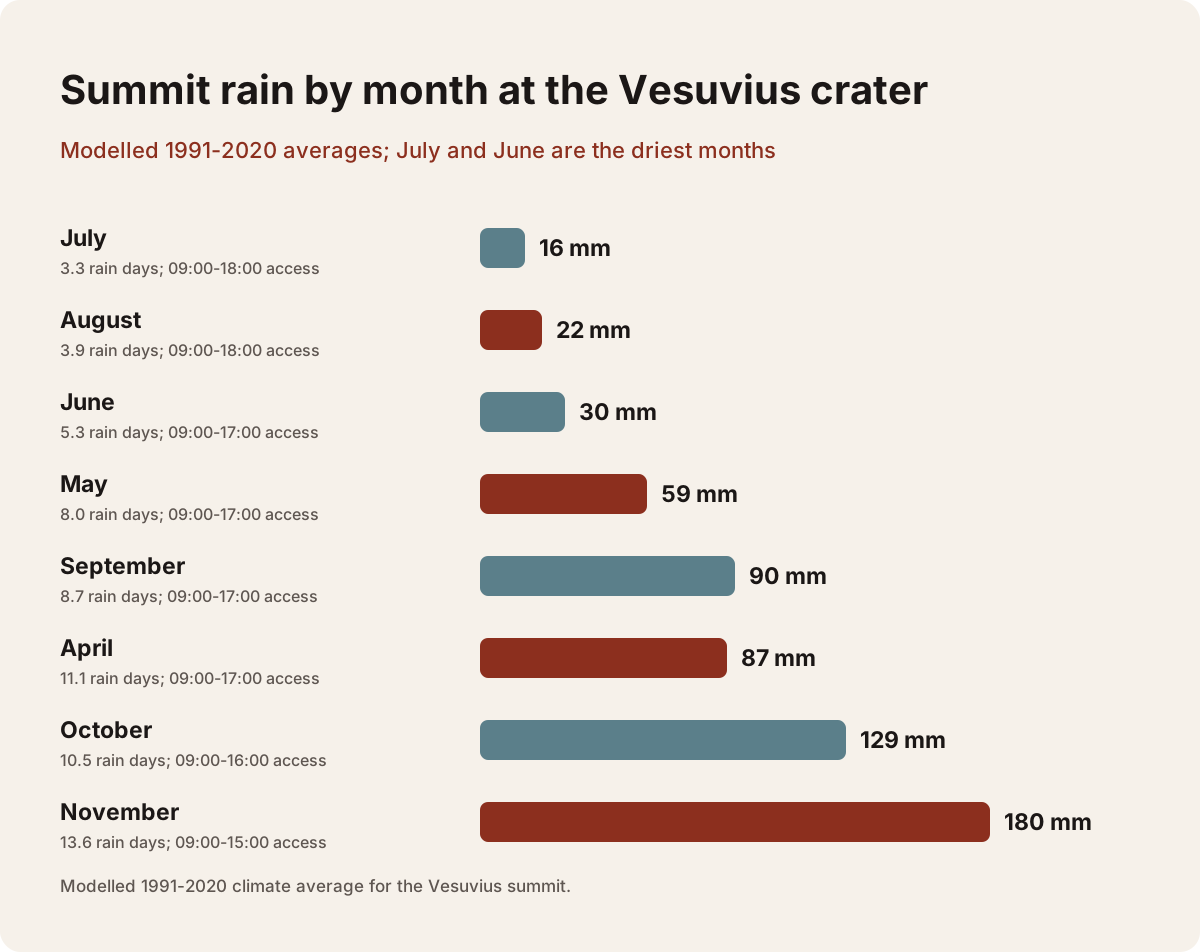
On the modelled 1991-2020 climate average, the driest and sunniest summit months are July, with 16 mm of rain over 3.3 rain days, and June, with 30 mm over 5.3 days. The trade-off is peak heat in the city below and the year's biggest crowds. May, June and September offer the best balance of low rain, mild summit temperatures and full 09:00 to 17:00 access hours.
Monthly planning is really a three-way negotiation between rain, temperature and daylight access. The following table condenses the modelled averages and the park's own access hours into one view; closing times are last-access times, and the visit must end within one hour of them.
| Month | Summit high/low C | Summit rain mm (days) | Crater access | Daily cap |
|---|---|---|---|---|
| January | 5.6/0.0 | 119 (11.7) | 09:00-15:00 | 2,160 |
| February | 6.0/-0.1 | 103 (11.2) | 09:00-15:00 | 2,160 |
| March | 8.3/1.5 | 104 (10.5) | 09:00-16:00 | 2,520 |
| April | 11.1/3.8 | 87 (11.1) | 09:00-17:00 | 2,880 |
| May | 15.1/7.5 | 59 (8.0) | 09:00-17:00 | 2,880 |
| June | 19.2/11.6 | 30 (5.3) | 09:00-17:00 | 2,880 |
| July | 22.1/14.5 | 16 (3.3) | 09:00-18:00 | 3,240 |
| August | 22.8/15.2 | 22 (3.9) | 09:00-18:00 | 3,240 |
| September | 18.7/12.0 | 90 (8.7) | 09:00-17:00 | 2,880 |
| October | 14.8/8.5 | 129 (10.5) | 09:00-16:00 | 2,520 |
| November | 10.4/4.9 | 180 (13.6) | 09:00-15:00 | 2,160 |
| December | 6.7/1.4 | 147 (13.1) | 09:00-15:00 | 2,160 |
Read the rain column with care. November is the wettest summit month at 180 mm across 13.6 rain days, and October carries 129 mm, but that is a monthly total spread over many days, not a guarantee of a washout on your specific date. The deeper autumn problem is cloud base: the same humid southwesterly air that brings October and November rain often parks a low cloud sheet at or just above the 1,175 m rim, which hides the bay view without a drop falling on you. The monthly pages under Mount Vesuvius by month break each month's trade-offs down in detail, including the shoulder seasons. Getting above that cloud sheet is easier said than done, and our guide to Vesuvius 4x4 and e-bike ascents explains what each way up the mountain actually offers on a hazy morning.
Winter deserves a separate word. January and February deliver crisp, often spectacularly clear summit days between fronts, with summit lows around freezing, and the shorter 09:00 to 15:00 access window concentrates everyone into fewer hours. The full picture, including what the cold means for clothing, is in Mount Vesuvius in winter, while the heat-and-crowd calculus of the July and August window is covered in Mount Vesuvius in summer.
For most visitors the practical answer is late spring or September: rain days are roughly half the winter count, the summit sits in the comfortable 15 to 19 C daytime band, and the 17:00 last access leaves room for a relaxed afternoon slot. Whenever you go, book the slot first and let the slot shape the day, not the reverse; the deeper planning logic is laid out in How To Hike Mount Vesuvius.
Three tour formats fit that weather-first logic well, and comparing them side by side is the fastest way to see which matches your tolerance for uncertainty.
What Time Of Day Gives The Best Visibility From The Vesuvius Crater?
Morning slots generally offer the most reliable visibility. In summer, cloud often builds through the afternoon as the plains heat up and thermals push haze and cloud toward the rim, while winter mornings tend to be at their clearest before weather fronts arrive later in the day. Crater access opens at 09:00 in every month, so an early slot uses the most stable air.
There is no measured hourly visibility statistic for the summit, so this is qualitative guidance rather than a number, and it should be paired with a live check on the morning of your visit. The pattern that repeats across the Campanian summer is morning clarity followed by afternoon cumulus build-up over the Apennines and, on some days, over Vesuvius itself. Haze is the subtler enemy in July and August: even a "clear" summer afternoon can put a milky filter between the rim and Capri, while a 10:00 slot the same day can show the bay in hard detail. In the October-to-March half of the year the dominant risk reverses, with frontal cloud and rain moving in from the west, and the last up bus of the day, the EAV 808 arriving at Quota 1000 at 15:25, lands after the winter last entry of 15:00 anyway, which is worth knowing before you plan a late arrival.
A useful structural fact works in the morning booker's favour: a normal crater ticket is valid from 120 minutes before to 120 minutes after the printed slot, within opening hours. Book a 10:00 slot and you can enter from 09:00 if the sky is perfect and threatening to change. Slots are sold in 10-minute increments with 50 tickets each, released 30 days ahead, so the desirable morning windows go first in peak season; a dedicated ticket product such as the Mount Vesuvius Excursion skip-line ticket with digital guide, from €16 per person and rated 4.2 from 3,756 reviews, exists precisely to secure that entry without standing in the wrong line.
The webcam question deserves its own paragraph, because it is the single best pre-visit tool. Cloud base and wind at the rim are not measured in any dataset we can print, so the honest advice is: look before you leave. The Vesuvius webcam and current conditions guide explains which cameras show the summit and the bay approach, and how to read them an hour before your slot. If the camera shows the rim in cloud at 08:00 with a northerly flow, the odds of it clearing are reasonable; a stationary grey deck from the south is a different story, and that is the day to lean on your cancellation terms.
Speaking of which: which crater product should you actually book with fickle weather in mind?
How Cold Does It Really Feel On The Vesuvius Trail?
Summit lows sit near 0 C from December to February and the trail commonly feels several degrees colder than the modelled air temperature because the ridge is exposed and the gravel path holds no heat. In shoulder months a 10 C difference between the city and the rim at the same hour is normal. Layers, not a single warm jacket, are the correct answer to a mountain that can pass through three microclimates in 40 minutes of walking.
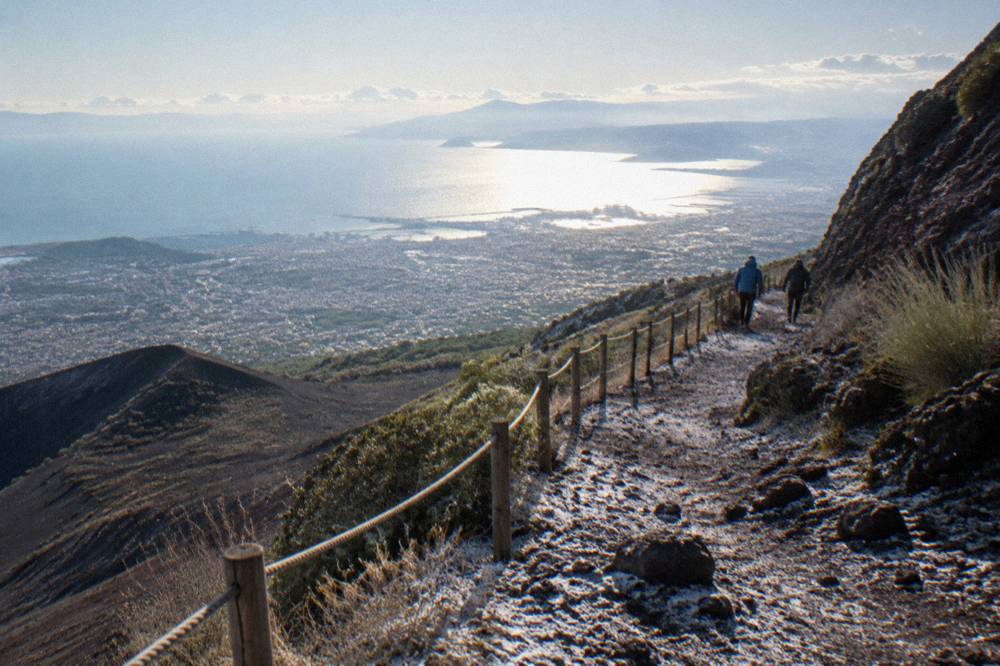
The numbers behind that answer come straight from the modelled averages. The coldest summit months are January at 5.6/0.0 C and February at 6.0/-0.1 C; the warmest are August at 22.8/15.2 C and July at 22.1/14.5 C. The sting is the wind chill on the final ramp to the turnaround at 1,170 m, where the path leaves the leeward shoulder and meets the full flow across the crater. Even in August, guests coming off an air-conditioned bus in shorts report a cold five minutes at the top. The detailed clothing arithmetic, what to wear at each temperature band and why the gravel demands closed shoes, is worked through in the companion piece Is It Cold At The Top Of Vesuvius?.
One figure worth fixing in mind: the 6-to-7-degree summit-versus-city gap holds every single month of the modelled record. It never inverts, and it never widens dramatically. That predictability makes packing simple, because the forecast for Naples on the morning of your visit is a usable proxy for the summit six or seven hours later, minus wind. The only addition the averages cannot give you is rain cover: a light shell does double duty against wind and showers and weighs nothing on the climb.
Can Bad Weather Close The Vesuvius Crater Trail?
Yes, automatically. The park closes both the ticket service and the trail on any day the regional Civil Protection authority issues a weather alert of orange or higher. Tickets for slots inside a closure are refunded automatically, with no request needed, and slots adjacent to a closure are refundable on request within 30 days, with refunds processed within 60 days.
This is the single most important weather rule on the mountain, and it is set out in the park's Gran Cono access rules. Two consequences follow. First, you do not need to gamble on a closure decision yourself: if the alert is raised, the mountain closes, full stop, and the refund machinery starts without you writing an email. Second, closure risk is seasonal in shape even though no individual closure can be predicted: the November-to-March period, with 13 or more rain days a month at the summit on the modelled average, simply carries more alert days than July does. We do not track or print individual past closures, and no reader should treat any specific date's status as a standing fact; check the operator's listing and the park's news for current status.
The refund rules have precise edges worth knowing before you book. Slots inside the closure window are refunded automatically. Slots adjacent to a closure, say you booked 12:00 and the alert is lifted at 11:00, are refunded on request within 30 days by writing to the park's contact address. All refunds are processed within 60 days. For tours bought through operators, the same force-majeure logic normally flows through the operator's own cancellation terms, and most Vesuvius day products carry a free-cancellation flag on the listing, but the operator's terms, not the park's, govern that refund, so read the listing's cancellation line before booking rather than after. The full index of guides sits on Mount Vesuvius Tours.
Practically, the closure rule should shape your itinerary, not just worry you. Build a plan B into any winter or shoulder-season day: a Pompeii-first morning, where the excavations are walkable in light rain that would shut the crater, with the volcano as the afternoon only if the alert board is clean. The classic pairing logic, ruins-first versus crater-first, is unpacked in How To Hike Mount Vesuvius, and flexible products such as the Pompeii and Vesuvius day trip with pizza lunch come with the cancellation cover that fickle-weather days reward.
| Weather situation | What it means for the crater | Best response |
|---|---|---|
| Orange or higher regional alert | Trail and box office close automatically | Refund is automatic for covered slots; switch to Pompeii or museum plan |
| Low cloud at rim level | Path open, view of the bay gone | Check webcam before travelling; consider an earlier or later slot |
| Steady rain below alert level | Path normally open, gravel slippery | Waterproof shell, grippy shoes, allow extra time on descent |
| Strong wind below alert level | Path open; rim feels much colder | Windproof layer, hat, gloves in cooler months |
| Summer haze over the bay | Path open, distant islands faint | Prefer a morning slot; view of the crater itself unaffected |
How Should Weather Shape Which Vesuvius Tour You Book?
In the clearest months, any format works and the cheapest transfer-plus-ticket product is enough. In October-to-March, when alert-day risk is highest, pick a product with free cancellation flagged on the listing and a short decision window, ideally one with a same-morning departure from Naples or Pompeii rather than a fixed Rome-length day. Tours bundling lunch or a second site give your day a weather-proof spine.
The roster makes this concrete. The shared-bus Pompeii: Mount Vesuvius Crater Transfer with Ticket, from €49 per person and rated 4.1 from 551 reviews, is a three-hour shuttle-and-entry product from Pompeii, cheap and simple, and a good fit for a stable forecast. Nicola from the United Kingdom reviewed its sibling transfer product plainly: "Easy way to get from Pompeii to Vesuvius and back again." For a plan with more slack, the From Naples All-Inclusive Mount Vesuvius Half-Day Tour, from €44.80 per person with pickup, rated 4.5 from 891 reviews, compresses the volcano into 3.5 to 4 hours and leaves the rest of the day free to re-plan around weather.
Longer products carry more weather exposure but also more fallback content. The From Naples: Pompeii and Vesuvius Day Trip with Pizza Lunch, from €53.25 per person, rated 4.8 from 9,744 reviews, spreads the day across two sites and a meal, so a clouded-over crater still leaves you a full Pompeii walk and lunch on the volcano slopes. Charles from the United States summed up the guide quality that carries a mixed-weather day: "Gaetano was a great guide. Personable and knowledgeable. Good at keeping the group together."
Two more formats earn a mention in the weather context. The Mount Vesuvius Transfer with Entry Tickets from Naples, from €35.10 per person, rated 4.4 from 1,785 reviews, is a three-hour direct transfer with guaranteed entry, the shortest possible exposure window for a nervous forecast. And if you want the crater and nothing but the crater, from-ercolano products such as the Vesuvio Park entry with roundtrip bus, from €36 per person, rated 4.2 from 1,308 reviews, sit on the Ercolano side where the Circumvesuviana drops you, making an early start, and therefore the best light, easier.
The booking sequence that weather logic suggests: watch the forecast until 30 days out, buy your preferred morning slot or tour while the 30-day ticket release window is open, then re-check the forecast and the webcam at 48 hours and again on the morning. Every product named above flags free cancellation on its listing, which converts a weather gamble into a scheduling decision.
What Can You Actually See From The Rim In Different Conditions?
In clear air, the rim gives one of southern Italy's great panoramas: the whole Bay of Naples from Pozzuoli to the Sorrento Peninsula, Capri and Ischia offshore, and the full curve of the crater's fumarole-streaked walls below you. In rim-level cloud, you see the crater interior itself, steam vents and shattered lava, at close range and little else. Both are the same ticket.
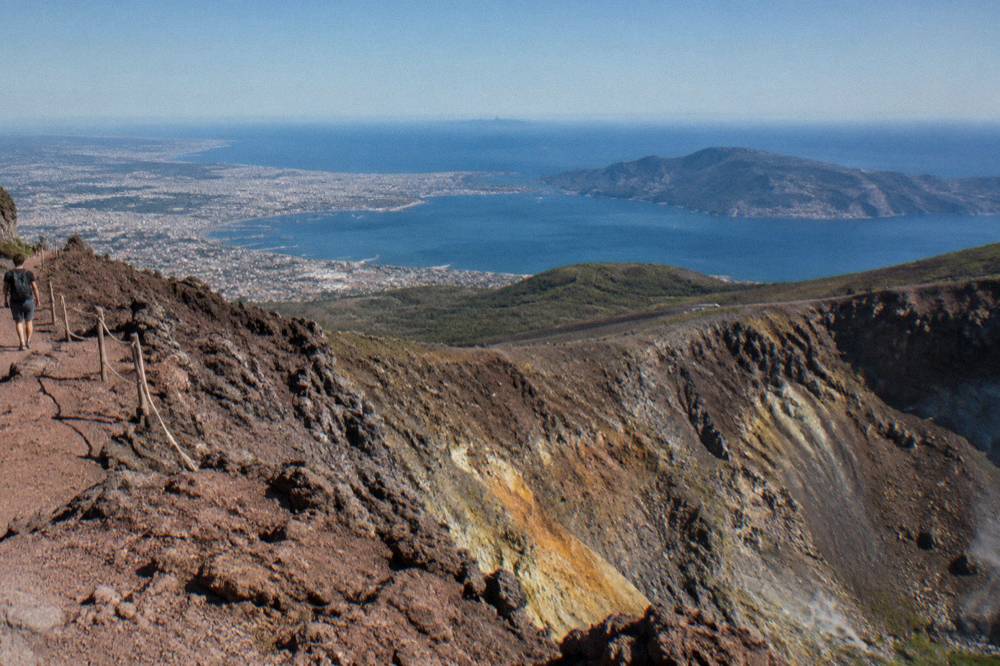
This is the honesty section, because the marketing photos only show one of the two experiences. The crater is elliptical, up to 580 m across, with fumaroles steaming on the inner walls, a reminder that Vesuvius last erupted in March 1944 and is monitored continuously by the INGV Osservatorio Vesuviano, whose alert-level page currently publishes green, the lowest level, with 121 small earthquakes recorded in the September bulletin, none above magnitude 1.7. When the view goes, that geology becomes the whole show, and honestly, it is a good show: standing inside the throat of the volcano that buried Pompeii, with sulphurous steam drifting past, is memorable even without the bay.
The in-between condition is the most common and the least photographed: high overcast or haze, where the near crater is sharp, Naples is a grey smudge, and Capri is a rumour. Jody S., reviewing a three-site day tour, described the payoff of the good end of the range: "a beautiful view of Naples, the crater, the country side, Sorrento and Capri." If panorama is your priority, treat visibility as a resource to be spent on a morning slot in a dry month, and consider the sunset question settled in advance: park access ends between 15:00 and 18:00 depending on month, always before sunset, so no crater visit is a sunset visit; that framing is unpacked in the site's Mount Vesuvius sunset tour guide.
Does The Summit Really Run Six Degrees Colder Than Naples?
Yes, and the gap is one of the most consistent climate facts on this site. On the modelled 1991-2020 climate average, the summit-level cell runs 6 to 7 C below the Naples cell in every one of the twelve months, from a 6.0 C gap in the cold months to 6.5 C in summer.
The table below shows the pairing month by month so you can run the subtraction yourself on any forecast. The summit figures are the modelled average at the 1,000 m level, roughly the Quota 1000 trailhead, and the summit itself at 1,281 m per INGV runs slightly colder still, though the public path ends at 1,175 m.
| Month | Naples high C | Summit high C | Gap C | Naples low C | Summit low C |
|---|---|---|---|---|---|
| January | 11.7 | 5.6 | 6.1 | 5.5 | 0.0 |
| February | 12.2 | 6.0 | 6.2 | 5.4 | -0.1 |
| March | 14.6 | 8.3 | 6.3 | 7.1 | 1.5 |
| April | 17.4 | 11.1 | 6.3 | 9.4 | 3.8 |
| May | 21.5 | 15.1 | 6.4 | 13.3 | 7.5 |
| June | 25.7 | 19.2 | 6.5 | 17.5 | 11.6 |
| July | 28.6 | 22.1 | 6.5 | 20.3 | 14.5 |
| August | 29.3 | 22.8 | 6.5 | 21.0 | 15.2 |
| September | 25.1 | 18.7 | 6.4 | 17.7 | 12.0 |
| October | 20.9 | 14.8 | 6.1 | 14.1 | 8.5 |
| November | 16.4 | 10.4 | 6.0 | 10.4 | 4.9 |
| December | 12.7 | 6.7 | 6.0 | 6.8 | 1.4 |
Two practical corollaries follow from the consistent gap. First, the "it was freezing at the top" reviews you will see on listings are usually written by summer visitors dressed for Naples, not by anyone caught in unusual weather; the cold is structural, and dressing for it is trivial once you know the rule. Second, the gap narrows slightly in the winter months (6.0 to 6.2 C) and widens slightly in the warm half of the year, so the summer visitor actually experiences the larger absolute difference between the bus stop and the rim. The mountain height behind all of this, 1,281 m, is published by INGV, the national volcanology institute, whose figure we use throughout this site.
What Should You Pack For Vesuvius Weather, Season By Season?
Pack for two climates in one day. Summer calls for sun protection, two litres of water and a layer against the windy rim; winter demands an insulated jacket, hat and gloves for the freezing low, while shoulder seasons suit a windproof shell over a midlayer, and closed shoes matter every month because loose volcanic gravel covers the path, with a rain cover worth carrying from October to April, when summit rain days run 10 or more per month.
The packing logic falls straight out of the climate table, so here it is in clothing terms.
| Season | Summit typical day | Rain days per month | Core packing |
|---|---|---|---|
| Winter (Dec-Feb) | Highs 5.6-6.7 C, lows near 0 C | 11.2-13.1 | Insulated jacket, hat, gloves, waterproof shell, grippy boots |
| Spring (Mar-May) | Highs 8.3-15.1 C | 8.0-11.1 | Midlayer, windproof shell, light gloves, water-resistant shoes |
| Summer (Jun-Aug) | Highs 19.2-22.8 C | 3.3-5.3 | Sun hat, sunscreen, 2 litres of water, light windbreaker |
| Autumn (Sep-Nov) | Highs 10.4-18.7 C | 8.7-13.6 | Layered tops, waterproof, warm layer for the rim, boots |
Water deserves special emphasis in the hot half of the year, and not only for temperature: the Quota 1000 plaza has no public toilets at present and the facilities situation on the mountain is thin, so carry what you need. The full kit list, including the footwear question and what matters for children, is assembled in the dedicated packing guide on this site. One weather-specific addition: sunglasses matter more than most visitors expect, because the gravel and pale volcanic rock throw glare upward even under overcast, and because the wind at the rim dries contact lenses uncomfortably.
A final word on the whole frame. Weather planning for Vesuvius is not about optimising toward a guaranteed postcard, because no month offers that; November carries 13.6 rain days and July still serves the occasional rim-level cloud. It is about stacking the odds: a dry month, a morning slot, a cancellation-friendly tour and a webcam check at breakfast. Visitors who compare the full range of Mount Vesuvius tours against the season they are actually travelling in, rather than the season in the photographs, are the ones writing the five-star reviews.
Common Questions About Mount Vesuvius Weather And Visibility
What Is The Weather Like At The Top Of Mount Vesuvius?
On the modelled 1991-2020 climate average the summit runs about 6 to 7 C cooler than Naples in every month, from July highs of 22.1 C to January highs of 5.6 C. The rim is exposed to wind and the path is loose gravel, so it commonly feels colder than the air temperature suggests.
Which Month Has The Best Weather For Visiting Mount Vesuvius?
July is the driest summit month at 16 mm of rain over 3.3 rain days, but June, and September offer the best balance of low rain, mild summit temperatures around 15 to 19 C, and the full 09:00 to 17:00 access window with a daily cap of 2,880.
Does Bad Weather Ever Close The Vesuvius Crater Trail?
Yes, automatically. Any day with a regional weather alert of orange or higher closes both the ticket service and the trail. Tickets for slots inside a closure are refunded automatically, and adjacent slots are refundable on request within 30 days, with refunds processed within 60 days.
Is It Cold At The Top Of Vesuvius In Summer?
It can feel cold at the rim even in August. Modelled summit highs are 22.8 C in August against 29.3 C in Naples, but the exposed final ramp to the 1,170 m turnaround catches the full wind, so a light layer is worth carrying in every month.
What Time Of Day Has The Best Visibility From The Crater?
Morning slots generally offer the most reliable visibility. Summer afternoons often build haze and cumulus over the bay, while winter mornings are typically clearest before any front arrives. Access opens at 09:00 year round, and a normal ticket allows entry from 120 minutes before the printed slot.
Can You See The Bay Of Naples From Mount Vesuvius When It Is Cloudy?
Not from above the cloud base. When cloud sits at rim level the panorama disappears, though the crater interior, its fumaroles and the volcanic rock remain fully visible at close range. Check a summit webcam an hour before your slot to see where the cloud base sits that day.