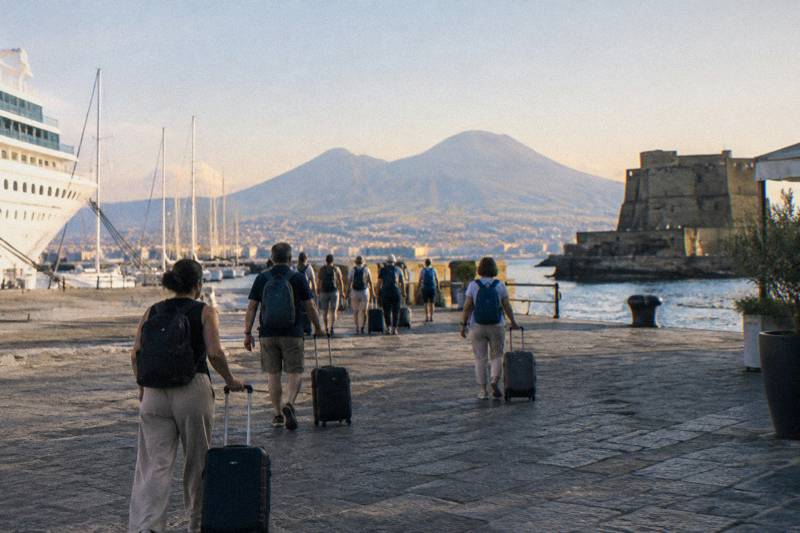
Is Vesuvius Ever Going To Erupt Again?
Vesuvius is the only active volcano on mainland Europe, and the question of its next eruption isn't hypothetical. Here is what the monitoring data actually shows, what the civil protection plan involves, and how that affects your visit.
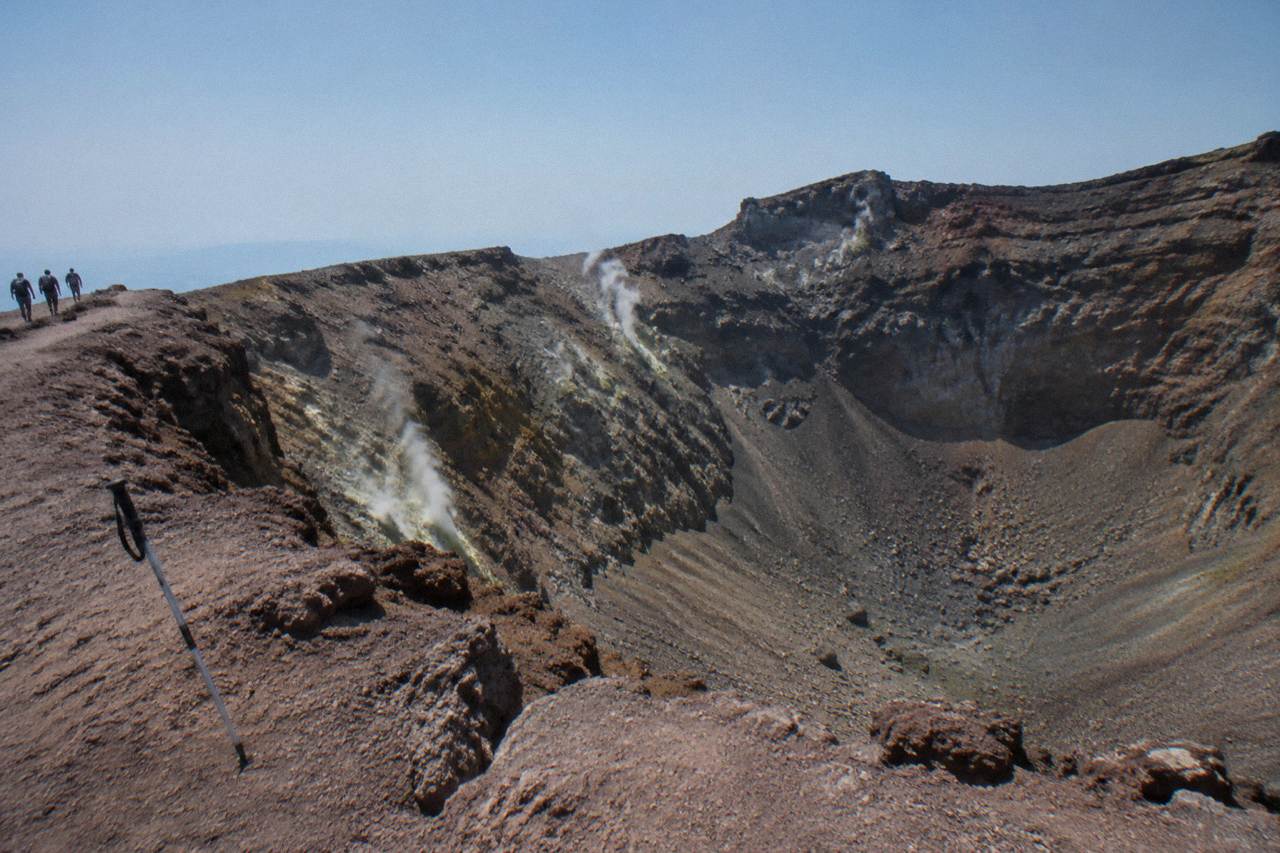
Yes, Vesuvius will erupt again. It is an active stratovolcano on a roughly 20,000-year eruptive cycle, and its last event was the 1944 lava-and-ash eruption that destroyed several villages on the lower slopes. That 81-year pause is long by the volcano's recent history, and every monitoring body, from the Istituto Nazionale di Geofisica e Vulcanologia (INGV) to the civil protection agency, treats the next eruption as a planning certainty, not a remote possibility. The good news for visitors: the alert level today is green, the lowest of four, and the crater is open for guided hiking under tightly managed access rules. A visit now is safe, heavily monitored, and deeply interesting.
This article explains what the science actually says about the timing and style of the next eruption, how the red-zone evacuation plan works, and why you can hike the crater path this month without ignoring the risk. If you are here because you want to book a crater tour and the word "active" stopped you, read on. The answer is more nuanced, and more reassuring, than a single headline. The Mount Vesuvius Tours roster lists every bookable operator with their current rating and price on the live listing, and understanding the volcano's real status is the best pre-booking research you can do.
Is Vesuvius Going To Erupt Again?
Geologically, Vesuvius is in a closed-conduit, open-vent state and has erupted many times since the famous AD 79 event. The INGV Osservatorio Vesuviano, which operates the world's oldest volcano observatory, states plainly that a future eruption is inevitable. The question is not whether, but when, and the current data say not soon. The volcano has been quiet since 1944, but underground swarms of tiny earthquakes, fumarole temperatures, and ground deformation are tracked minute by minute. The observatory publishes a monthly bulletin with the latest seismic and geochemical readings, and as of the September 2026 bulletin, 121 small earthquakes were recorded, all below magnitude 1.7, with no sign of magma movement toward the surface.
That level of activity is typical background noise for a volcano of this type. The conduit that fed the 1944 lava flows is largely sealed, and hydrothermal circulation in the crater is slowly declining, a multi-year trend that points to a cooling system, not a heating one. Staff at the observatory, housed in a historic building on the slopes, watch for three things that would change the picture: a sustained acceleration of uplift, a shift in the chemical signature of the fumaroles, and a distinct swarm of deeper, larger quakes. None of that is happening now. A visit to the crater this year is not a gamble; it is a walk on a sleeping volcano that is watched more closely than any other in Europe.
The best way to experience the crater safely is with a tour that bundles the mandatory volcanological guide and the timed entry ticket. Operators package the hike with round-trip transfers from Naples, Pompeii, or the port. For the full list of hiking options, see the Mount Vesuvius hiking tours hub, which breaks down every format from group treks to private guides.
Is Vesuvius Likely To Erupt Again?
In the language of volcano science, likely is a probability distribution, and for Vesuvius the next eruption is considered a medium-term certainty on a timescale of decades to centuries. The Civil Protection Department maintains a four-level alert system, and Vesuvius has been at the base green level since the system was adopted, with no upgrade in sight. The green level means monitoring parameters are within normal background values, and no anomalous trends have been detected that would justify moving to yellow, the attention phase. The observatory's September 2026 bulletin recorded 121 earthquakes with a maximum magnitude of 1.7; nearly all were shallow, in the crater area, and consistent with the long-term background.
What would trigger an alert change? The protocol, published by the Dipartimento della Protezione Civile, defines yellow as the level where monitored parameters show persistent anomalies that could, but not necessarily will, lead to an eruption. In past decades, seismic swarms have prompted brief periods of heightened monitoring without an alert-level change, and each episode faded without an eruption. Today, the automatic network includes 20 permanent seismic stations, seven tiltmeter stations, six GPS sites, and a network of cameras and gas sensors that blanket the cone and its surroundings. The data feed goes straight to the operations room in Naples and is public-facing on the INGV website.
This system exists precisely because another eruption is considered likely enough to justify the cost of round-the-clock surveillance. The red zone, a 25-municipality area with about 700,000 residents, has a standing evacuation plan that drills on a three-day timeline. The plan updates every few years, most recently in 2025, and it is the reason the word "eruption" triggers a serious, rehearsed response in Campania. Understanding that plan, not panicking at a tweet, is the right way to think about risk.
Many visitors book a tour that includes a volcanological guide, someone who can explain the crater's dynamics on the spot. The Check availability for a shuttle-and-ticket combo that takes you from Naples to the crater path and back, with entry timed to your slot. If you want to pair the volcano with the ruins, the Pompeii and Vesuvius tours hub lists every combo that does both in a single day.
Is Mount Vesuvius Expected To Erupt?
Scientists do not issue a date for the next eruption because the signals are not there. Expected in the monitoring sense means the precursors, a clear pattern of accelerated seismicity, measurable ground swelling, and gas chemistry changes, are observed, and they are not. The INGV bulletin from September 2026 describes exactly the opposite: a slow, multi-year decline in hydrothermal activity, with fumarole temperatures stable or dropping slightly and no magmatic deformation. The 121 earthquakes that month were mostly below magnitude 1.0, and 113 of them were so small they could not be located with precision. That is a quiet volcano, not a stirring one.
The 1944 eruption, the last time Vesuvius opened, began with a small explosion on 18 March that destroyed part of the intracrater scoria cone. Activity intensified on 19 March, and lava flows reached the towns of San Sebastiano al Vesuvio and Massa di Somma on 21 March. The entire event lasted about ten days and was effusive-explosive in character, the kind of eruption that could happen again in a similar timeframe. The INGV maintains a detailed page on that event and uses it as a reference for what a future moderate eruption might look like. Their history page documents the sequence.
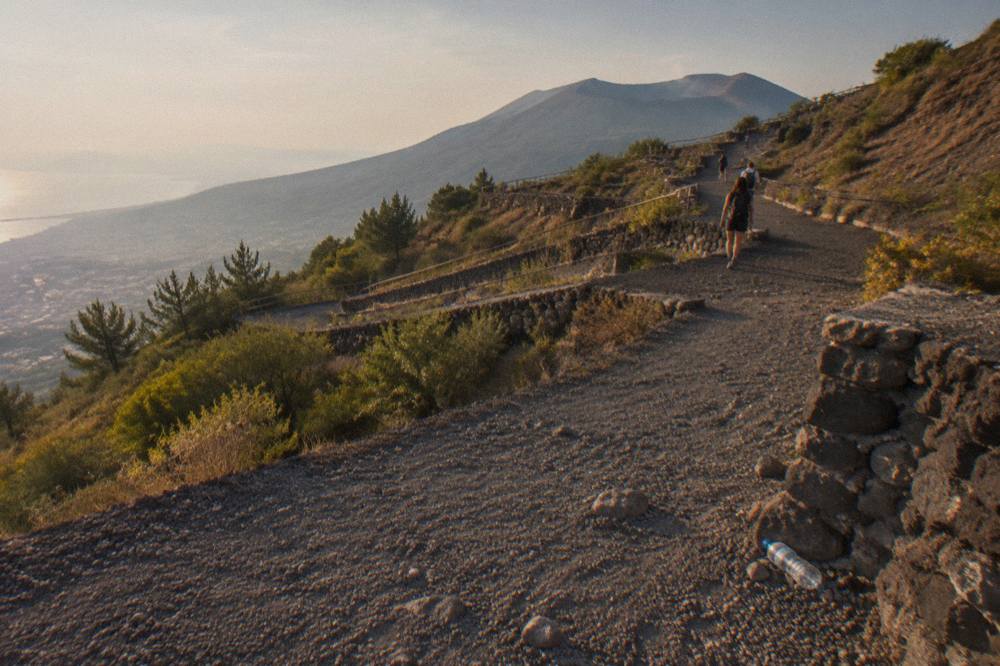
A future eruption is more likely to be of that moderate, strombolian-to-subplinian scale than a repeat of the AD 79 Plinian column that buried Pompeii, a 20,000-year-cycle event. The AD 79 eruption, traditionally placed on 24 August, is now debated: a charcoal graffito found in 2018 at Pompeii reads "XVI K Nov" (17 October), and the park's own team calls an October date highly probable. Either way, that class of eruption is not the one the alert system watches for in the near term.
For the crater visitor, the most important safety system is the automatic closure on days with an orange weather alert or higher, and the mandatory volcanological guide on the trail above 1,000 metres. If you are comparing routes, a shuttle-and-ticket tour like the one from Naples or Pompeii simplifies the logistics considerably.
Is Vesuvius Likely To Erupt Soon?
No. The word soon in volcanology is layered: on a human scale of months to a few years, the observatory's data show no evidence of an imminent eruption. On a geological scale of centuries, the next eruption is overdue by the average of the last few cycles, which have been 40 to 100 years apart. The 81-year gap since 1944 is toward the long end of that average, but the volcano's behaviour is episodic, not clockwork. The current quiet is best understood as an extended repose, typical of closed-conduit systems that cool and reseal between events.
The observatory's real-time monitoring dashboard is public and refreshes continuously. It shows all parameters inside the green band. The 121 quakes of September are routine; the volcano has averaged a few hundred small events per year for decades. The only way to know if that changes is to check the bulletin, which updates monthly, or to watch the alert level, which the Civil Protection agency would change if precursors appeared. Nothing in the current data suggests that change is imminent.
This matters for trip planning because a visitor who books a crater slot for next week is not walking onto a volcano that is about to blow. The experience is designed to be educational and safe, and the guides carry radios linked to the park's operations centre. A guided hike is not a dare; it is a regulated activity.
To put that into practice, a tour like the Shuttle with Priority Ticket combines the timed crater entry with a direct coach from Naples, so you do not have to figure out the bus timetable or the parking rules on your own. It is the quickest way to get onto the trail and back. If you are still weighing whether the hike is right for you, our article on how hard the walk up Vesuvius really is breaks down the gradient, the surface, and the fitness level required.
How Likely Is Mount Vesuvius To Erupt Again?
The scientific consensus, summarised by the INGV, is that the probability of an eruption in any given decade is low single-digit, but the probability over the next century is high enough that civil protection planning treats it as a near-certainty. This is not a contradiction: it reflects a volcano whose repose periods have historically been 40 to 100 years and whose last eruption was 81 years ago. The hazard is real, the urgency is not.
The monitoring network has been upgraded repeatedly. Today, the observatory runs 20 permanent seismic stations, seven tiltmeter stations, six GPS sites, and a network of cameras and gas sensors. The data are transmitted to the operations room in Naples and shared with the Civil Protection Department in Rome. The alert-level system is designed so that a move from green to yellow would trigger a formal review and a warning to the population, with a timeline of weeks to months before any potential eruption. An eruption would not happen without days to weeks of accelerating precursors, giving authorities time to activate the evacuation. That is the whole point of the system.
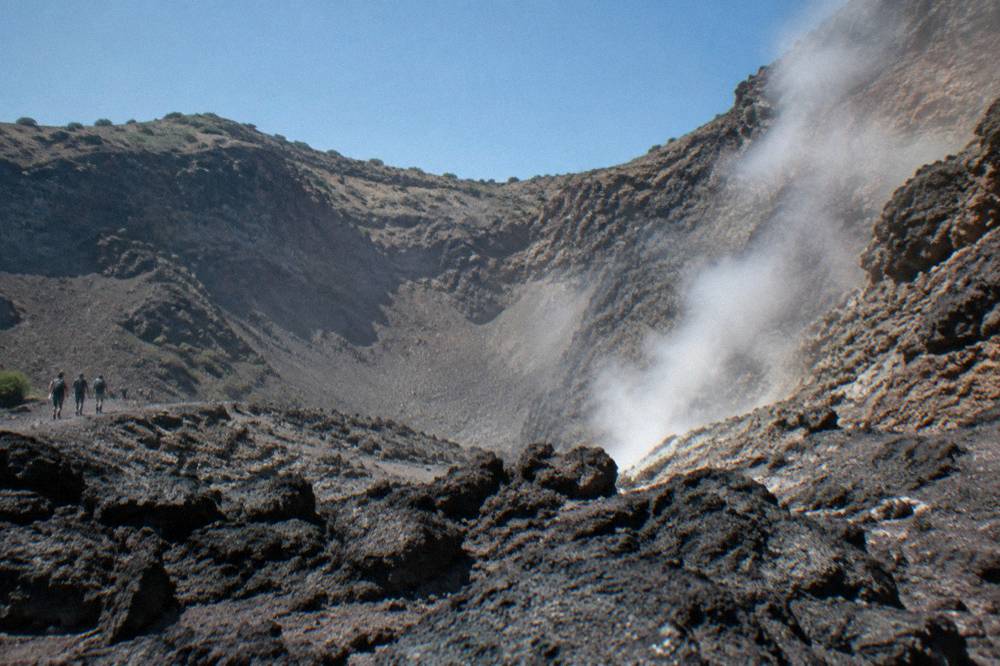
For visitors on a day trip from Naples or the Amalfi Coast, the practical implication is that a booked tour is highly unlikely to be cancelled by volcanic activity. The more common cancellation risk is weather: the trail and box office close automatically on orange-alert days, with refunds processed within 60 days. Operators on the live listing, particularly the ones with flexible cancellation policies, handle this routinely. A good fallback is to carry a tour ticket that includes both Pompeii and Vesuvius, so that if the crater path closes for weather, you still have the ruins.
If you are still deciding whether the trip is worth it, our article on whether going up Mount Vesuvius is worth it weighs the cost, the effort, and the payoff.
| Metric | Value |
|---|---|
| Alert level (October 2026) | Green (baseline) |
| September 2026 earthquakes | 121 (max magnitude 1.7) |
| Quakes below magnitude 1.0 | 113 of 121 |
| Fumarole temperature trend | Stable to slightly declining |
| Ground deformation | None detected (magmatic) |
| Years since last eruption | 81 (1944) |
| Red-zone population | About 700,000 across 25 municipalities |
What Would Happen If Vesuvius Erupted?
A future eruption is most likely to be of moderate scale, similar to the 1944 event, producing lava flows, ashfall, and pyroclastic surges that would affect areas inside the red zone. The Civil Protection plan is built around a three-day evacuation of the 700,000 residents before the eruption column becomes dangerous. The assumption is that the volcano would give days of warning through the monitoring network, and that the population would be moved to pre-arranged reception areas in other regions. The plan is published, updated, and tested.
The red zone covers 25 municipalities, from Torre del Greco and Ercolano on the coast up to the Somma-Vesuvius complex and inland to Ottaviano and San Giuseppe Vesuviano. The zone is defined not by a perfect circle but by the areas that could be affected by lava flows, ballistic projectiles, and pyroclastic density currents. The exact boundaries shift with each plan revision; the 2025 update kept the same population number but refined the traffic routing. On a visit, you can see the green signboards marking the edge of the zone along the main roads, a quiet reminder that the volcano is not just a scenic backdrop.
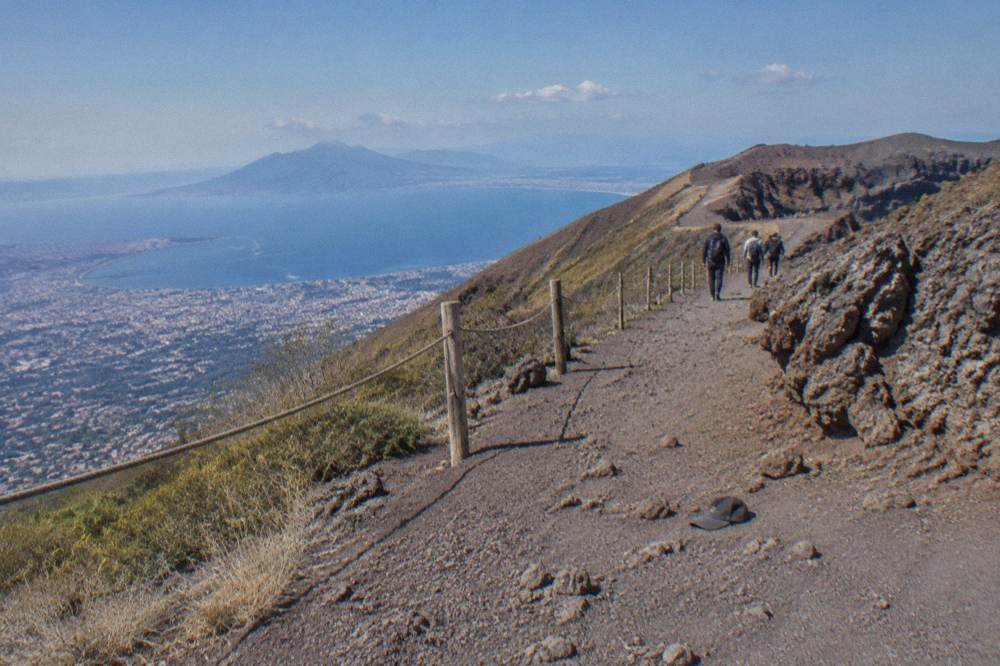
The experience of visiting the crater today puts that into perspective. You stand at 1,175 metres, looking into a 580-metre-wide elliptical crater with fumaroles steaming on the inner walls. The volcanological guide explains the system, and you follow a marked path that stays well back from the rim's most active sections. The visit is designed so that even if the volcano were to enter a pre-alert phase, the park would close the trail long before any visitor was at risk. The guide's presence is mandatory above 1,000 metres for exactly that reason.
For those who want the fullest context, a dedicated trekking tour with a volcanological guide can go deeper into the crater's geology and history. Check availability for a three-hour guided trek that spends more time on the cone and less on the road.
| Feature | AD 79 (Plinian) | 1944 (Effusive-Explosive) |
|---|---|---|
| Type | Plinian column, pyroclastic flows | Lava flows, ashfall, minor explosions |
| Duration | About 24 hours | About 10 days |
| Cycle length | Roughly 20,000-year events | 40 to 100-year events |
| Warning signs | Limited historical record | Days to weeks of precursors expected next time |
| Affected area | Pompeii, Herculaneum, Stabiae buried | San Sebastiano, Massa di Somma (lava); ash across Campania |
| Relevance to next eruption | Low (rare cycle) | High (most likely scenario) |
How Does The Alert System Work?
The Italian civil protection alert system for volcanoes has four levels: green for normal baseline activity, yellow for attention when parameters show persistent anomalies, orange for pre-alarm when precursors indicate a possible eruption, and red for alarm when an eruption is imminent or underway. Vesuvius has been at green since the system was adopted. A move to yellow would mean parameters have shifted outside baseline, and a formal notification would be sent to the Civil Protection Department, the regional government, and the media. The public would be informed through official channels, and the park would likely close the crater trail as a precaution. The INGV publishes the current level online at its status page, which is the single most reliable place to check before travel.
The system is deliberately conservative: it is built to allow time for a gradual, orderly response, not a last-minute scramble. International best practice, refined after major volcanic incidents in recent decades, demands that a volcano alert be raised early and communicated clearly, even if it later proves to be a false alarm. Italy follows that protocol. The fact that Vesuvius has stayed green for two decades tells you that the scientific committee has not seen data to justify a move.
For the tour operator and the visitor, the alert system is a backstop, not a day-to-day concern. No tour in the roster on this site operates inside a closed or restricted zone, and the park's access rules are updated whenever the alert status changes. The current green level means normal operations: timed tickets, guided groups of 20, and a path that opens at 9:00 and closes between 15:00 and 18:00 depending on the month. The only closures that affect a booking now are weather-related, not volcanic.
| Alert Level | Name | Meaning | Crater Access |
|---|---|---|---|
| Green | Normal | Parameters within baseline; no anomalies | Open, standard protocol |
| Yellow | Attention | Persistent anomalies detected; monitoring intensified | Likely restricted or closed as precaution |
| Orange | Pre-alarm | Precursors indicate possible eruption | Closed; evacuation preparations begin |
| Red | Alarm | Eruption imminent or underway | Closed; evacuation in progress |
Is The Crater Visit Safe Right Now?
Yes. The crater path is operated under a strict access protocol, with volcanological guides accompanying every group above 1,000 metres and a real-time link to the park operations centre. The path is open, the fumaroles are monitored, and the seismic network would detect any change well before it reached the surface. Tens of thousands of people hike the Gran Cono trail every year without incident, and the park's safety record on the trail is unblemished.
The main hazard on the trail today is not the volcano but the weather and the terrain. The path is a 4,010-metre round trip with a steady climb on loose volcanic gravel, and the crater rim can be windy. Suitable shoes and water are essential, and the park recommends checking the forecast before you go. On days with a regional orange weather alert, the trail closes automatically, and ticketed visitors get a refund within 60 days. That closure rule is the one practical stop-out for a tour, and it is clearly published on the park's own page.
The experience of walking the crater rim with a guide who can point out the different lava flows and explain the monitoring network is the ultimate answer to the "will it erupt" worry. You see, hear, and feel that the volcano is asleep, that the instruments are watching, and that the system works. The guides, many of whom are geologists, give the science a human face, and their presence is mandatory because the park wants every visitor to leave informed, not just impressed. For a step-by-step walkthrough of the hike itself, our guide on how to hike Mount Vesuvius covers meeting points, timings, and what to bring.
If you prefer a trek that spends more time on the cone with a volcanological specialist, the three-hour trekking tour is a strong alternative that still starts from a convenient meeting point near Pompeii.
Why Do People Worry About Vesuvius Erupting?
The worry is cultural, not irrational. Vesuvius is the only volcano that destroyed a major Roman city in a single afternoon, and the images of Pompeii's plaster casts are among the most reproduced disaster photographs on the planet. That event, the AD 79 Plinian eruption, has shaped the volcano's public image more than any scientific data. The tens of thousands of visitors who walk through the ruins every year come away with a powerful, visceral fear of the mountain that looms behind. What they often miss is the vast difference between that rare, catastrophic type of eruption and the moderate events that have characterised the volcano's recent millennia.
Between AD 79 and 1944, Vesuvius has erupted dozens of times, and the vast majority were small to medium in scale. The 1944 event was the most recent, and while destructive locally, it was not a city-ending catastrophe. The fear is rooted in history, but the safety infrastructure is rooted in the lessons of that history. The observatory, the alert system, the evacuation plan, and the mandatory guide on the trail all descend directly from the realisation that a populated volcano demands permanent vigilance.
A visit to the crater helps replace the abstract worry with a tangible understanding. You stand on the rim, look into the 580-metre-wide crater, and see the fumaroles gently steaming, not roaring. The guide explains the difference between an open-vent and a closed-conduit system. You come down with a sense that the volcano is not a sleeping monster but a natural system under constant watch. That is the real answer to the worry, and it is one you can only get by going up.
For those coming from Naples, a shuttle-and-ticket tour is the most direct way to get onto the crater path before the day heats up. It includes the park entry fee and a timed slot, so you skip the ticket lottery and can plan the rest of the day around a fixed morning window.
Can You Still Visit Vesuvius During A Yellow Alert?
Technically, the park would decide on a case-by-case basis, but the protocol strongly implies that a move to yellow would trigger a closure of the crater trail as a precaution. The park has not published a fixed rule for a yellow-alert scenario because the level has never been raised, but the general principle is that access would be restricted until the situation was clarified. A move to yellow does not mean an eruption is imminent; it means the monitoring committee has seen something it wants to investigate. The closure would likely be temporary, lasting days or weeks, not months.
For a visitor who has already booked a tour and then sees a yellow-alert headline, the operator's cancellation policy is the first thing to check. Most tours on this site offer free cancellation up to 24 hours before departure, and a park closure is treated as a force-majeure event with a refund. The best pre-booking advice is to choose a flexible ticket and to keep an eye on the official INGV alert page as the date approaches. The probability of a yellow alert during a one-week holiday window is extremely low, but the insurance of a cancellable tour is worth having.
The experience of visiting Vesuvius is not just about the crater. The national park has 11 trails, several of which are at lower elevations and would not be affected by a crater-path closure. The wine-tasting rooms on the slopes, the hiking routes through the Tirone Reserve, and the panoramic viewpoints at Quota 800 remain open in most scenarios. A tour that combines the crater with a winery lunch or a Pompeii visit hedges the risk beautifully, because even if the crater path closes, the rest of the day stands.
A transfer-and-ticket combo like the shuttle from Naples bundles the essentials and leaves the afternoon free for Pompeii or a vineyard stop. It is the most efficient one-day package on the roster.
Common Questions About Vesuvius Eruptions
Is Vesuvius ever going to erupt again?
Yes. It is an active volcano on a typical repose cycle, and the scientific consensus is that another eruption will happen, most likely of moderate scale. The timing is uncertain but not imminent, as current monitoring data show background-level activity only.
How likely is Mount Vesuvius to erupt again?
On a decade scale, the probability is low single-digit. On a century scale, civil protection agencies treat it as a near-certainty. The INGV maintains the alert level at green, meaning no precursors have been detected.
Is Vesuvius likely to erupt soon?
Not on a human timescale of months to a few years. The observatory's data show a cooling trend in the hydrothermal system and no magmatic deformation. The volcano is quiet, and the next eruption is expected to give days to weeks of warning.
Is Mount Vesuvius expected to erupt?
No eruption date has been forecast because the monitoring parameters are within baseline. The volcano is expected to erupt again eventually, but scientists look for specific precursors that are absent today.
What would happen if Vesuvius erupted?
A moderate eruption like 1944 would likely produce lava flows, ashfall, and pyroclastic surges inside the red zone. The 700,000 residents in the 25-municipality zone would be evacuated under a rehearsed plan that allows three days' notice.
How does the alert system work?
It has four levels: green (normal), yellow (attention), orange (pre-alarm), and red (alarm). Vesuvius has been at green for two decades. A move to yellow would trigger a formal notification and likely close the crater trail as a precaution.