Herculaneum And Vesuvius In One Trip
Herculaneum is smaller, quieter and better preserved than Pompeii, and it sits closer to the Vesuvius trailhead than any other major ruins site. Here is how to pair the two in a single day, what tickets cost and which tours do the combination well.
Short answer
Herculaneum costs €16 full price (€2 reduced for visitors aged 18 to 25) and Vesuvius trail tickets are €10 under park rules (€11.68 from the authorised seller). Both can be done in one day: Herculaneum in 2 to 3 hours, the Gran Cono trail in about 2.5 hours round trip, with a short transfer between them.
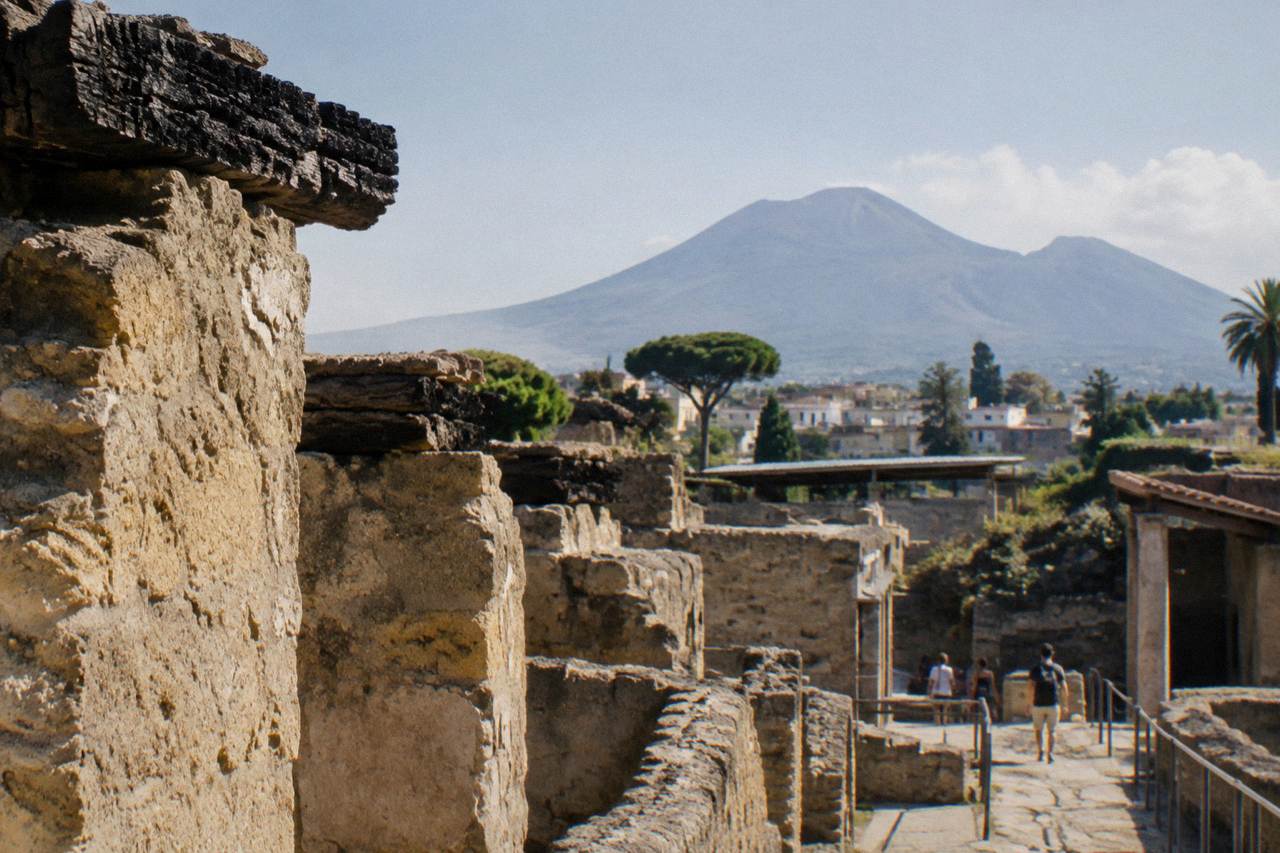
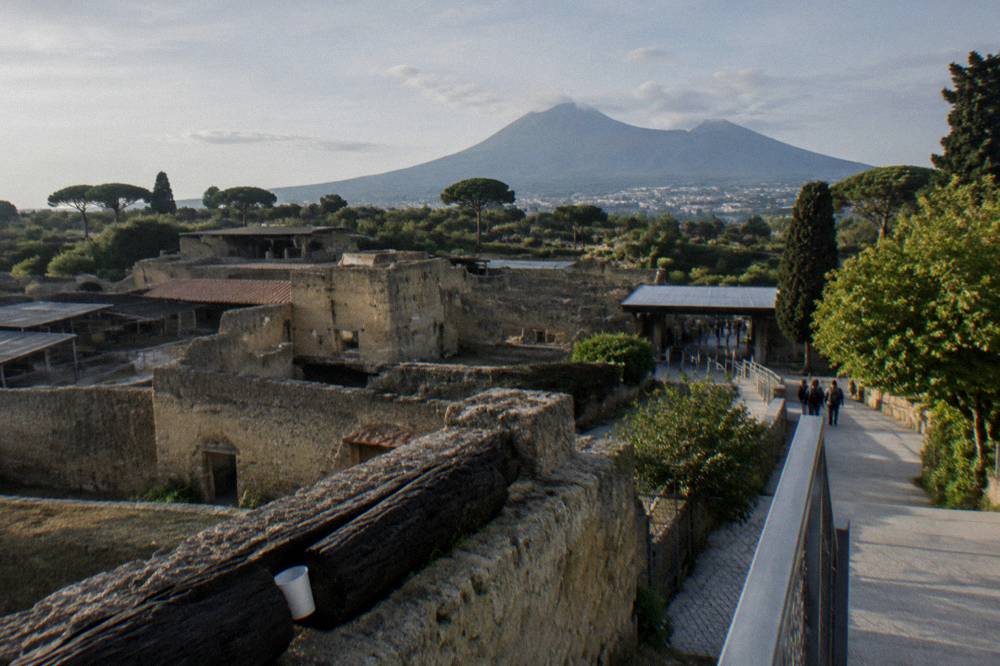
Herculaneum was buried by the same AD 79 eruption that sealed Pompeii, traditionally dated August 24, though a 2018 find points to October. The town lay closer to the volcano, and the surge of superheated material that hit it carbonised wood and preserved upper storeys, door frames and even a wooden roof structure that Pompeii lost entirely. The result is a compact site you can walk end to end in two hours, sitting at the foot of the mountain whose crater trail starts a short drive above Ercolano.
That geography is the whole argument for this pairing. Herculaneum and Vesuvius are the closest ruins-and-crater combination on the mountain: the Circumvesuviana stops at Ercolano Scavi for the excavations, and the trailhead plaza at Quota 1000 lies up the same provincial road above the town. Pompeii works too, and we cover that timing in Pompeii And Vesuvius In One Day, but the Herculaneum route means less driving and a quieter site. If you are still deciding between the two ruins, start with Pompeii Or Vesuvius: Which Should You Pick, then come back here for the pairing plan.
Why Does Herculaneum Pair So Well With Vesuvius?
The two sites sit on the same flank of the volcano, about 20 to 30 minutes apart by road, and they need opposite amounts of time: Herculaneum rewards two to three focused hours, while the Gran Cono crater trail takes 2 hours 30 minutes round trip. Together they fill one full day without the rushed feeling of a three-site itinerary.
Distance is the headline. Pompeii lies on the plain south of Vesuvius; Herculaneum clings to the western slope, directly below the access road that climbs to Quota 1000. A driver covers the transfer in well under half an hour, and several operators run exactly this combination as their standard product. Dedicated Herculaneum-and-Vesuvius listings dominate this corner of the market; the wider three-site category adds Pompeii for travellers with more stamina than schedule.
Scale is the second reason. Pompeii is an entire city, capped at 20,000 visitors a day, and its admission slots between 16 March and 14 October are split 15,000 in the morning window and 5,000 in the afternoon. Herculaneum is a fraction of the size, excavated only in part, and rarely feels crowded in comparison. Walking its single decumanus, the boat sheds facing the modern waterfront and the bath complex takes a morning, not a day.
The pairing also tells one story rather than two. From the crater rim of Vesuvius you look down on the modern towns of the red zone, roughly 700,000 residents across 25 municipalities, and Ercolano is one of them. Standing at the boat sheds where the eruption's victims sheltered, then standing on the volcano that produced the surge, closes a loop in a way few itineraries manage.
What Do Herculaneum And Vesuvius Tickets Cost?
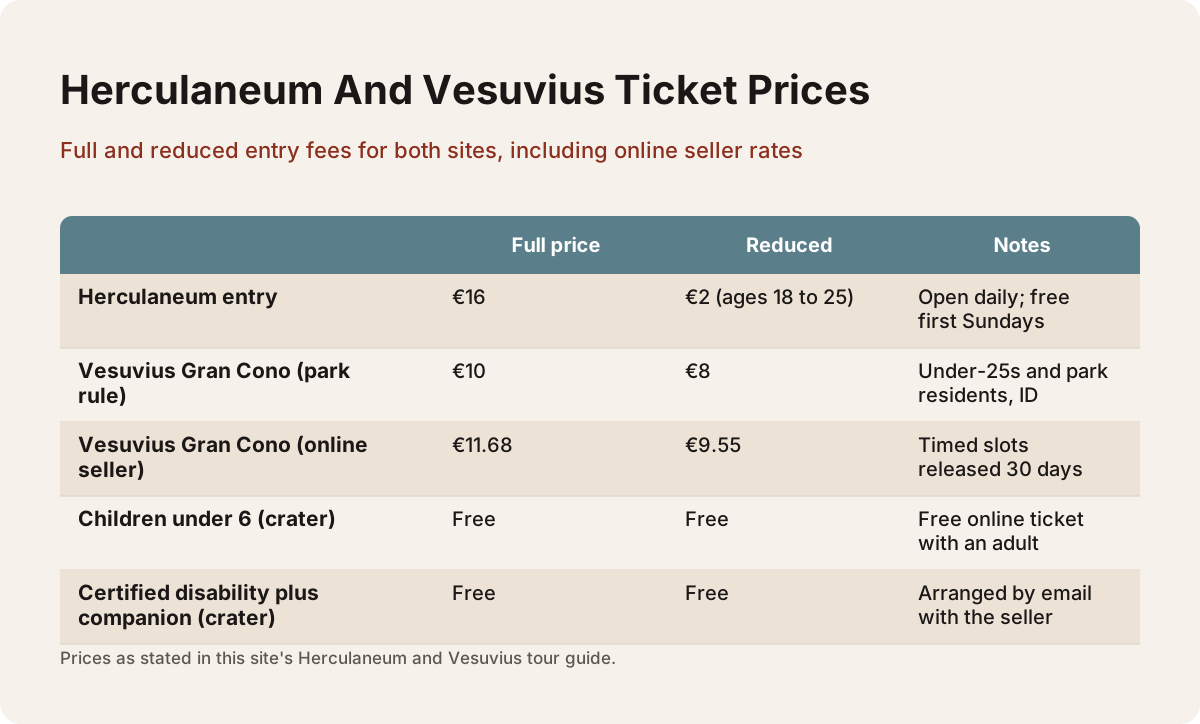
Herculaneum's full ticket is €16, reduced to €2 for visitors aged 18 to 25; Vesuvius Gran Cono entry is €10 under the park's ticketing rules, with the park's authorised online seller showing €11.68. Reduced crater entry of €8 (€9.55 online) applies to under-25s and residents of the 13 park municipalities with ID. Children under 6 walk the crater free with an adult.
Two details do most of the damage to budgets. First, Vesuvius tickets are online-only, sold by timed slot, 50 tickets per 10-minute slot, released 30 days ahead; there is no cash desk to fall back on. Second, a normal crater ticket is valid from 120 minutes before to 120 minutes after the printed slot, within opening hours, which matters when you plan the ruins first and the crater second.
| Item | Full price | Reduced | Notes |
|---|---|---|---|
| Herculaneum entry | €16 | €2 (ages 18 to 25) | Open daily; closed 25 December; free first Sundays |
| Vesuvius Gran Cono (park rule) | €10 | €8 | Under-25s and residents of the 13 park municipalities, ID required |
| Vesuvius Gran Cono (authorised online seller) | €11.68 | €9.55 | Online-only timed slots, released 30 days ahead |
| Children under 6 (crater) | Free | Free | Online free ticket with an adult, ID |
| Certified disability plus companion (crater) | Free | Free | Arranged by email with the seller |
Guided combinations shift the arithmetic because they bundle. The Small-Group Herculaneum & Vesuvius Tour with Pizza Lunch runs from €140 per person for about 7 hours with a meal included, rated 4.0 from 276 reviews; it is this article's featured pick because the small-group format and the lunch slot solve the midday timing problem this pairing creates. A from-Naples guided pairing such as Naples: Mount Vesuvius and Herculaneum Guided Tour, from €101.70 per person and rated 4.3 from 109 reviews, keeps the day lighter on the wallet.
Checking prices on tour listings rather than assuming is worth the habit. Bundle lines change with season and inclusions, and whether a given price includes the park's crater ticket or the Herculaneum entry varies by operator: read the listing's inclusions list before comparing, and treat anything not printed there as check the listing. The same caution applies to cancellation windows, which the featured listings flag as free but which each operator defines in its own terms.
How Should You Time The Two Sites In One Day?
Do Herculaneum in the morning and Vesuvius in the afternoon. The excavations open 8:30 in every season, and two to three hours on site puts you at lunch around 11:30; the crater's afternoon window runs to 16:00 in March and October, 17:00 from April to June and September, and 18:00 in July and August. A crater slot between 13:30 and 15:00 gives comfortable margin for the transfer and the 2 hours 30 climb.
The reason the order matters is closure asymmetry. Herculaneum's last entry is 18:00 in summer (15:30 in winter), but the site needs your longest unhurried block early while shade still covers the excavations, which sit in a deep trench that turns into a sunken oven by mid-afternoon in July and August. The crater trail, by contrast, is best after the morning coach waves descend: park data caps the trail at 360 hikers per hour, 60 every 10 minutes in three groups of 20, and the mid-afternoon slots thin out.
Winter inverts the pressure. From November through February the crater's last access is 15:00, so the volcano must come first, or you compress the ruins badly. The EAV 808 bus up from Pompei illustrates the trap: its final uphill run arrives at Quota 1000 at 15:25, after the winter last entry, so late transport is not a plan. The full mechanics are in our guide to Mount Vesuvius Opening Hours.
A tour solves this scheduling puzzle by fixing it in advance, which is exactly why the guided format sells so well on this route. The operator holds the crater slots, sequences the ruins around them and builds the lunch stop into the middle, so the only thing you time is your own alarm. Independent travellers should still read the season table below before committing to an afternoon plan.
| Season | Crater access | Herculaneum last entry | Suggested order | Day cap, crater |
|---|---|---|---|---|
| July, August | 09:00 to 18:00 | 18:00 | Herculaneum first, crater mid-afternoon | 3,240 |
| April to June, September | 09:00 to 17:00 | 18:00 | Herculaneum first, crater by 14:30 | 2,880 |
| March, October | 09:00 to 16:00 | 18:00 (15:30 from 15 Oct) | Herculaneum first, crater by 14:00 | 2,520 |
| November to February | 09:00 to 15:00 | 15:30 | Crater first, Herculaneum after | 2,160 |
Weather closes the crater faster than it closes anything else, and the rule is automatic: the ticket office and the trail close on any day with an orange weather alert or higher from the regional civil protection authority, with automatic refunds for slots inside a closure. Slots adjacent to a closure are refundable on request within 30 days, and refunds are processed within 60 days. Build one flexible hour into the afternoon, and check the live forecast before you leave the hotel.
Can You Do Herculaneum And Vesuvius On Your Own Without A Tour?
Yes, and the pairing is one of the easier DIY combinations on the mountain. Take the Circumvesuviana from Napoli Centrale toward Sorrento or Poggiomarino-Via Pompei and get off at Ercolano Scavi; from the excavations, taxis and private shuttles run up to the trailhead. Drivers follow the A3 to the Torre del Greco exit, then SP144 to the Quota 800 car park, then walk 1.8 km to Quota 1000 or take the €1 shuttle.
The parking picture deserves its own paragraph. The Quota 1000 plaza itself allows no parking, and it has no public toilets at present; the municipal parking along the provincial road, run by the Comune di Ercolano, allows a maximum stay of 4 hours, with cars up to 8 seats paying €7. The park's own advice is to secure the crater ticket first and only then pay for parking, which is the correct order of operations for a DIY day.
Crater tickets must be bought online in advance, full stop. If your slot sells out, a last-minute release of 10 tickets per slot opens 30 minutes before the slot, buyable only via the wifi near the entrance, with a maximum of 5 per email address and names on the tickets matching ID; 20 percent of daily tickets are held back for this. It works, but it is a gamble on a day built around two fixed sites.
The honest trade-off is interpretation. Herculaneum's houses, with their carbonised doors and vivid mosaics, reward a guide far more than a photogenic stroll suggests, and on the crater every visitor above 1,000 m is accompanied by the park's volcanological guides as a mandatory service, but that accompaniment is about supervision and brief commentary, not a two-hour lecture. The short version is that a guided pairing buys logistics and context, while DIY buys flexibility and a lower bill. Readers wondering whether a guided version of this exact day exists from Naples will find the answer in Can I Take A Guided Tour From Naples To Vesuvius And Pompeii?.
Which Tours Combine Herculaneum And Vesuvius Best?
Three formats cover almost everyone: a small-group minivan day with lunch, from €140 per person, rating 4.0 from 276 reviews; a straight guided pairing from Naples, from €101.70 per person, rating 4.3 from 109 reviews; and a private archaeologist-led version with a winery stop, from €890 per group, rating 5.0 from 97 reviews. All three flag free cancellation on the listing.
The small-group pizza-lunch tour earns its place through pacing. Seven hours is the realistic length of this pairing, and building lunch into the middle prevents the classic mistake of a 14:00 crater slot on an empty stomach. Guest reviews of comparable Herculaneum-and-crater days consistently praise exactly this: Jody S., reviewing a three-site day, wrote "We had a good hike to the crater of Mt. Vesuvius with a beautiful view of Naples, the crater, the country side, Sorrento and Capri." One caution on proof: the small-pool listings in this category carry review counts in the dozens, so treat their averages as a small sample rather than a verdict.
Private versions change the experience more here than at Pompeii, because Herculaneum's preserved interiors reward a slower, question-driven walk. The private three-site tour from A Drive Into The Blue, from €265 per group and rated 5.0 from 309 reviews, and the Pompeii, Herculaneum and Winery day with an archaeologist, from €890 per group and rated 5.0 from 97 reviews, sit at the top of that range. Jessica E.'s review of the first captures the appeal: "Antonino was awesome! He was very knowledgeable about each location on the tour and made sure we had plenty of time to fully see what we wanted."
Between the poles, the shared-vehicle options cover the middle of the market. Around Vesuvio's three-site day, from €112.50 per person, rated 4.1 from 1,098 reviews, and Di Sarno's hotel-pickup three-site trip, from €120 per person, rated 4.6 from 588 reviews, both add Pompeii to the pair; they belong on your shortlist only if you genuinely want all three sites, which is a long day. In the two-site bracket, the From Ercolano roundtrip bus with park entry, from €36 per person, rated 4.2 from 1,308 reviews, is the budget floor for a transfer-plus-ticket solution on this side of the mountain.
What Will You Actually See At Each Site?
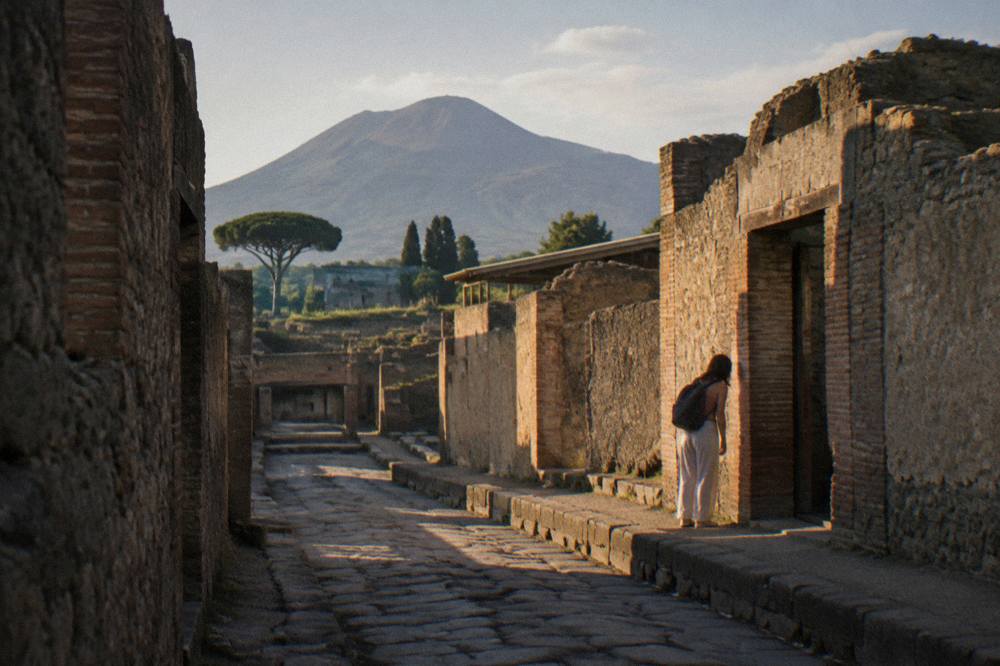
At Herculaneum: carbonised wooden doors and window frames, two-storey houses with intact upper floors, vivid mosaics and frescoes, the bath complex, and the boat sheds where skeletons of sheltering residents were found. At Vesuvius: the Gran Cono trail, 4,010 m round trip to a turnaround at 1,170 m, the elliptical crater up to 580 m across with fumaroles on its inner walls, and the panorama across the Bay of Naples.
Herculaneum's preservation is the point. Where Pompeii gives scale, Herculaneum gives intimacy: you stand in doorways whose wooden lintels survived, look up at storeys Pompeii lost, and read the site in an hour and a half of unhurried walking. Note one standing rule if your heart is set on specifics: Villa dei Papiri and the Ancient Theatre are closed until further notice, so the visit concentrates on the town houses and the waterfront complex.
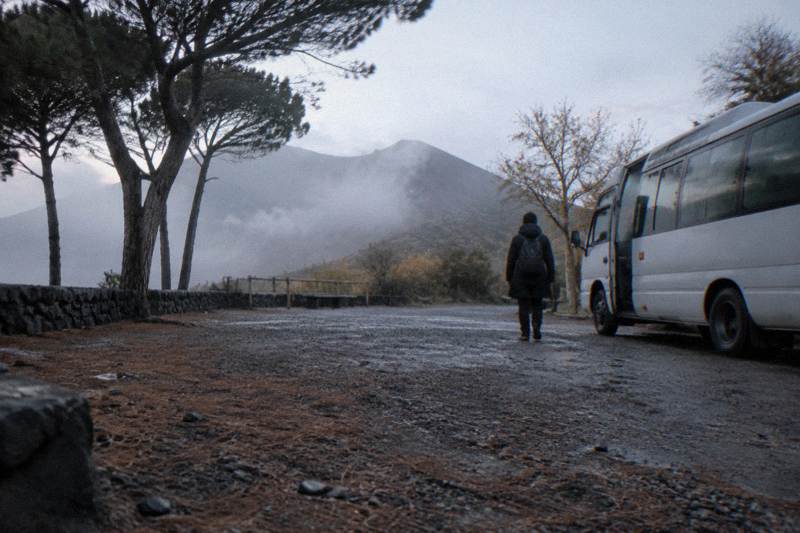
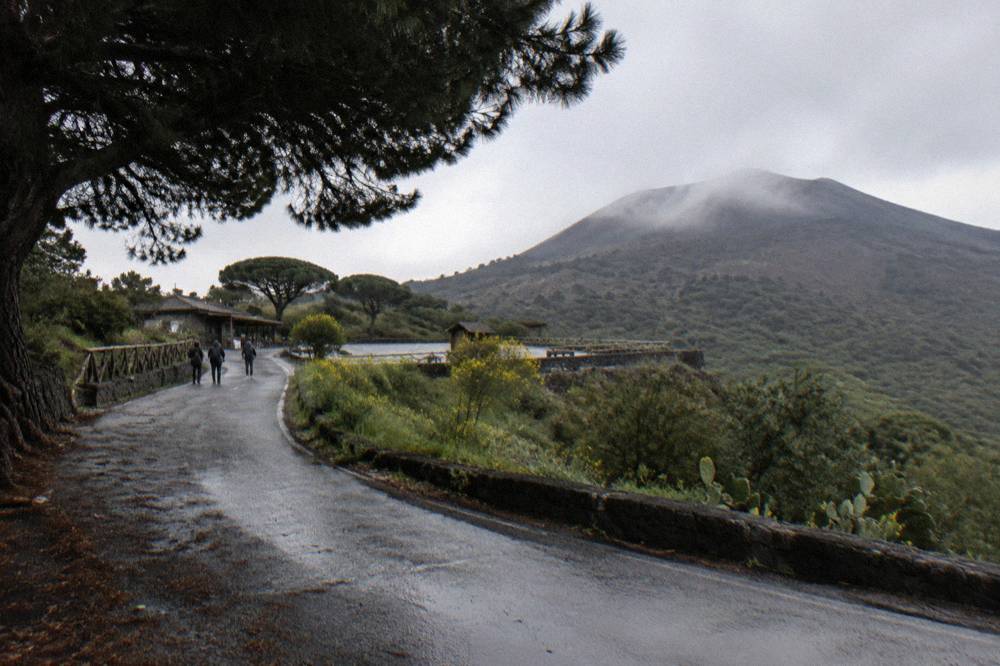
The crater walk is shorter than most visitors expect and rougher underfoot than they plan for. Official difficulty is rated low, and the trail is out and back from the Quota 1000 plaza with a ticket hut at 1,118 m, but the surface is loose volcanic gravel on the descent, and summit temperatures run about 6 to 7 C below Naples year round, so a layer and proper shoes matter even in summer. Sturdy trainers are the stated minimum in guest feedback; sandals are not.
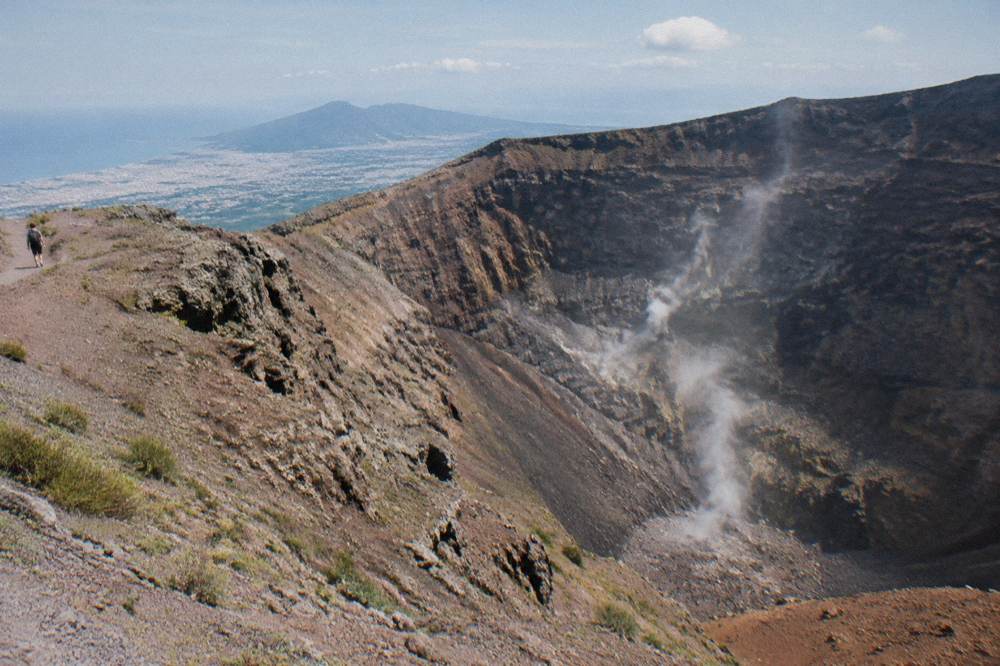
Is the volcano itself a live threat while you stand on it? The alert level is published as green, with monitoring within base values, and the September 2026 observatory bulletin recorded 121 small earthquakes, maximum magnitude 1.7, alongside a long-term decline in hydrothermal activity in the crater. The last eruption was March 1944. The short answer is that a visit is a walk on a closely monitored, currently quiet volcano.
How Hard Is The Combined Day, Really?
Count the walking honestly: two to three hours on flat stone at Herculaneum, plus a 4,010 m round-trip crater walk rated low difficulty but climbed on gravel to 1,170 m, plus standing time at lunch and transfers. Most reasonably fit adults manage it, but it is a big-mileage day with sun exposure, and visitors with knee trouble or limited mobility feel the crater descent. Older children handle it.
Two specific friction points recur in guest reviews. First, footwear: a reviewer on a combined Naples day trip, Millie from the United Kingdom, flagged "very uneven surfaces and very hot in summer so trainers and water bottles." Second, heat in the trench: Herculaneum sits below modern street level, and the excavated hollow holds still air; summer afternoons there are hotter than the crater rim despite the altitude difference.
Mitigation is scheduling, not fitness. The morning-first order gives you the excavations before peak heat and the crater in the cooler afternoon, and the modelled climate data supports it: summit-level highs run about 6 to 7 C below Naples every month, so the afternoon crater segment is the gentler half of the day in July and August even before the wind on the rim is counted. The turnaround at 1,170 m is not reachable by vehicle, so anyone with genuine mobility limits should weigh the climb carefully before committing.
When Is The Best Month For This Pairing?
Aim for April, May, June, September, or October: crater access runs to 16:00 or 17:00, summit highs sit between 11 and 19 C in the shoulder months, and rain days drop to 5 to 11 versus November's 13.6. July and August offer the longest access window, to 18:00, but Naples highs climb to 28.6 and 29.3 C, while winter closes the crater at 15:00.
The modelled 1991-2020 climate average puts the numbers in context. October, at a summit high of 14.8 C and 129 mm of rain over 10.5 days, is a month of trade-offs: mild walking temperatures, but the shortened 16:00 crater window. May is arguably the ideal pairing month, with 15.1 C summit highs, only 59 mm of rain across 8 days, and a 17:00 window that forgives a long lunch. The month-by-month breakdown lives in Best Time To Visit Vesuvius.
| Month | Summit high/low C | Rain mm (days) | Crater last access | Verdict for the pairing |
|---|---|---|---|---|
| April | 11.1/3.8 | 87 (11.1) | 17:00 | Comfortable, green slopes |
| May | 15.1/7.5 | 59 (8.0) | 17:00 | Best overall balance |
| July | 22.1/14.5 | 16 (3.3) | 18:00 | Widest window, peak heat below |
| September | 18.7/12.0 | 90 (8.7) | 17:00 | Warm sea views, thinner crowds |
| October | 14.8/8.5 | 129 (10.5) | 16:00 | Mild, but tighter afternoon |
| November | 10.4/4.9 | 180 (13.6) | 15:00 | Wettest; crater-first only |
Seasonal data is modelled climate average, not a forecast; check the live picture the week you travel. Tour schedules across the roster are bookable for future dates, so confirm the operator's current schedule on the listing before locking non-refundable accommodation around it. The EAV bus 808 timetable in force from 1 October 2026 is another moving piece worth re-checking if you plan to use it.
Herculaneum And Vesuvius, Or All Three Sites With Pompeii?
Add Pompeii only if you have the stamina for a 7.5 to 9 hour touring day and accept that each site gets a shallow pass. The pairing described here is the better first visit for most travellers: two sites, one narrative, a genuine lunch. Travellers who want all three should pick a dedicated three-site product, because Pompeii alone justifies a 2 hour guided minimum.
The arithmetic is unforgiving. Herculaneum at two to three hours, a crater slot with climb and descent at three hours including transfer, and Pompeii at two to three hours minimum adds to a day with no slack, no weather buffer and a late crater descent. The roster's three-site options, from €112.50 to €120 per person, exist precisely because the logistics defeat most DIY attempts. Jody S.'s three-site review above is the happy case; the more common outcome at pace is ruins fatigue by 15:00.
If Pompeii is the must-see and the volcano is the maybe, flip the decision instead of stacking it. The classic pairing in that case pairs the bigger city with the crater, and the choice logic in Pompeii Or Vesuvius: Which Should You Pick applies directly. What the three-site day genuinely offers is efficiency for a once-in-a-lifetime visitor with one free day; what it costs is the slow hour in a Herculaneum house that makes this pairing special.
Common Questions About Herculaneum And Vesuvius Tours
Can you visit Herculaneum and Vesuvius in one day?
Yes, comfortably. Herculaneum needs two to three hours and the Gran Cono crater trail takes 2 hours 30 minutes round trip plus transfer time of roughly half an hour between the sites. Book a crater slot between 13:30 and 15:00, do the ruins in the morning, and the day fits without rushing.
How much do Herculaneum and Vesuvius tickets cost together?
Herculaneum is €16 full price, €2 for visitors aged 18 to 25. The Vesuvius crater ticket is €10 under the park's ticketing rules, with the authorised online seller showing €11.68. Two adults therefore pay about €56 in base tickets, before transport, guiding or lunch.
Should you do Herculaneum or Vesuvius first?
Herculaneum first, from April through October, because the crater's afternoon access window stays open to 16:00 or later and the excavations are cooler in the morning. From November to February the crater closes at 15:00, so climb Vesuvius first and visit the ruins afterwards.
Is Herculaneum better than Pompeii?
They are different rather than better. Herculaneum is far smaller, far quieter and better preserved, with carbonised wood and intact upper storeys; Pompeii is an entire city with amphitheatres, villas and scale. If you prefer intimacy and preservation, choose Herculaneum; if you want spectacle and size, choose Pompeii.
Do you need a guided tour for Herculaneum and Vesuvius?
Not strictly, since crater entry already includes mandatory accompaniment by the park's volcanological guides above 1,000 m. But a tour removes the transfer, the timed-slot booking and the parking decisions, and Herculaneum's interiors reward expert commentary. Small-group pairings with lunch start around €140 per person.
What is the best month to combine Herculaneum and Vesuvius?
May and September. Summit daytime highs run 15 to 19 C, rain days fall to 8 or 9 a month, and crater access stays open to 17:00, which forgives a relaxed morning at the ruins and a proper lunch before the climb.
The pairing holds up across seasons, budgets and fitness levels, which is why it anchors this corner of Mount Vesuvius Tours. Pick the month, book the crater slot the day the 30-day window opens, and let the smaller city tell you what the big one lost.