Mount Vesuvius Opening Hours By Season
Vesuvius does not have one opening time. The crater trail changes its last-access hour four times a year, sells out by time slot, and closes automatically on orange weather alerts. Here is the full window, month by month, and how to fit a tour inside it.
Short answer
Crater access runs 09:00 to 15:00 in January, February, November and December, to 16:00 in March and October, to 17:00 from April to June and in September, and to 18:00 in July and August. The closing time is last access, and the visit must end within one hour of it. Tickets are online only, by 10-minute time slot.
The Gran Cono crater trail at Vesuvius runs on a shifting clock. Access opens at 09:00 every day of the year, but the hour at which the park stops letting people onto the path changes four times across the seasons, and the daily cap on visitors changes with it. Add online-only, time-slotted tickets and an automatic closure rule tied to regional weather alerts, and "what time does Vesuvius open" becomes a planning question with several moving parts. This guide lays out the whole window: the crater hours, the last-access rule, the caps, the archaeology sites' clocks at Pompeii and Herculaneum, the last transport down, and how commercial tours fit inside the day.
What Are The Opening Hours For The Mount Vesuvius Crater Trail?
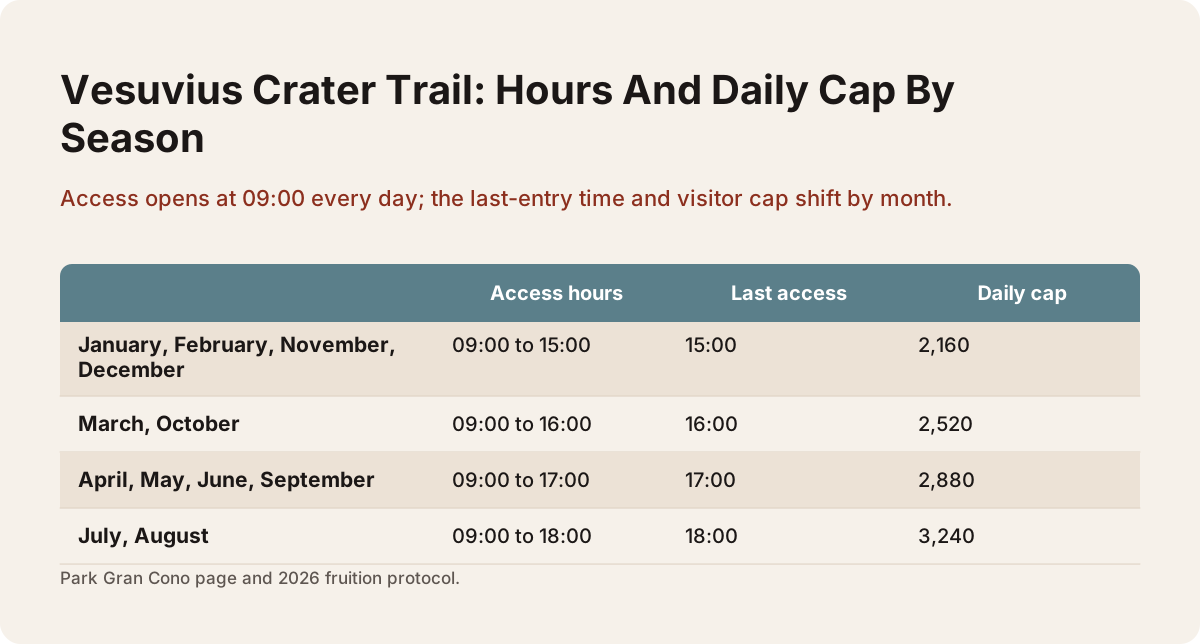
The crater trail opens at 09:00 every day and stops admitting visitors at 15:00 in January, February, November and December, at 16:00 in March and October, at 17:00 in April, May, June and September, and at 18:00 in July and August. The daily cap moves with the seasons: 2,160 visitors in the winter months, 2,520 in March and October, 2,880 in spring and September, and 3,240 in July and August.
Those hours come straight from the park's own Gran Cono page, which publishes the access timetable alongside the visitor-cap rules set out in the park's 2026 fruition protocol. There is no day of the week when the trail closes early, and no weekly closing day applies to the crater. The variable is the month, and the table below is the one to plan around.
| Months | Crater access hours | Last access | Daily visitor cap |
|---|---|---|---|
| January, February, November, December | 09:00 to 15:00 | 15:00 | 2,160 |
| March, October | 09:00 to 16:00 | 16:00 | 2,520 |
| April, May, June, September | 09:00 to 17:00 | 17:00 | 2,880 |
| July, August | 09:00 to 18:00 | 18:00 | 3,240 |
Two details in that table deserve emphasis. First, the closing time is a last-access time, not a closing time in the museum sense: nobody is marched off the path at 15:00 in January, but nobody new starts up after it. Second, the caps are real and enforced through the ticketing system, which releases a fixed number of slots per day and stops when the cap is reached. A full breakdown of the ticket system itself is in Mount Vesuvius Tickets: What You Buy And Where; here the focus is the clock.
The park publishes the hours and the accompaniment rule on its official Gran Cono page, which is also where any seasonal adjustment would appear first. If your trip straddles a month boundary, say late March into early April, plan for the earlier month's hours and treat the extra hour as a bonus.
What Does Last Access Actually Mean On The Vesuvius Crater Trail?
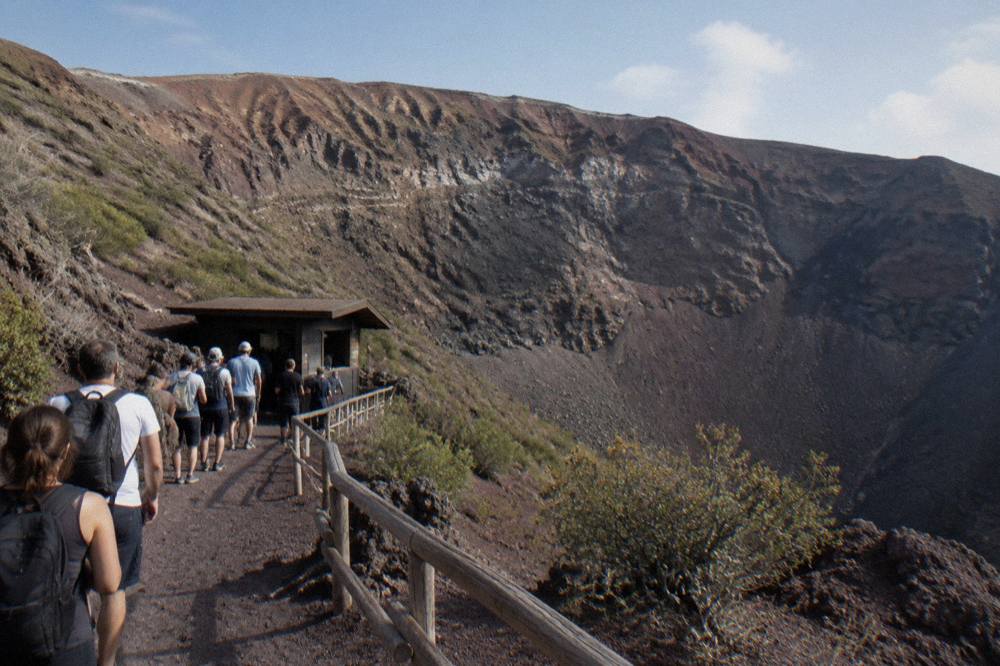
Last access is the latest moment you may pass the ticket hut and start the walk, and the park requires the visit to end within one hour after it. In January that means starting by 15:00 and being back through the gate by 16:00. The rule keeps everyone off the path in daylight, since the trail is unlit and the descent crosses loose volcanic ash that is slow going even in good conditions.
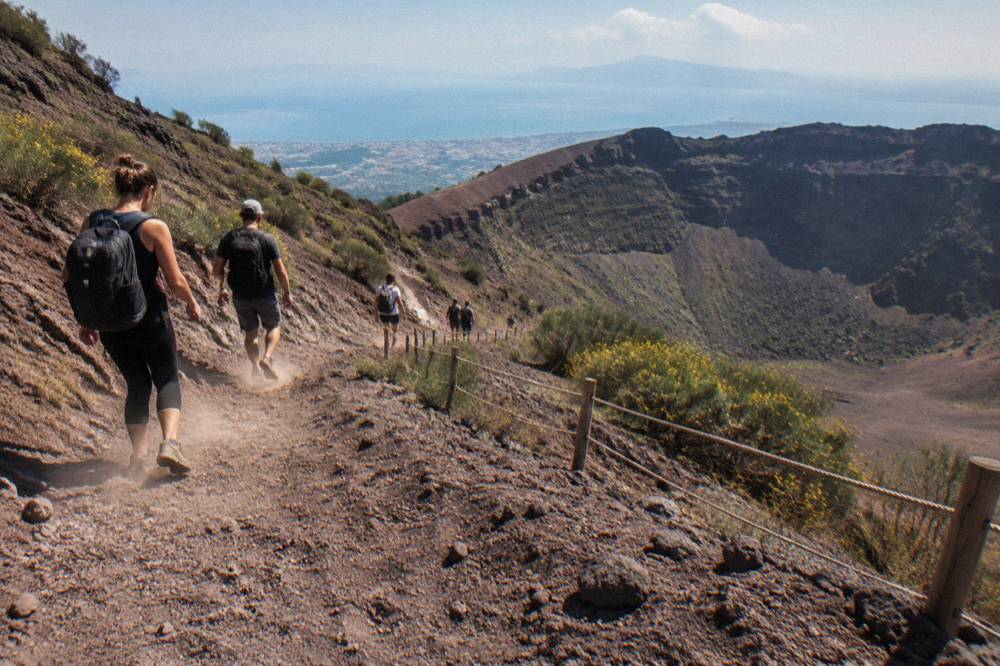
The trail itself is short: 4,010 metres round trip, about two and a half hours at a normal pace, with the ticket hut at 1,118 metres and the turnaround at 1,170 metres. The park rates the difficulty low, but the surface is soft ash and the return trip is downhill on the same material. An hour of margin after last access is what the protocol allows for the slowest visitor to get down.
There is a second timing rule that matters just as much and is less well known. A normal pre-purchased ticket is valid from 120 minutes before to 120 minutes after the printed slot, within opening hours. So a 12:00 slot can be used from 10:00 to 14:00, as long as the last-access time for the month has not passed. That flexibility is generous, but it collapses in the last two hours of the day: a 16:40 slot in March is worthless, because last access is 16:00.
Last-minute tickets work differently. When a day sells out, the system releases 10 extra tickets per 10-minute slot, 30 minutes before the slot, buyable only over the wifi near the entrance, with a maximum of 5 per email address. Those tickets are named, so the name on the ticket must match your ID. Their entry window is narrower: 30 minutes before to 15 minutes after the printed time. If your whole plan depends on a last-minute ticket late in the day, you are stacking two risks, and the honest answer is to book ahead, a question covered in detail in Do You Need To Book Vesuvius In Advance?.
For travellers who would rather not calculate any of this, a transfer-and-ticket product removes the slot arithmetic entirely. The Vesovius Easy Tour from Naples or Pompeii bundles the crater entry with the transfer from €35.10 per person, runs 3 to 4 hours, and flags free cancellation on the listing; the operator times the arrival to the access window so the last-access rule is handled before you ever see it.
How Do Daily Ticket Caps Change When You Should Arrive?
The park sells crater tickets only online, in 10-minute time slots of 50 tickets each, released 30 days ahead. When a day's allocation is gone, the only recourse is the last-minute release of 10 tickets per slot, 30 minutes before each slot, at the entrance itself. In July and August the cap is 3,240, and in peak weeks the popular late-morning slots are the first to disappear.
The practical consequence is that the opening hours are only half the story. The other half is which slot inside those hours you can actually buy. Morning slots after 09:00 and the early afternoon slots carry the most demand, because they fit both cruise schedules and the Pompeii-plus-Vesuvius day trip that most visitors build. The 09:00 opening itself is often the calmest hour on the path, and the summit climate table later in this guide explains why the morning is also the more comfortable walk in summer.
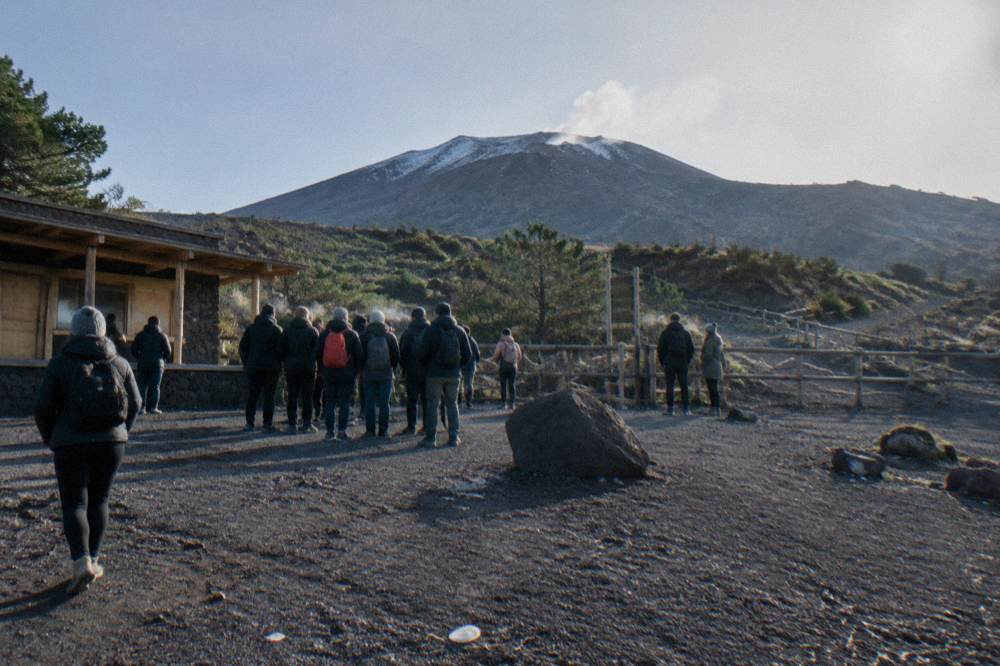
A skip-line ticket product is the low-effort way to lock a slot without watching the calendar. The skip-line ticket with digital guide from operator inStazione starts from €16 per person, runs 2.5 hours to a full day, and carries a 4.2 rating from 3,756 reviews on the listing. Check the listing for what entry is included, since ticket-bundling varies by product.
The cap also interacts with the closure rule, covered further down: when a day closes for weather, everyone holding a slot inside the closure gets an automatic refund, and the adjacent slots become refundable on request. That means a last-minute slot chase on a marginal-weather day can end with nothing to chase. Booking 30 days out, when the slots first appear, remains the only way to choose your hour deliberately.
When Do Pompeii And Herculaneum Open And Close?
Pompeii opens at 9:00 year round, with last entrance at 15:30 and closing at 17:00 from mid-October to mid-March, and last entrance at 17:30 with closing at 19:00 the rest of the year. Herculaneum opens at 8:30 every day, closing at 17:00 in winter and 19:30 in summer. Both close on 25 December, and Pompeii also closes on 1 January.
The two archaeology parks run longer evening hours than the crater in every season, which is why the standard advice is ruins first, volcano second: Pompeii's gate opens before the crater's, and its last entry comes after the crater's last access in every month. A visitor who does the crater in the morning and the ruins in the afternoon loses nothing; the reverse order risks arriving at the trailhead after last access.
| Site | Months | Opens | Last entry | Closes |
|---|---|---|---|---|
| Pompeii | 15 Oct to 15 Mar | 9:00 | 15:30 | 17:00 |
| Pompeii | 16 Mar to 14 Oct | 9:00 | 17:30 | 19:00 |
| Herculaneum | 15 Oct to 15 Mar | 8:30 | 15:30 | 17:00 |
| Herculaneum | 16 Mar to 14 Oct | 8:30 | 18:00 | 19:30 |
Pompeii also caps daily entries at 20,000, with tickets personal and nominative, and both sites admit everyone free on the first Sunday of the month, with direct access and no booking (see Best Month For Pompeii). Those free days are the most crowded days of the month at both parks, and combining a free Sunday at Pompeii with a paid crater slot in the afternoon is a legitimate budget plan, if an early one. The official hours and ticket pages for Pompeii and Herculaneum carry the authoritative versions of these tables.
What Time Does The Last Transport Leave Vesuvius?
The EAV bus 808 from Pompei Piazza Anfiteatro makes nine runs up a day between 08:30 and 14:30, taking 55 minutes, and its last arrival at Quota 1000 is 15:25, after the winter last access of 15:00. The last return down leaves Quota 1000 at 16:50. The municipal shuttle between the Quota 800 car park and Quota 1000 costs €1 each way and takes about four minutes.
That 15:25 arrival is the trap in the timetable. In January, February, November and December, a visitor whose only plan is the last bus up arrives 25 minutes after the park has stopped admitting anyone. Even in March and October, a 15:25 arrival leaves a 35-minute visit, which the one-hour rule makes impossible. Anyone using public bus 808 needs one of the earlier runs, and the full timetable is published by EAV.
| Transport | First up | Last up arrives Quota 1000 | Last down | Notes |
|---|---|---|---|---|
| EAV bus 808 (from Pompei) | 08:30 | 15:25 | 16:50 from Quota 1000 | €3.80 single on board, 55 minutes |
| Municipal shuttle (Quota 800 to Quota 1000) | With opening | Continuous | With closing | €1 each way, about 4 minutes |
| On foot, Quota 800 to Quota 1000 | With opening | With opening | With closing | About 30 minutes, 1.8 km |
The lesson generalises: every do-it-yourself route to the trailhead has a last useful departure that is earlier than the park's last access. Drivers face the same arithmetic from the Quota 800 car park, where the 30-minute walk or the four-minute shuttle has to be added to the access deadline. Commercial transfers sidestep it. The bus transfer with park entry fee from Naples or Pompeii, from €35.10 per person over three hours, is built around the access window, with a 4.3 rating from 1,923 reviews on the listing.
Do Vesuvius Opening Hours Change With The Weather?
Yes, automatically. The ticket office and the trail close on any day when the regional Civil Protection authority issues a weather alert of orange level or higher, with no discretion and no partial opening. Tickets for slots inside a closure are refunded automatically, and slots adjacent to a closure are refundable on request within 30 days, with refunds processed within 60 days.
This is the rule that makes the posted hours a ceiling rather than a guarantee. The park does not publish a closure calendar, because the trigger is the alert level on the day, not the season. What can be said from the climate record is which months carry the most rain: the modelled 1991-2020 climate average for the 1,000-metre level puts November at 180 mm of rain across 13.6 rain days, making it the wettest month on the summit, against 16 mm across 3.3 days in July, the driest.
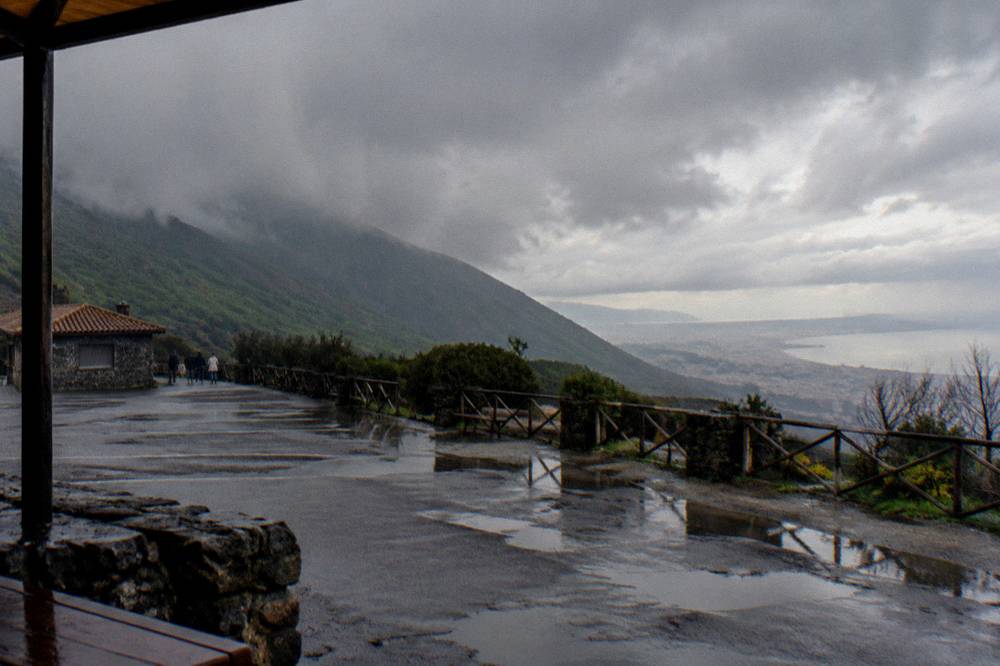
For a visitor, the practical response is threefold. Book a slot in the morning, when an alert issued midday has not yet closed the day. Keep an eye on the regional alert bulletin the day before. And prefer bookable products with free cancellation, which most of the roster flags on the listing, so a closure costs you nothing. The park's own Gran Cono page carries the closure and refund rules verbatim, and the current alert level and monitoring picture are published by the INGV Osservatorio Vesuviano, whose September 2026 bulletin recorded 121 small earthquakes with a maximum magnitude of 1.7 at alert level green.
Which Hours Suit Each Season Best At Mount Vesuvius?
Morning slots win in every season, but for different reasons. In July and August the summit's modelled average high is 22 to 23 C against Naples' 29 C, and the 09:00 opening is the coolest walk of the day. From November to March the last access is 15:00 and sunset falls between about 16:35 and 17:35, so the afternoon offers no light advantage and more closure risk.
The climate figures below are the modelled 1991-2020 climate average for the 1,000-metre level around the trailhead, not a forecast, and they explain the seasonal logic of the timetable. The summit runs roughly 6 to 7 C cooler than Naples in every month, so a day that feels warm at the port can feel wintry at the turnaround point, especially with wind on the exposed ash.
| Month | Crater last access | Summit high/low C | Rain mm (days) | Sunrise/sunset on the 15th |
|---|---|---|---|---|
| January | 15:00 | 5.6 / 0.0 | 119 (11.7) | 07:25 / 16:57 |
| April | 17:00 | 11.1 / 3.8 | 87 (11.1) | 06:25 / 19:40 |
| July | 18:00 | 22.1 / 14.5 | 16 (3.3) | 05:43 / 20:33 |
| October | 16:00 | 14.8 / 8.5 | 129 (10.5) | 07:12 / 18:24 |
October is worth a special note, because it is the month where the two rules collide most often: the last access drops to 16:00 while the rain days climb back to 10.5 a month on the summit. An October plan should treat the morning slot as the default and the 16:00 deadline as hard. The month-by-month picture across the whole year, including the shoulder months not tabled here, is in the site's Mount Vesuvius by month pages.
Can You Visit Vesuvius At Sunrise Or Sunset?
No, not on the crater trail. Access starts at 09:00 in every month and ends between 15:00 and 18:00, while sunset falls between about 16:35 in December and 20:37 at the June solstice, so the park's window always closes before the light does. There is no sunset crater hike in the official system, and no product in this site's tour roster sells one.
This surprises visitors who have seen photographs of the crater at golden hour. Those images exist, but they come from the park's own evening events, from viewpoints on the lower slopes, or from wineries and terraces around the park that operate on their own clocks. The Gran Cono path itself is a daylight, ticketed, guided affair, and the one-hour rule after last access exists partly to keep the descent off the ash in fading light.
The alternatives for an evening with Vesuvius in view are real, just not on the rim. Winery lunches and tastings on the slopes run into the late afternoon, and the organic farm lunch with wine pairing in the national park, from €58 per person over about two and a half hours with a 5.0 rating from 241 reviews, is one of several products that put the volcano in the background rather than underfoot. For the timing of everything that does happen on the mountain, the site's Mount Vesuvius hiking tours hub collects the guided options.
How Do Tour Times Fit Inside The Vesuvius Access Window?
A crater visit needs about three hours door to door: the 30-minute transfer or walk from Quota 800, the two-and-a-half-hour round trip, and margin at the gate. Any tour that also covers Pompeii needs a full day, since Pompeii's own last entry is 15:30 in winter and 17:30 in summer, and the crater's last access comes first in every month.
The roster's timing splits cleanly into three shapes. Half-day volcano products of 3 to 4 hours fit a single morning or a single afternoon, but only if the afternoon starts early enough to clear last access. Full-day Pompeii-and-Vesuvius combos of 7 to 8 hours run the ruins in the morning and the crater after lunch, arriving on the path in the early afternoon, inside the window in every month. And transfer-plus-ticket products of about 3 hours are the minimal option, timed to a slot the operator has already secured.
| Tour shape | Typical duration | Fits the window when | Example from the roster |
|---|---|---|---|
| Volcano half-day | 3.5 to 4 hours | Any start before noon | All-Inclusive Mount Vesuvius Half-Day from Naples, from €44.80 per person |
| Ruins plus volcano, full day | 7 to 8 hours | Always, with morning ruins | Pompeii and Vesuvius Day Trip with Pizza Lunch, from €53.25 per person |
| Transfer plus ticket | About 3 hours | Any slot the operator books | Vesuvius Easy Transfer and Entry Ticket, from €39 per person |
The half-day shape is the one to check against the calendar. The All-Inclusive Mount Vesuvius Half-Day Tour from Naples runs 3.5 to 4 hours with hotel pickup, from €44.80 per person, and carries a 4.5 rating from 891 reviews on the listing. In November that product's afternoon departure cannot reach the trail before 15:00, so its value depends on the month; in July it works at almost any hour of the day. The Vesovius Easy Tour from €35.10 per person sits in the same shape and is the roster's most flexible fit for a tight window.
One further timing note for groups and families: the mandatory volcanological guide accompanies every visitor above 1,000 metres, and the protocol caps a tour at two hours on the shortest route and three on the longest. That is a ceiling on the crater portion of any tour, not a floor, so a listing advertising long crater time is describing the overall day, not the walk. Whether a guided product is worth it over a bare ticket is weighed in Guided Tour Or Self-Guided At Mount Vesuvius, and the ticket-bundled options are gathered under the Vesuvius tickets with tour hub.
A final word on where these hours sit in a wider plan. The site itself, Mount Vesuvius Tours, keeps a season-by-season status picture for the trail, and the closure rule means any day's real window is confirmed only on the day. Book the slot, book the transfer, and treat the printed hours as the boundary of the possible rather than a promise of the actual.
Common Questions About Mount Vesuvius Opening Hours
What are the opening hours for the Mount Vesuvius crater trail?
Access runs from 09:00 to 15:00 in January, February, November and December, to 16:00 in March and October, to 17:00 in April, May, June and September, and to 18:00 in July and August. The closing time is the last moment you may start the walk; the visit must end within one hour of it.
Do Vesuvius opening hours change on weekends or holidays?
No. The crater trail uses the same hours every day of the week, and the park publishes no weekly closing day for the crater. The only standing closures are triggered by orange-level or higher regional weather alerts, which close the ticket office and trail automatically for that day.
What happens if I arrive at Vesuvius after the last access time?
You cannot start the walk. The last-access time is enforced at the ticket hut at 1,118 metres, and the park requires every visit to end within one hour of it. Tickets keep a flexibility window of 120 minutes before to 120 minutes after the printed slot, but never past the day's last access.
When does the last bus leave Mount Vesuvius?
The EAV bus 808 makes its last run down from Quota 1000 at 16:50, reaching Pompei Piazza Anfiteatro at 17:45. Its last run up arrives at 15:25, which is after the winter last access of 15:00, so the last bus up only works in the months with later access hours.
Is Vesuvius open in the evening or at sunset?
The crater trail is not. Access ends between 15:00 and 18:00 depending on the month, always before sunset, and no product in the tour roster sells a sunset crater hike. Evening views of the volcano come from the lower slopes, wineries and viewpoints outside the ticketed trail.
Can Vesuvius close even during the published opening hours?
Yes. An orange-level or higher weather alert from the regional Civil Protection authority closes the ticket office and the trail automatically for the whole day. Slots inside a closure are refunded automatically, and adjacent slots are refundable on request within 30 days, with refunds processed within 60 days.