What To Bring On A Mount Vesuvius Tour
The crater path is a 4,010 metre round trip on loose volcanic ash with no shade, a mandatory park guide above 1,000 metres, and a ticket window that closes the moment the regional weather alert turns orange. What you carry decides whether the day is a walk or an ordeal.
Short answer
Bring two layers even in summer, sturdy closed shoes for the ash trail, more water than you think you need, your passport or ID for reduced and free crater tickets, sunscreen and a hat because the top has no shade, and your printed or digital ticket slot. The park's adult ticket is €10 under its ticketing rules; the authorised online seller shows €11.68, and ID is required for the reduced rate.
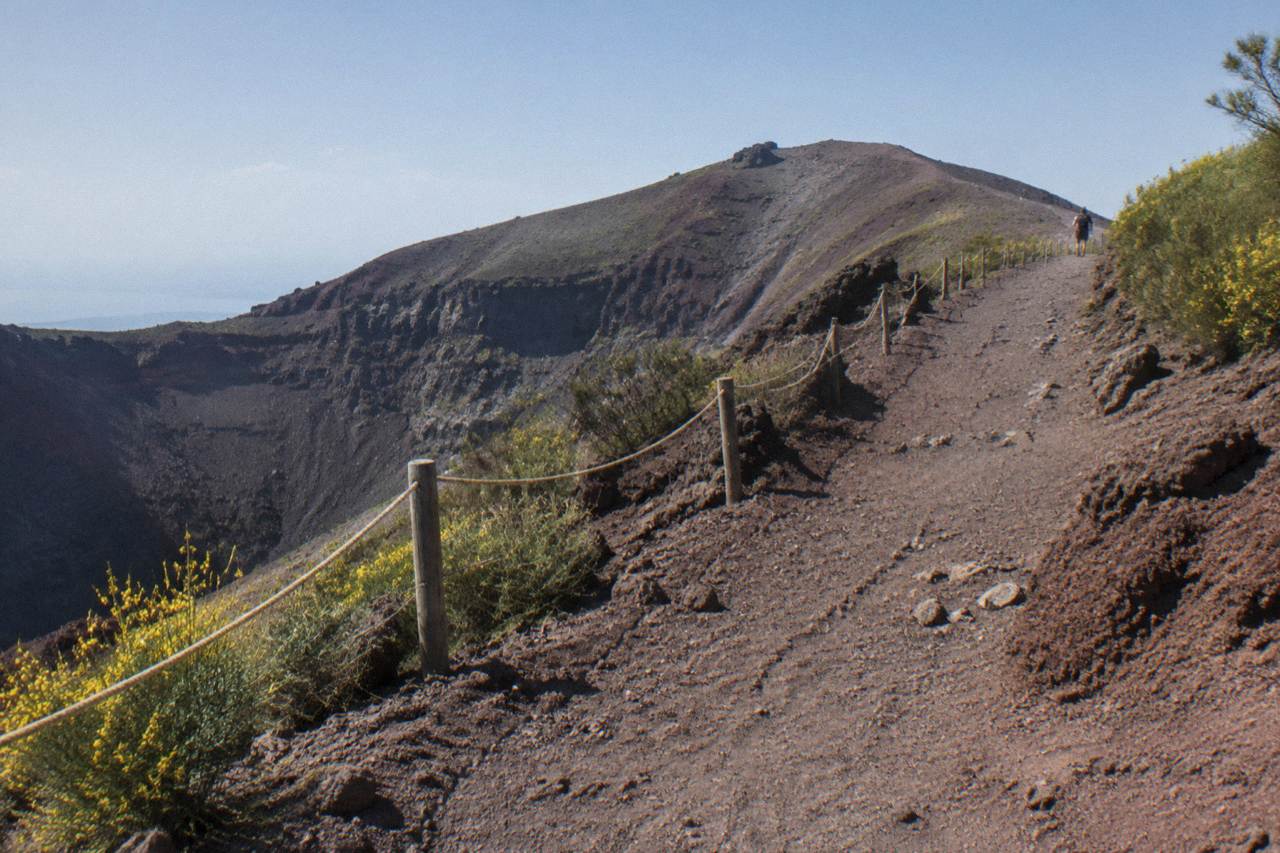
The Gran Cono trail is 4,010 metres round trip, tops out at 1,175 metres and takes about two and a half hours at the park's own pace, on ground the park grades as low difficulty but made of loose volcanic ash and gravel. There is no shade on the upper path, no water fountain at the turnaround, and the summit level runs roughly 6 to 7 degrees Celsius cooler than Naples in every month of the modelled 1991-2020 climate average, often with wind on top of that. Packing for Vesuvius is therefore less about gear and more about a short, blunt list done properly: shoes that grip, water, layers, sun protection and the ID that unlocks your ticket.
This guide walks through that list item by item, season by season, and flags the things people wrongly assume they need, like cash-only payments and hiking boots. It also covers the documents side, because the crater's reduced and free tickets are checked against ID, and the practicalities at the Quota 1000 plaza, where the park states there is no parking and no public toilets "temporarily". If you are still choosing between a guided day and a self-guided transfer, the Mount Vesuvius hiking tours hub compares the formats, and Vesuvius tours from Naples collects the departures most visitors use.
What Should You Actually Pack For The Crater Walk?
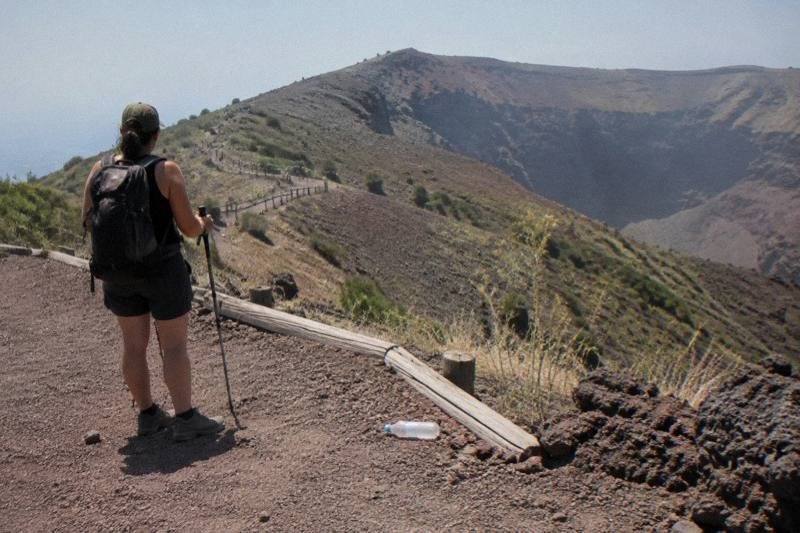
Pack for a short, exposed, dusty walk on loose ground: closed shoes with grip, one to two litres of water per person, a windproof layer, sun protection, your ID and your ticket. Nothing technical is required. The park grades Trail 5 as low difficulty, but the surface is volcanic ash and gravel, the upper path has no shade, and the turnaround sits at 1,170 metres where the wind picks up.
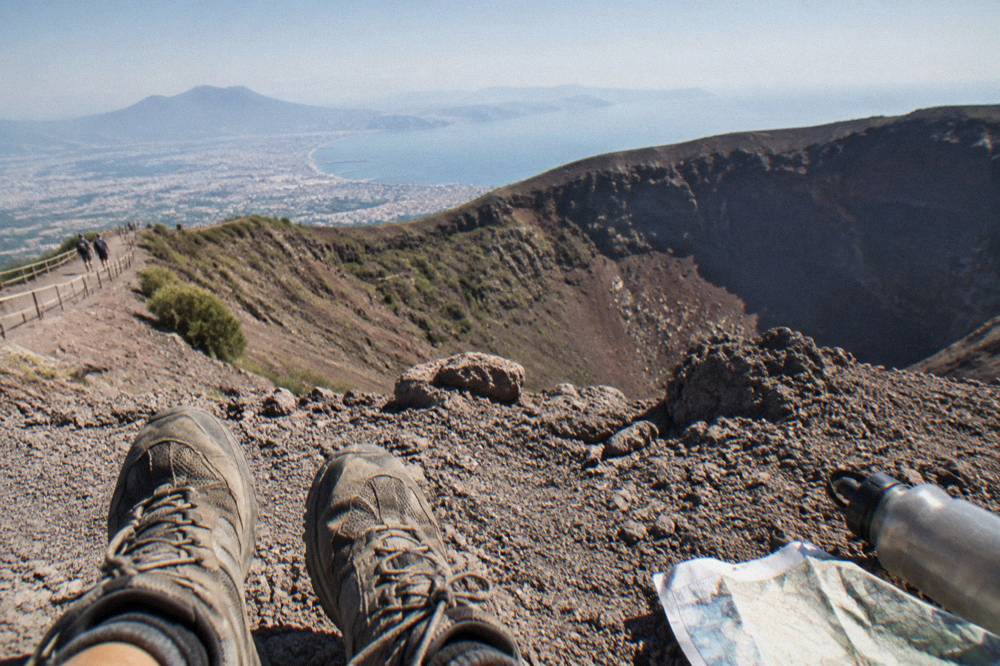
The single most consequential item is footwear. The trail surface is fine, loose ash and scree, and it moves underfoot on the steeper sections. Trainers with a decent tread are genuinely fine, which is not something that can be said of every volcano walk. One guest review of the Naples day tour that climbs Vesuvius after Pompeii puts it plainly: "Very uneven surfaces and very hot in summer so trainers and water bottles." That is Millie from the United Kingdom, and her advice is the packing list in miniature. What fails on this trail is smooth-soled shoes, sandals and anything with no ankle hold, because the ash rolls sideways on the descent.
Water comes next. The walk is two and a half hours in mild conditions, but there is no shade, the reflected heat off the ash is real in summer, and there is nothing to buy at the turnaround. One to two litres per person is a sensible planning range for the crater leg alone; on a full-day tour that adds Pompeii, carry more or plan a refill stop, because the ruins are equally exposed. A review of the same Naples day tour from Melanie from the United States praises the guide's thoroughness but the day still runs seven hours in the sun.
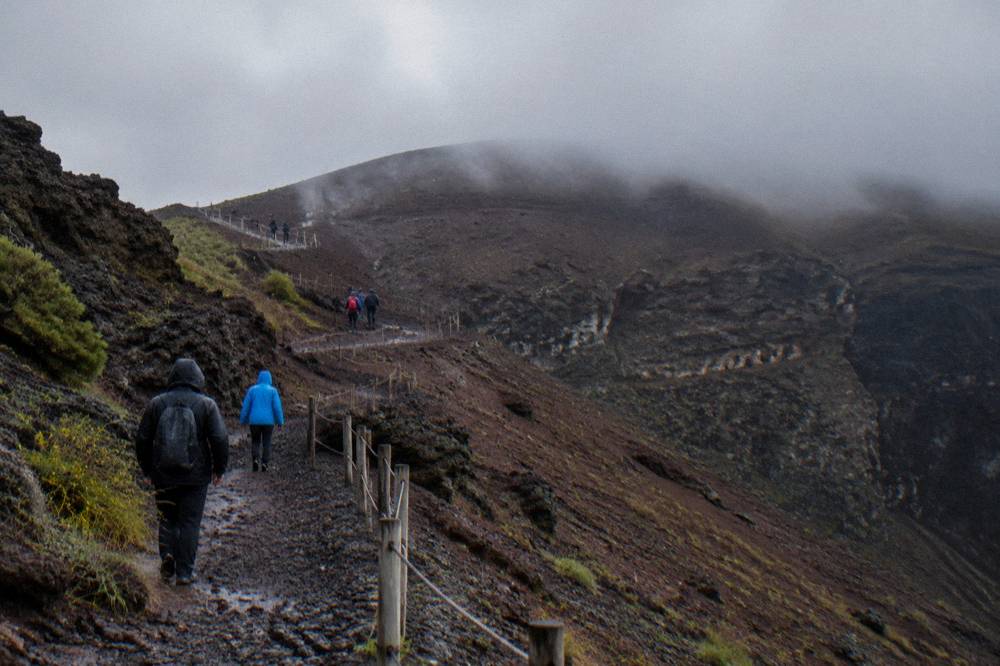
Layers are the item people skip and then regret. The modelled 1991-2020 climate average puts summit-level highs about 6 to 7 degrees Celsius below Naples every single month, and the crater rim is windy even on still days in the valley. A light windproof jacket or fleece that fits in a small daypack covers the gap between the sweaty climb and the photo stop at the top.
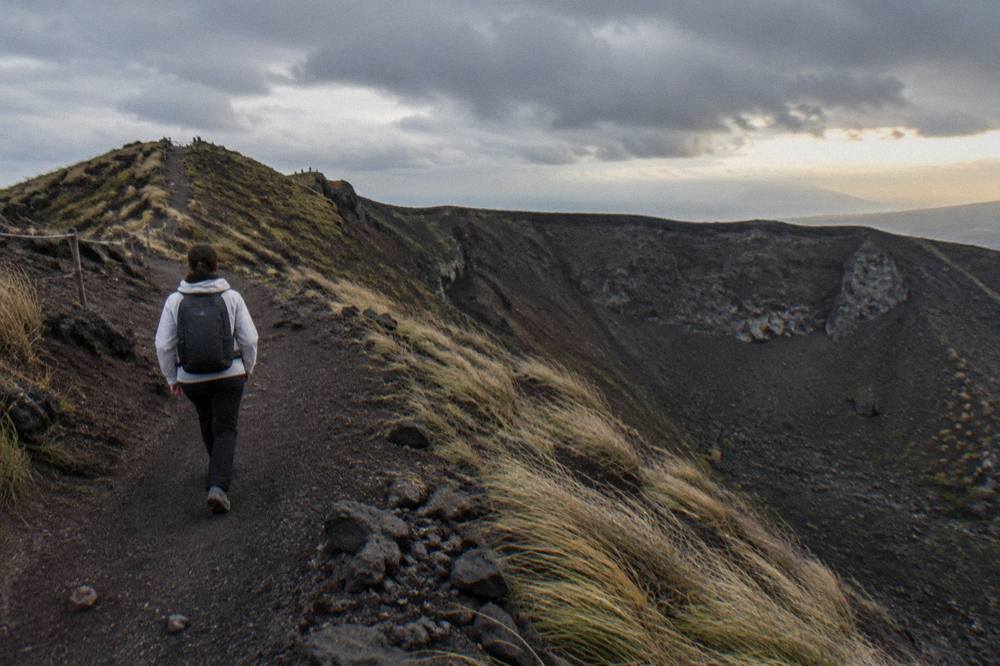
The rest of the core list is small: sunscreen and a hat, because the sun reflects off the ash; sunglasses, same reason; a small daypack rather than a shoulder bag, because both hands stay free on the loose sections; and your documents, covered in full further down. A phone with a full battery matters more than a camera, since the crater photographs well on any modern phone and you will want the live weather and ticket emails to hand.
| Item | Why It Matters On Vesuvius | Planning Note |
|---|---|---|
| Closed shoes with grip | Ash and scree surface shifts underfoot | Trainers with tread are enough; sandals are not |
| Water, 1 to 2 litres per person | No shade, no purchase point at the turnaround | More if the day also includes Pompeii |
| Windproof layer or fleece | Summit runs 6 to 7 C below Naples | Fits in a daypack |
| Sunscreen and hat | Reflected sun off pale ash | Reapply after the climb |
| ID document | Required for reduced and free crater tickets | Passport or national ID card |
| Ticket, printed or on phone | Scanned at the hut at 1,118 m | Valid 120 minutes either side of the slot |
How Much Water And Sun Protection Do You Need On The Volcano?
Plan on one to two litres of water per person for the crater walk alone, more from June to August, plus sunscreen, a hat and sunglasses. The upper path has no shade at all, the ash reflects sunlight back up at you, and the park's own guidance tells visitors to take care in the heat and wear suitable shoes. There is nothing to buy at the turnaround point.
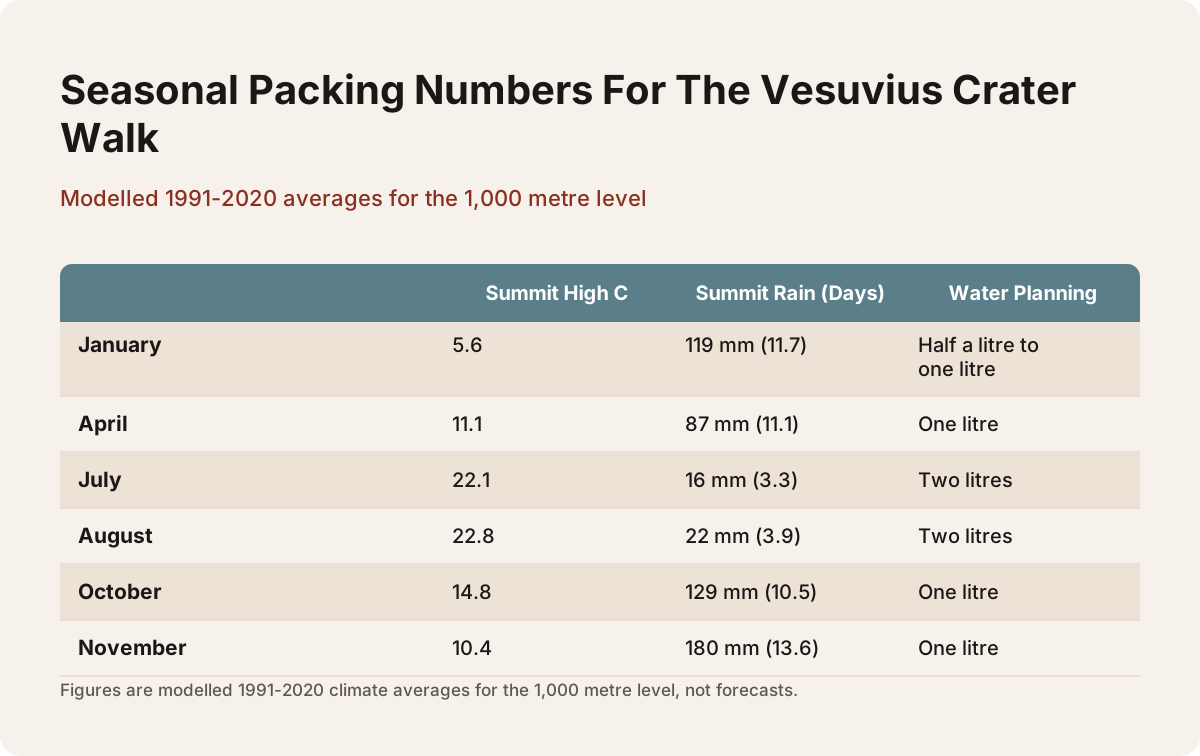
The seasonal numbers explain the range. In the modelled 1991-2020 climate average, the summit-level cell records July highs of 22.1 degrees Celsius and August highs of 22.8, which sounds mild until you remember there is no shade, the walk is a sustained climb for most of it, and the pale ash reflects rather than absorbs the sun. Naples itself averages 28.6 and 29.3 in the same months, and many tours stage the crater leg in the early afternoon, the hottest part of the day. A guest review of the full-day Naples tour that includes both Pompeii and the volcano describes exactly this combination of heat and uneven ground.
In the shoulder months the calculus shifts. April and October summit highs average 11.1 and 14.8 degrees Celsius, and October brings 129 mm of rain across about 10.5 rain days, so the water requirement drops and a light rain shell joins the list. November is the wettest summit month in the dataset at 180 mm, and January and February average highs of 5.6 and 6.0 with nights at or below freezing. Nobody needs two litres of water in February; everybody needs a proper warm layer.
Sun protection deserves its own paragraph because it is the most commonly under-packed category. The crater path climbs a bare slope of grey ash with essentially no vegetation above the treeline, so the ultraviolet exposure is direct and reflected simultaneously. Sunscreen applied at the trailhead, a brimmed hat and sunglasses are the working combination. This is also where a small tube beats a large one: the daypack space on a guided tour is limited, and the walk is short enough that a pocket-size tube covers it.
| Month | Summit Average High C | Summit Rain (Days) | Water Planning | Extra Item |
|---|---|---|---|---|
| January | 5.6 | 119 mm (11.7) | Half a litre to one litre | Warm layer, gloves |
| April | 11.1 | 87 mm (11.1) | One litre | Light rain shell |
| July | 22.1 | 16 mm (3.3) | Two litres | Full sun kit |
| August | 22.8 | 22 mm (3.9) | Two litres | Full sun kit |
| October | 14.8 | 129 mm (10.5) | One litre | Rain shell |
| November | 10.4 | 180 mm (13.6) | One litre | Rain shell, warm layer |
Figures are modelled 1991-2020 climate averages for the 1,000 metre level, not forecasts.
The full-day Naples tour that pairs Pompeii with the crater climb, from €67.20 per person with lunch included and a 4.3 rating across 14,121 reviews, is the format where water planning matters most: it runs 7 to 7.5 hours, the meal is covered, but the two exposed sites are not.
What Shoes And Clothing Work Best On The Ash Trail?
Trainers or light hiking shoes with a grippy tread are the right footwear; the park grades the trail as low difficulty, so boots are optional and sandals are a mistake. Wear layers you can shed, long trousers or leggings are comfortable against blowing ash, and bring a windproof layer for the rim. Clothing matters less than shoes here, but the wrong shoes define the day.
The trail's own statistics frame the decision. It is 4,010 metres round trip with a top altitude of 1,175 metres, officially two and a half hours, difficulty low, starting at the Quota 1000 plaza with the ticket hut at 1,118 metres and the turnaround at 1,170 metres. That is a modest mountain walk, not a hike, and the park's protocol allows a tour no more than two hours on the shortest route and three on the longest. Boots are therefore a preference, not a requirement. What the surface demands is tread: the ash and gravel roll underfoot most on the descent, and smooth soles turn a low-difficulty path into a skid.
Clothing follows the same logic of exposure and wind. Above the treeline the path is bare, so in summer a breathable layer, a hat and sunscreen carry the climb, with a light jacket stuffed in the pack for the rim, where the wind is constant. In the cooler months the same layering runs in reverse: start warm, shed on the climb, put it back on within minutes of reaching the turnaround. Long trousers or leggings are a comfortable choice year-round because the wind can blow fine ash against bare legs.
One clothing note that surprises visitors: the mandatory accompaniment rule means every group above 1,000 metres is accompanied by the park's volcanological guides, who set the pace and keep the group to the right side of the walkway. You do not need to dress for independent mountaineering; you need to dress for a guided walk on loose ground with a wind at the top. The What To Wear Hiking Mount Vesuvius guide expands the clothing side in depth.
If a day of walking on ash sounds less appealing than a day of riding across it, the horse riding option changes the packing list entirely: closed shoes and long trousers still apply, but the two-hour ride from €69 per person, rated 5.0 from 151 reviews, does the climbing for you.
For visitors who prefer the volcano handled end to end, the question is worth asking directly before you pack. A tour that bundles the ruins, the crater and a vineyard meal removes most of the logistics from your bag: entry arrangements and lunch are the operator's problem, and your list shrinks to shoes, water, layers and ID.
Do You Need ID, Cash Or A Printed Ticket On The Day?
Bring your passport or ID card without fail: the crater's reduced ticket and every free ticket are checked against it, and last-minute tickets are nominative, meaning the name on the ticket must match your ID. Cash is not required by any rule we can verify, cards are the norm, and your ticket works printed or on a phone, valid from 120 minutes before to 120 minutes after its printed slot.
The ID requirement is the document most visitors underestimate. The park's adult ticket is €10 under its ticketing rules, and the authorised online seller shows €11.68; the reduced ticket is €8 at the park's rules, €9.55 online, and it applies to under-25s and residents of the 13 park municipalities, with ID explicitly required. Children under 6 enter free with an adult, on a free online ticket, again with ID. If anyone in your group qualifies for either, their ID is not optional; it is the ticket.
The nominative rule extends to last-minute tickets. When a day sells out, the park releases 10 extra tickets per 10-minute slot, 30 minutes before the slot, buyable only via the wifi near the entrance, with a maximum of 5 per email address, and since 11 April 2026 these tickets carry the holder's name. A partner or teenager cannot collect one for you. The full mechanics are covered in Mount Vesuvius Tickets: What You Buy And Where.
On cash: no roster listing and no verified park rule states that anything on Vesuvius is cash-only, so do not build your day around that assumption. Cards are the working norm at the park's own sales channels, and any tour-side purchase, a shuttle seat, a winery lunch, runs through the operator's listing. Where a specific vendor's payment setup matters, check the listing before you go rather than carrying a wad of euros on spec.
The ticket itself is flexible. A normal ticket is valid from 120 minutes before to 120 minutes after the printed slot, within opening hours, so a printed copy or a phone screenshot both work, and a delayed Circumvesuviana train does not void your crater slot. What does void a plan is weather: the ticket office and the path close automatically on any day the regional civil protection authority issues an orange weather alert or higher, with automatic refunds for slots inside a closure. Build a margin into your day and check the forecast the evening before.
| Document Or Item | Required? | Why |
|---|---|---|
| Passport or ID card | Yes, for anyone claiming reduced or free entry | Park checks ID against the ticket category |
| Crater ticket, printed or digital | Yes | Scanned at the hut at 1,118 m; valid 120 minutes either side of slot |
| Cash | Not required by any verified rule | Cards are the norm; check a vendor's listing if unsure |
| Pompeii or Herculaneum ticket | Only if visiting | Pompeii Express is €20, tickets are personal and nominative |
| EHIC or travel insurance card | Recommended | Standard day-trip practice, no Vesuvius-specific rule |
What Should You Bring For Kids Or Less Fit Walkers?
Bring the same core list plus a spare layer for children, snacks, and a realistic plan for the climb: the trail is graded low difficulty but it is still a steady 4,010 metre round trip on ash. Every visitor above 1,000 metres is accompanied by the park's volcanological guides, and the pace is set by the group, so nobody is racing. For genuinely less fit hikers, a transfer-and-ticket product skips the walking approach entirely.
Children under 6 enter the crater free with an adult, which makes the family arithmetic attractive, but the packing list grows: a spare warm layer, because children feel the rim wind faster than adults; more snacks than seem reasonable; and a firm rule on shoes, because the ash is at its most punishing on small feet. The site's dedicated Vesuvius Hike With Kids guide covers the family planning in full. Tour-side, note the age floors on some products: the wine tasting tour from Naples lists a minimum age of 3, and several small-group tours set a minimum age of 6.
For less fit visitors, the honest packing answer is that no item of gear substitutes for the right product. The park's own guidance for the Gran Cono is to take care, check the weather and wear suitable shoes, and the trail's low grade reflects its short length, not a flat profile. The Mount Vesuvius Hike For Less Fit Visitors guide lays out the alternatives, and the practical version is a transfer product such as the direct transfer with guaranteed entry, from €35.10 per person, rated 4.4 from 1,785 reviews, which handles the logistics while you walk only the crater leg itself. A review of that product from Mia from the United Kingdom captures the appeal: "being able to explore and walk up in our own time was amazing!"
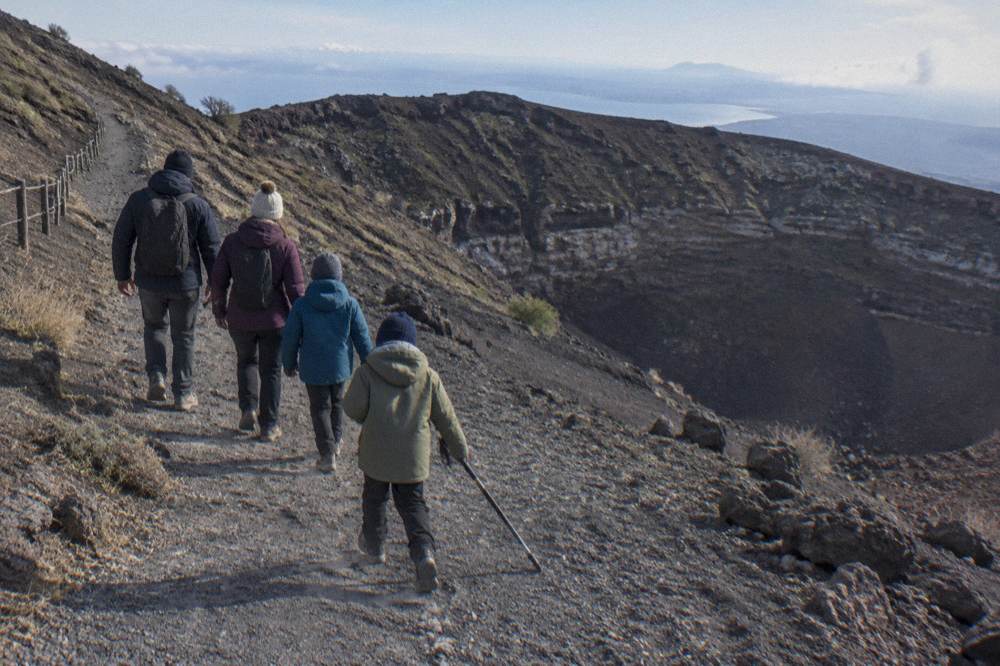
The other comfort item worth naming is time. A normal ticket's 120-minute window either side of the slot, plus the guided pace above 1,000 metres, means the walk itself cannot be rushed and does not need to be. Pack patience with the water and the layers.
What Should You Leave Behind On A Vesuvius Tour?
Leave behind drones, large bags you cannot carry comfortably on loose ground, and anything that assumes shade, shops or toilets at the top: the park states the Quota 1000 plaza has no public toilets "temporarily" and no parking, and the upper rim route is closed to the public. Hiking poles are a matter of taste, not necessity. Nothing on the verified rules bans a specific item beyond the rim closure.
Start with what the park does say. The upper rim route around the crater is interdicted to the public, reserved for researchers, so no packing choice changes where you can walk. The Quota 1000 plaza, where the trail starts, has no parking and no public toilets "temporarily", per the park's own page, which is why the Are There Toilets At Mount Vesuvius? post exists and why the meeting-point logistics matter, covered in Mount Vesuvius Tour Meeting Points And Pickups.
What the park does not say matters too. The verified pages carry no rule on drones, dogs, smoking or bags, so this guide does not invent one; if you need a definitive answer on a specific item, the park's info point is the channel. The general guidance is simply to take care, check the weather and wear suitable shoes.
Practically, the things that weigh a day down on Vesuvius are bulky tripods, hard-sided suitcases (yes, it happens on port days), and anything glass. Shore-excursion visitors are the most exposed to this, because the transfer windows are tight; the site's shore excursion guide covers those timings. A small daypack with the core list beats a wheeled anything on ash.
| Leave It Behind | Why |
|---|---|
| Drones and bulky camera rigs | No verified rule either way, but the rim is closed and the path is busy |
| Wheeled or hard-sided bags | The ash surface and the 1,118 m ticket hut defeat wheels |
| Umbrella | The rim wind makes it useless; pack a rain shell instead |
| Assumption of toilets or shops at the top | The park states no public toilets at Quota 1000 "temporarily", nothing at the turnaround |
| More than a daypack of layers | The walk is 2 h 30; you will carry everything the whole way |
How Does The Season Change What You Pack?
In July and August pack for heat and full sun, two litres of water and a hat; from November to February pack for near-freezing summit nights, gloves and a warm layer; in the shoulder months pack a rain shell, because October and November are the wettest summit months in the modelled 1991-2020 climate average. Crater hours also shift by season, from 09:00 to 18:00 last access in summer to 09:00 to 15:00 in winter.
The season table is the packing list's backbone. Summer summit highs of 22.1 and 22.8 degrees Celsius with only 16 and 22 mm of rain make July and August the sun-protection months, with the widest daily window, last access 18:00. Winter flips it: January and February summit highs of 5.6 and 6.0 with lows at or below zero, and November's 180 mm of rain, make the rain shell and warm layer the load-bearing items, inside a shorter 09:00 to 15:00 access window. The site's Mount Vesuvius in winter and Mount Vesuvius in summer pages carry the month-by-month detail.
The closure rule is the seasonal wildcard no packing list fixes. The ticket office and the path close automatically on any day with an orange regional weather alert or higher, with automatic refunds for slots inside a closure and refunds on request for adjacent slots within 30 days. Alerts are more likely in the wet months, which is one more reason the rain shell earns its pack space from October through March: it is the item that lets a marginal day go ahead if the alert stays yellow.
Can You Skip Packing Food And Let A Tour Feed You?
Yes, if you book a tour with lunch included: the roster carries more than a dozen Vesuvius products with a meal in the price, from pizza lunches at €53.25 per person to vineyard tastings at €127.50 and above. On a lunch-included tour you pack water and layers only, and the meal, often on the volcano's slopes, is the operator's problem.
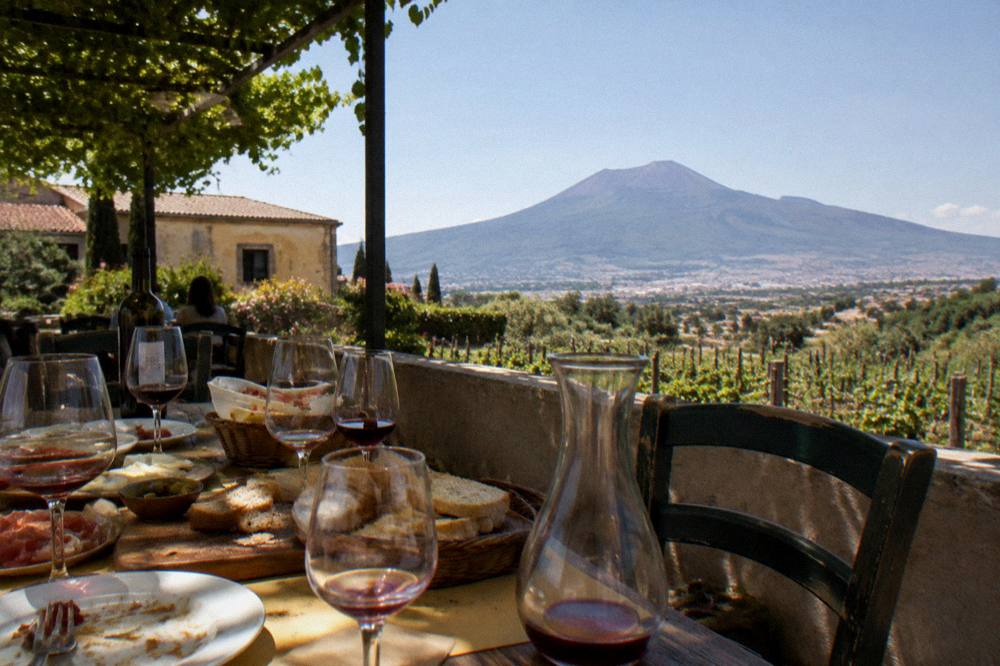
The economics are straightforward. The pizza-lunch day trip from Naples, from €53.25 per person with a 4.8 rating across 9,744 reviews, builds the meal into a 3.5 to 8 hour day, and a review from Dan from the United Kingdom calls it "a great trip for anyone wanting to visit Pompei and Mount Vesuvius in one day". At the top end, the all-inclusive Pompeii and Vesuvius day with lunch and wine tasting from €127.50 per person, rated 4.6 across 2,804 reviews, adds a vineyard stop on the slopes, where the Lacryma Christi DOC is produced across 15 municipalities.
The wine-lunch format is where the packing list shrinks to almost nothing. The featured option on this page, the Pompeii Tour and Vesuvius Wine Tasting with Lunch from Naples, runs 6 hours from €115 per person with pickup, meal and tasting included, rated 4.7 from 518 reviews, and it sits among the site's Mount Vesuvius wine tours. You bring shoes, water, ID and a layer; the operator brings the ruins, the crater logistics and the table. Its listing carries free cancellation flagged, so the decision is low-risk.
The one packing note that survives even a fully catered tour: water and sun protection still belong in your pack, because no lunch covers the two exposed hours on the crater path. And if your day runs through the park independently before or after a tour, remember the park's own transport realities: the EAV 808 bus costs €3.80 on board, the municipal shuttle between Quota 800 and Quota 1000 is €1 each way, and the provincial-road parking run by the Comune di Ercolano caps your stay at 4 hours, so the timing items in your pack matter as much as the warm ones.
For the full picture of who runs what, and which format pairs with which packing list, browse Mount Vesuvius Tours and the season pages before you finalise the bag.
Common Questions About What To Bring On A Mount Vesuvius Tour
Do I need hiking boots for Mount Vesuvius?
No. The park grades Trail 5 as low difficulty, 4,010 metres round trip over about two and a half hours. Trainers with a grippy tread are enough; what fails is smooth soles, sandals and shoes with no ankle hold, because the volcanic ash shifts underfoot, especially on the descent.
How much water should I bring to Vesuvius?
Plan one to two litres per person for the crater walk alone, and two litres in July and August, when summit highs average 22.1 and 22.8 degrees Celsius in the modelled 1991-2020 climate average. There is no shade on the upper path and nothing to buy at the turnaround.
Do I need my passport or ID for the Vesuvius ticket?
Yes, if anyone in your group claims the reduced ticket, €8 under the park's rules and €9.55 online for under-25s and residents of the 13 park municipalities, or the free child ticket for under-6s. ID is explicitly required, and last-minute tickets are nominative, so the name on the ticket must match the ID.
Is there anywhere to buy water or food at the top of Vesuvius?
Not at the turnaround. The path tops out at 1,175 metres with the ticket hut at 1,118 metres and no services beyond, and the park states the Quota 1000 plaza has no public toilets "temporarily". Carry what you need, or book a tour with lunch included.
What should I wear on a Vesuvius tour in summer?
Breathable layers, a hat, sunscreen and a light windproof jacket in a daypack. Summit highs run about 6 to 7 degrees Celsius below Naples every month, and the rim is windy, so the jacket you shed on the climb goes back on at the top.
Can I do the Vesuvius walk in sandals?
You can physically attempt it, but you should not. The surface is loose ash and gravel that rolls underfoot, and the park's own guidance is to wear suitable shoes. Closed shoes with tread are the one genuinely non-negotiable item on the packing list.