Mount Vesuvius For Less Fit Visitors
The official difficulty of the Vesuvius crater trail is low, but low is not the same as easy for everyone. This guide sets out what the walk genuinely demands, which tour formats cut the most effort, and where a slower visitor can rest, turn around, or skip the climb altogether.
Short answer
The Gran Cono crater trail is 4,010 m round trip, rated low difficulty, with about 2 h 30 of walking. Transfer tours remove the road leg, not the trail itself. The lowest-effort options are a bus transfer with entry from €35.10 per person, or a horseback ride on the slopes from €69 per person.
Mount Vesuvius is not a mountain you summit. The public trail ends at 1,175 m, well below the 1,281 m peak measured by INGV, and the park's volcanological guides accompany every visitor above 1,000 m. That distinction matters enormously for anyone planning a visit with limited fitness, because the walk is shorter, flatter at the start, and more supervised than most people expect. It is still a walk, on gravel, uphill, in whatever weather the mountain is serving that day.
The official difficulty rating for Trail 5, the Gran Cono, is low. The park's own infobox describes it as pending, facile e breve, sloping, easy and short. But a low rating on paper can feel different in the legs of a visitor who manages stairs carefully or pauses on inclines. The purpose of this guide is to translate the official numbers into a realistic picture, then match that picture against the tour formats on the market, so the choice reflects what your body can comfortably do rather than what a brochure implies.
Before anything else: nobody on this site can give medical advice. If you have a heart condition, breathing difficulty, joint trouble or any other health concern, ask your doctor before booking a volcano walk. Everything below is logistics, not medicine.
How Hard Is The Vesuvius Crater Walk Really?
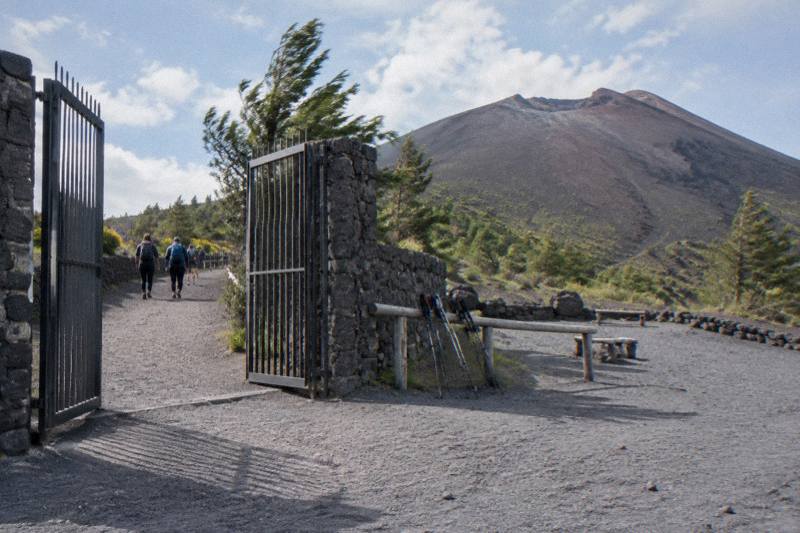
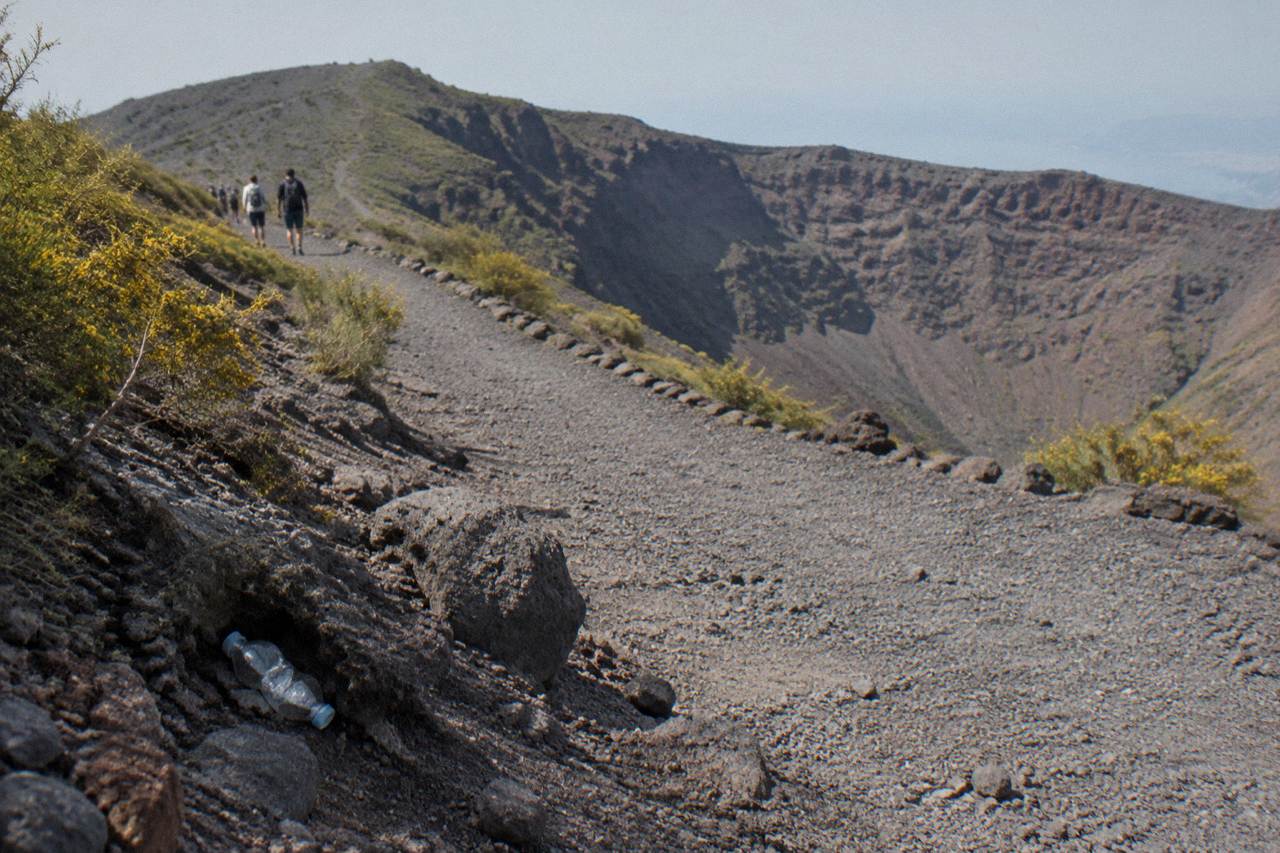
The Gran Cono trail is 4,010 m round trip, takes about 2 h 30 at a normal pace, and is rated low difficulty by the park. The path starts at the Quota 1000 plaza at roughly 1,000 m and climbs to a turnaround at 1,170 m, so the total ascent is modest. The surface is volcanic gravel and loose stone, and the park requires visitors to keep to the right of the walkway.
Those numbers come from the park's official Gran Cono trail page, which is the single best source for what the walk involves. The trailhead sits at the Quota 1000 plaza; the ticket hut is at 1,118 m and the turnaround point, a spot the park calls the Capannuccia, is at 1,170 m. In plain terms: you climb gently from the ticket check to the viewpoint, spread over roughly half the trail going up.
Two things surprise first-time visitors. First, the ascent is steady rather than steep, a long sloping shoulder of a path rather than a staircase. Second, the descent is where most people feel it: loose gravel is unforgiving on knees and ankles, and the same low-difficulty path that felt manageable upward becomes a balance exercise coming down. A walking pole or a companion's arm helps more on the way back than on the way up.
The park's protocol also caps how long a guided excursion may spend on the trail: no more than 2 hours on the shortest route and 3 hours on the longest. That cap works in a slower walker's favour. Nobody is rushed through at running pace, but nobody is given an open-ended mountaineering day either. The format is a paced walk with a fixed turnaround, which is exactly the structure many less fit visitors find reassuring.
For a fuller trail-by-trail picture, see the site's How To Hike Mount Vesuvius guide, and for what the top actually looks like, Inside The Mount Vesuvius Crater covers the viewpoint itself.
Which Vesuvius Tours Remove The Most Walking?
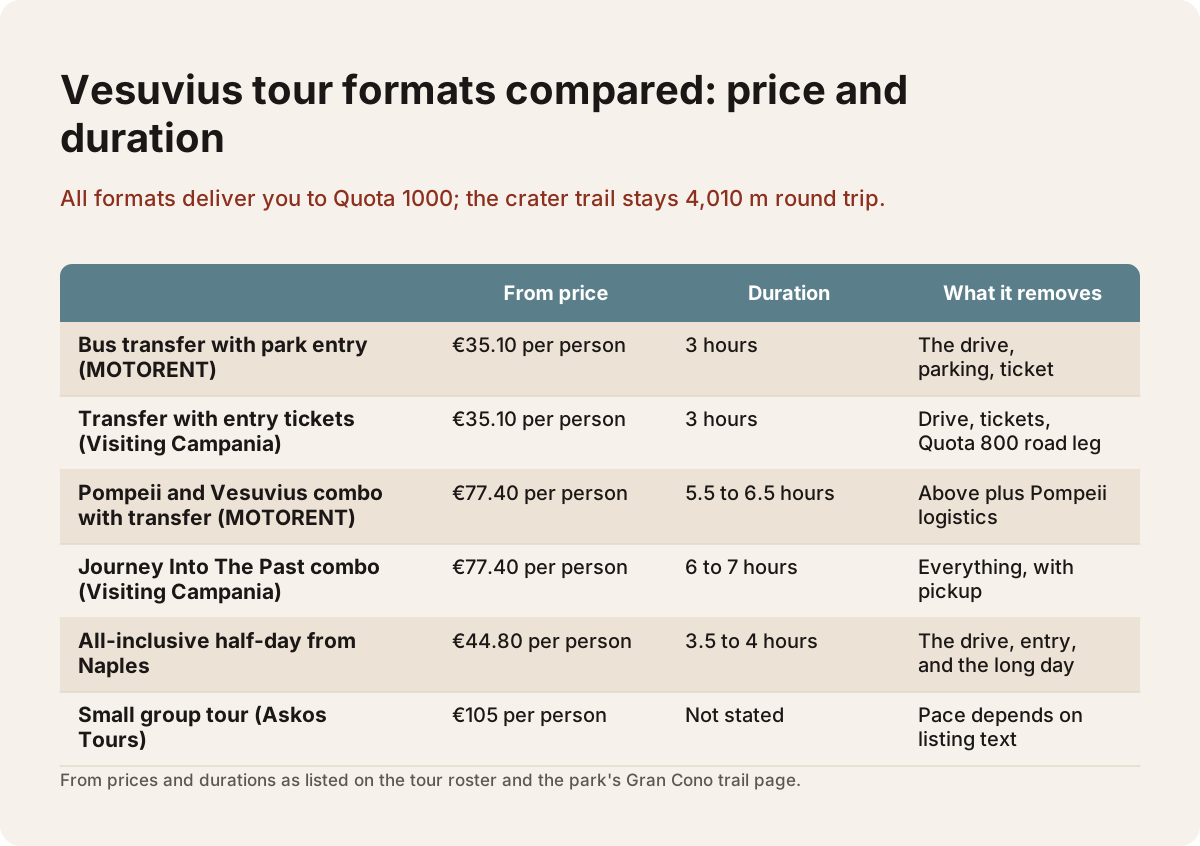
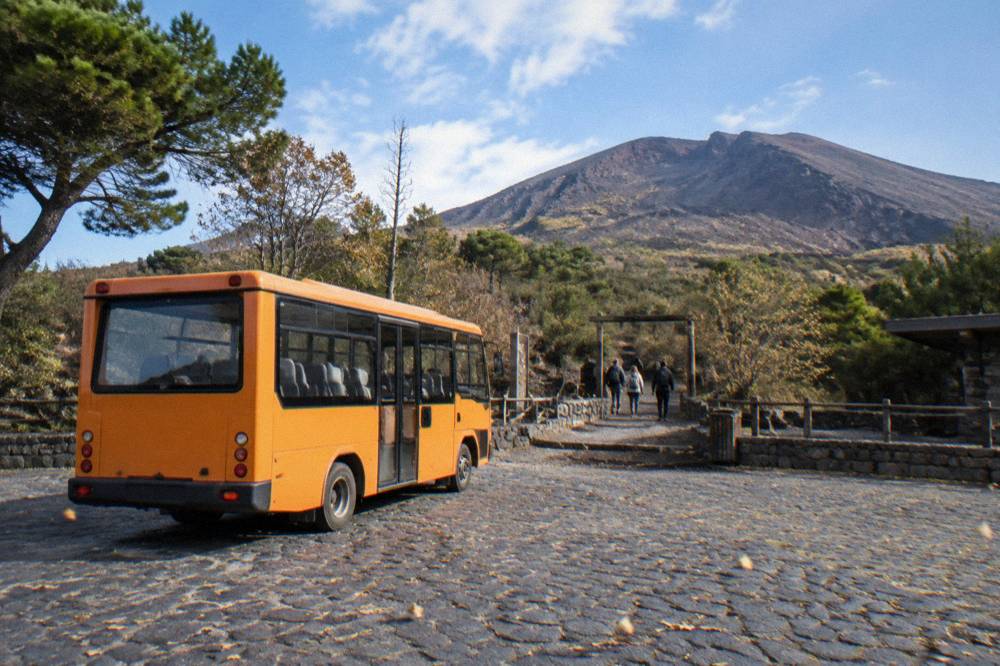
Transfer and shuttle tours remove the hardest part of a Vesuvius visit for most people: the road leg between the cities and the trailhead. A bus transfer with park entry included runs from €35.10 per person for about 3 hours. Combo tours that bundle Pompeii, transfer and tickets run from €77.40 per person. None of them shorten the crater trail itself, which the park fixes at 4,010 m.
This is the single most useful thing to understand when comparing products. Every Vesuvius tour on the market, however it is labelled, delivers you to the Quota 1000 plaza. From there, the walk is the walk. What varies is how much of the day's effort is spent before you even reach the trailhead. A visitor who drives, parks at Quota 800 and walks the 1.8 km access road adds roughly 30 minutes of uphill tarmac to the day before the trail proper begins. A transfer tour drops that leg entirely.
Three formats dominate the low-effort end of the Vesuvius hiking market:
The bus transfer with park entry, the Bus Transfer to Vesuvius with Park Entry Fee (from €35.10 per person, 4.3 across 1,923 reviews, operator MOTORENT S.R.L.), is the purest example: 3 hours, pickup included, entry included, and a guest review from Nicola of the United Kingdom calls it an "easy way to get from Pompeii to Vesuvius and back again". The transfer with entry tickets, the Mount Vesuvius Transfer with Entry Tickets (from €35.10 per person, 4.4 across 1,785 reviews), does the same job from Naples with guaranteed entry. Both sit alongside the wider skip-the-line ticket products on this site.
At the fuller end, the Journey Into The Past: Pompeii And Vesuvius Tour (from €77.40 per person, 4.3 across 256 reviews, operator VISITING CAMPANIA S.R.L.) bundles the ruins, the transfer and the crater access into 6 to 7 hours with pickup, so the only walking you have to plan is inside Pompeii and on the trail itself. It is the format this site recommends most often to visitors who want the logistics handled end to end. Read more about it on the Journey Into The Past tour page.
| Tour format | From price | Duration | What it removes |
|---|---|---|---|
| Bus transfer with park entry (MOTORENT) | €35.10 per person | 3 hours | The drive, the parking, the ticket queue |
| Transfer with entry tickets (Visiting Campania) | €35.10 per person | 3 hours | The drive, ticket purchase, the Quota 800 road leg |
| Pompeii and Vesuvius combo with transfer (MOTORENT) | €77.40 per person | 5.5 to 6.5 hours | All of the above plus Pompeii logistics |
| Journey Into The Past combo (Visiting Campania) | €77.40 per person | 6 to 7 hours | Everything, with pickup included |
| All-inclusive half-day from Naples (Project Napoli Service) | €44.80 per person | 3.5 to 4 hours | The drive, entry, and the long day |
One caution about wording: a tour advertised as small group is not automatically a slow-pace tour. The roster marks several products as small group, among them the Pompeii and Mount Vesuvius Small Group Tour (from €105 per person, 4.7 across 282 reviews, operator Askos Tours), and small groups do give a guide more room to accommodate a slower walker. But the listing text, not the group size, is what tells you the pace. Check the operator's live listing for anything that promises a gentler rhythm, and treat its absence as the honest answer.
What Does The Shuttle Actually Save You?
The Ercolano shuttle between the Quota 800 parking area and the Quota 1000 trailhead costs €1 each way and takes about 4 minutes, replacing a 1.8 km uphill road walk of roughly 30 minutes. For a less fit visitor arriving by car, that single euro each way is the difference between starting the trail fresh and starting it tired.
The arithmetic is blunt. The access road from Quota 800 to Quota 1000 is not a nature path; it is a provincial road with a steady gradient, no shade and, in summer, reflected heat. Walking it before the crater trail effectively doubles the day's climbing effort for someone who finds climbing hard. The park's own guidance is to buy parking only after securing a crater ticket, and parking along the provincial road is run by the Comune di Ercolano with a maximum stay of 4 hours and cars up to 8 seats at €7, per the municipal parking operator's site.
For visitors without a car, the shuttle question is moot because the transfer tours cover the whole leg. The EAV public bus line 808 runs from Pompei Piazza Anfiteatro up to Quota 1000 in 55 minutes for €3.80 on board, with 9 departures a day each way under the timetable in force from 1 October 2026, per the EAV timetable page. One planning note matters here: the last bus up arrives at 15:25, which is after the winter last entry time of 15:00, so in the November to February window the bus cannot be the only plan. The full logistics from the Pompeii side are covered in the site's separate transport guide.
The other thing the transfer format removes is the ticket itself. Crater tickets are sold only online, by time slot, 50 per 10-minute slot, released 30 days ahead, and the park's authorised online seller shows €11.68 full price against the €10 ticketing-rules figure. A tour that lists park entry included takes that purchase and its timing out of your hands. Where a listing does not say entry is included, check the listing for what entry is covered before assuming it.
Can You Ride Instead Of Walk On Vesuvius?
Yes, on the slopes but not to the crater. A two-hour horseback ride on Vesuvius runs from €69 per person with pickup, rated 5.0 across 151 reviews. Riding tours cross the lower slopes of the national park, not the Gran Cono trail, so they suit visitors who want the volcano's landscape and views without the climb. The crater rim itself is reachable only on foot.
The horseback option is genuinely underrated for this audience. The operator TASTETHEXPERIENCE runs the two-hour Horseback Riding On Vesuvius ride from €69 per person, and the same operator offers longer formats that add wine tasting and lunch, such as the Scenic Horseback Ride, Wine Tasting and Lunch on Mount Vesuvius from €130 per person, rated 5.0 from a small pool of 28 reviews. A guest on the combined Pompeii and riding tour, Amanda C., put it simply: "Pompeii, to lunch, to horse back on Vesuvius is the way to go!"
Riding is not a bypass to the crater. The Gran Cono is a walking trail with mandatory accompaniment by the park's volcanological guides above 1,000 m, and no product in the roster offers a saddle for that section. What riding delivers instead is the part of Vesuvius many visitors enjoy most: the lower slopes, the vineyards, the volcanic soil underfoot, and the long view across the Bay of Naples, all at walking-pace effort for the rider and none for the legs. The format pairs naturally with a winery visit, since several riding products include a tasting.
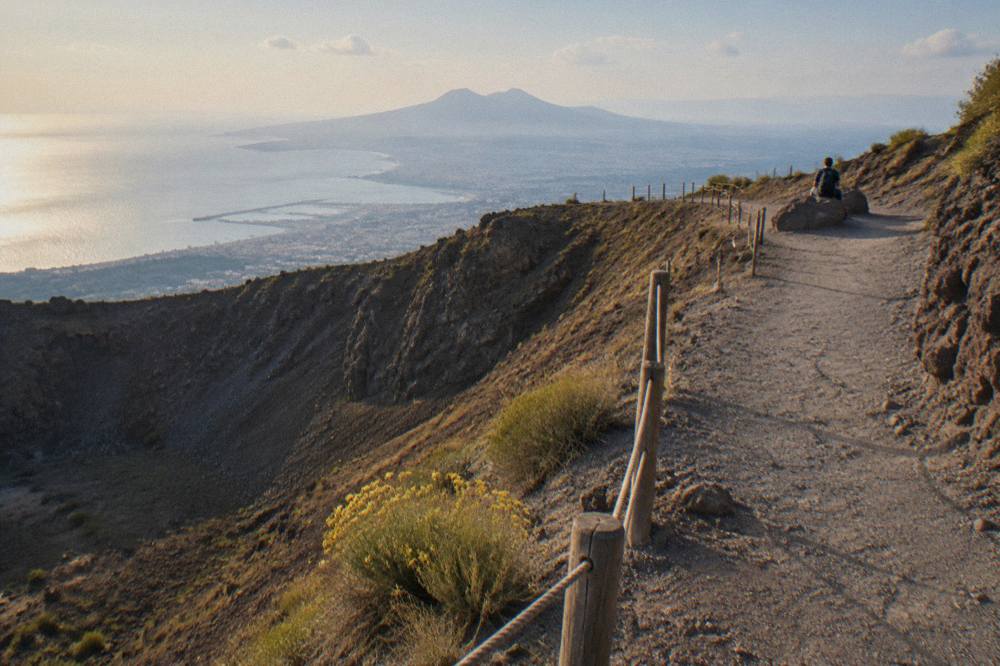
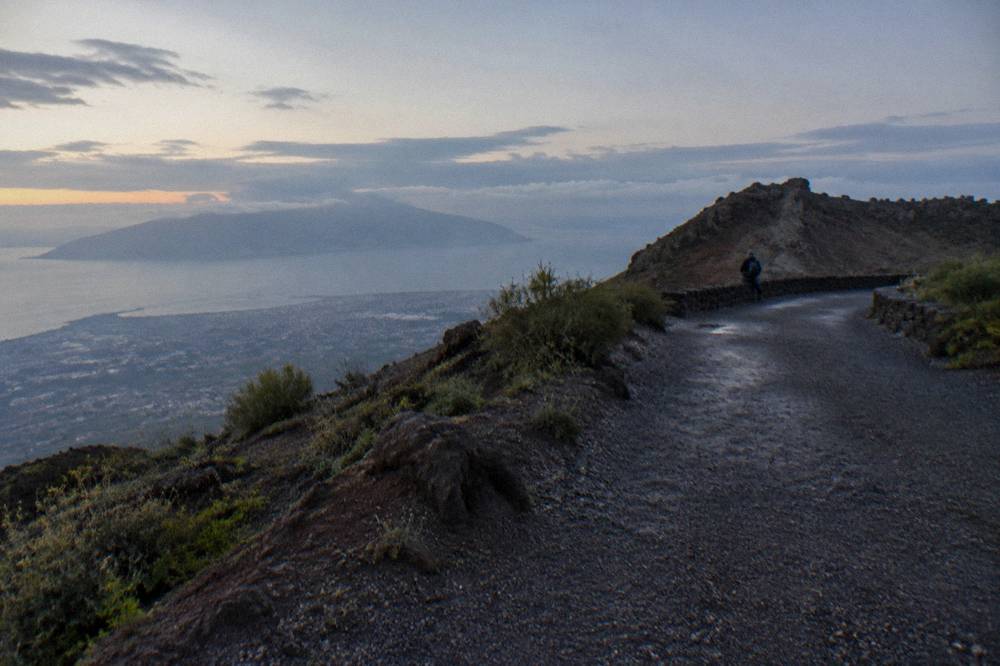
For visitors who want the crater view but cannot ride or walk it, the honest answer is that the viewpoint is earned on foot. The consolation is that the view from partway up the trail, a few minutes past the ticket hut, already spans the bay, the Sorrento peninsula and, on a clear day, Capri. Turning around early is a legitimate visit, not a failed one. The site's essay Is It Worth Going Up Mount Vesuvius? weighs exactly that trade.
Where Can You Rest On The Trail?
The Gran Cono has no benches, huts or toilets on the path itself, and the Quota 1000 plaza currently has no public toilets. Rest points are therefore informal: the edge of the walkway, the shade-free gravel shoulders, and the turnaround area at 1,170 m. A slower walker should plan pauses every few minutes rather than expecting built rest stops, and carry water accordingly.
This is the least flattering section of the guide and the most important one. The park's page is candid that facilities at the top of the access road are temporarily absent, and the trail is a working volcanic path, not a landscaped promenade. What that means in practice: you rest when you need to, on your own schedule, standing at the path edge. Because every visitor above 1,000 m is accompanied by the park's volcanological guides in groups, a slower pace is visible and accommodated, but it is your pace to set and your water to carry.
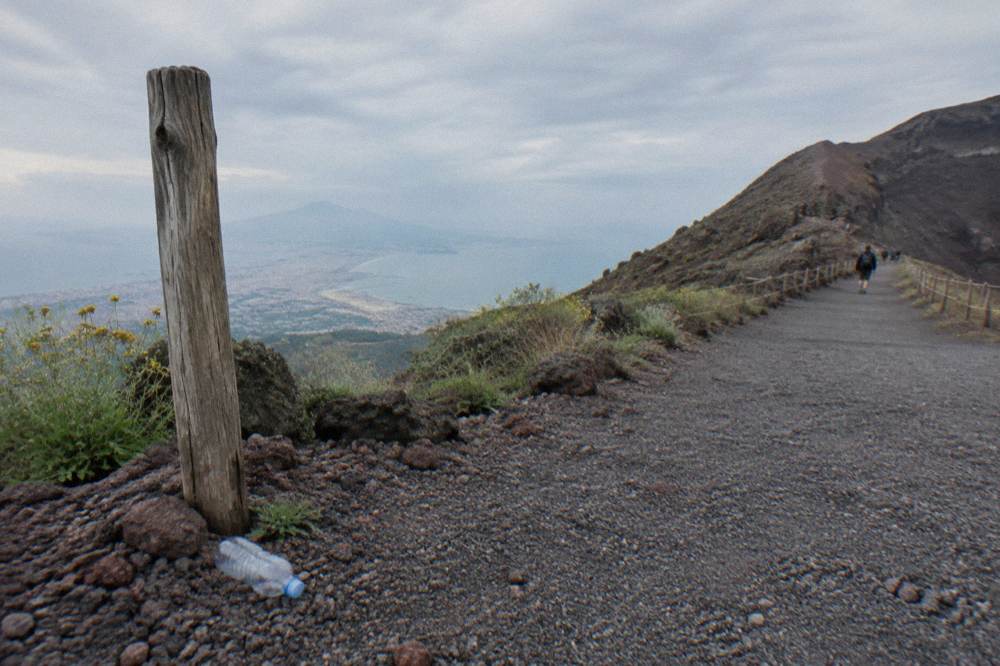
The trail breaks down into three effort phases, and knowing them helps a less fit visitor decide how far to commit:
| Section | Share of the upward path | Character | Rest strategy |
|---|---|---|---|
| Quota 1000 plaza to ticket hut | Opening stretch | Gentle opening slope, widest path | Pause here before the ticket check |
| Ticket hut (1,118 m) to midpoint | Middle stretch | Steadiest climbing of the walk | Short standing breaks every few minutes |
| Midpoint to Capannuccia (1,170 m) | Final stretch | Final rise to the turnaround | The view improves with every stop |
Two structural facts work in your favour. First, the 2 h 30 round-trip figure is a normal pace, not a race pace; the protocol's own caps (2 hours on the shortest route, 3 on the longest) leave margin. Second, the descent retraces the same path, so anything you climbed you can descend at your own speed, and the volcanological guide's group stays with the group. If a member of your party wants to wait at the plaza with a coffee from whatever vendor is trading there while the rest climb, that is a common and workable split.
What Time Of Year Is Easiest For The Climb?
Spring and autumn give the kindest conditions for a slower walker: April, May and September offer crater access until 17:00, summit highs of 11 to 19 C, and moderate rainfall. July and August are hottest, with summit highs near 23 C but access until 18:00. November to February is coolest, with last access at 15:00 and the year's heaviest rain in November.
The climate figures below are a modelled 1991-2020 climate average for the 1,000 m level, not a forecast. The pattern they show is consistent: the summit runs about 6 to 7 C cooler than Naples in every month, so a day that feels warm at the port can feel distinctly fresh at the trailhead. Less fit visitors should treat heat, not cold, as the main weather risk, because heat multiplies the effort of any climb.
| Month | Crater access hours | Daily cap | Summit high/low C | Summit rain mm (days) |
|---|---|---|---|---|
| March | 09:00 to 16:00 | 2,520 | 8.3 / 1.5 | 104 (10.5) |
| April | 09:00 to 17:00 | 2,880 | 11.1 / 3.8 | 87 (11.1) |
| May | 09:00 to 17:00 | 2,880 | 15.1 / 7.5 | 59 (8.0) |
| June | 09:00 to 17:00 | 2,880 | 19.2 / 11.6 | 30 (5.3) |
| September | 09:00 to 17:00 | 2,880 | 18.7 / 12.0 | 90 (8.7) |
| October | 09:00 to 16:00 | 2,520 | 14.8 / 8.5 | 129 (10.5) |
| November | 09:00 to 15:00 | 2,160 | 10.4 / 4.9 | 180 (13.6) |
Two scheduling notes follow from the park's rules rather than the climate. A normal ticket is valid from 120 minutes before to 120 minutes after the printed slot, within opening hours, which gives a slower visitor real flexibility on arrival time without invalidating the ticket. And the trail and box office close automatically on any day with an orange weather alert or higher, with automatic refunds for slots inside a closure; for current status, check the This Season band on the Mount Vesuvius Tours homepage and the matching month page.
A guest review on the Naples day tour from Melanie of the United States captures the summer reality plainly: "Very uneven surfaces and very hot in summer so trainers and water bottles." If you do visit in July or August, book the earliest slot of the day, when the gravel is still cool and the 09:00 opening gives you the freshest hours.
Do You Need To See Pompeii On The Same Day?
You do not, and for a less fit visitor splitting the two sites across two days is usually the better plan. Pompeii alone involves hours of standing and walking on uneven Roman paving. A combined Pompeii and Vesuvius day runs 6 to 12 hours depending on the departure city, which is a long day for anyone, and the shorter transfer-only Vesuvius products exist precisely for visitors who want to ration their effort.
The numbers make the case. A Vesuvius transfer tour is about 3 hours door to door. A combined Pompeii and Vesuvius day from Naples runs 6 to 8 hours on most rosters, and from Rome, 9 to 12 hours because of the travel leg. That is before counting the walking inside Pompeii itself, which the park caps at 20,000 daily visitors for good reason. For someone managing their energy carefully, one site per day is not a compromise, it is the plan.
If a combined day is the only option because of a cruise stop or a short stay, the shore-excursion format is built for exactly that constraint: the Naples Shore Excursion Mt Vesuvius And Pompeii Day Trip runs about 7 hours from €129.73 per person, rated 4.0 across 316 reviews, with pickup and a pizza lunch included, and a guest review from Rick praises the "great and well organized lunch". The trade is a fixed timetable, so pace flexibility inside the day is limited.
If you do split the days, the transfer-only products are the natural Vesuvius half. The From Naples All-Inclusive Mount Vesuvius Half-Day Tour (from €44.80 per person, 4.5 across 891 reviews, pickup included, 3.5 to 4 hours) is the roster's most direct example: the volcano, with nothing else attached, and back in Naples by early afternoon with the day's energy largely intact.
What Should A Slower Visitor Wear And Bring?
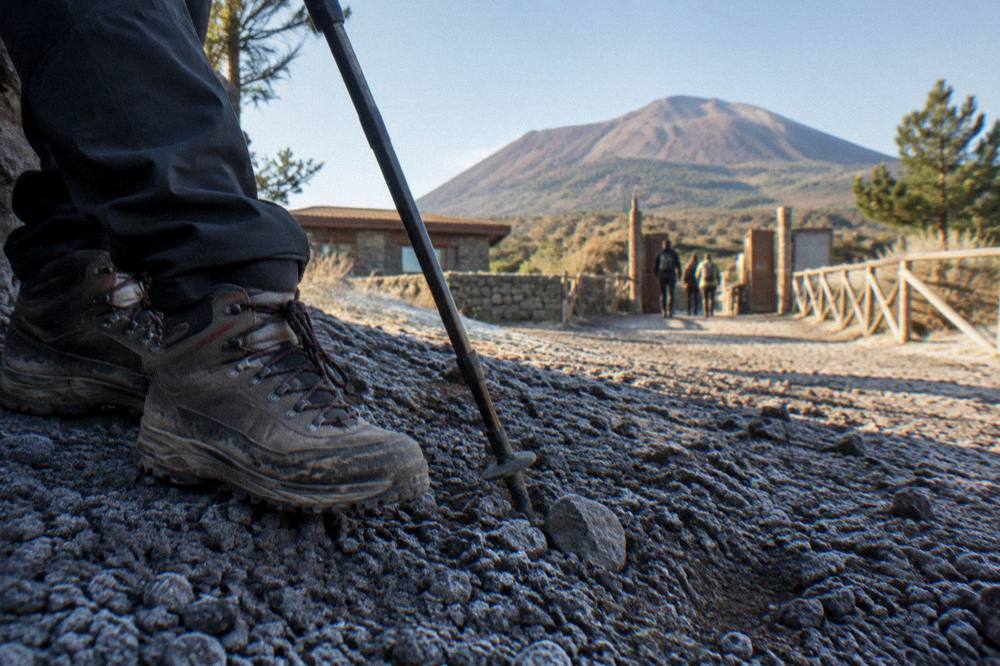
Closed walking shoes with grip are the single most important item, because the gravel surface punishes smooth soles on the descent. Beyond that: more water than feels necessary, sun protection with no shade on the trail, and layers, since the summit runs 6 to 7 C cooler than Naples year-round. A walking pole helps more on the descent than the climb.
The park's own guidance is minimal and sensible: wear suitable shoes and take care. The site's dedicated packing guide, What To Bring On A Mount Vesuvius Tour, covers the full list, and the site's clothing guide handles the wardrobe by season. For a less fit visitor specifically, three items earn their place beyond the basics.
First, the pole or the companion. Loose gravel descents are where slow walkers wobble, and a single trekking pole converts a balance test into a controlled walk. Second, the early slot. Booking the first entry window of the day means cooler gravel, thinner crowds on the path, and a shorter queue at the ticket hut, all of which reduce the day's invisible effort. Third, the honest turnaround plan. Decide before you start where your private point of no return is, whether that is the ticket hut or the midpoint, and treat reaching it as a completed visit rather than a shortened one.
Is Vesuvius Still Worth It If You Skip The Crater?
Yes, and for many less fit visitors the lower-slope visit is the better day. The national park's vineyards, the horse-riding paths and the wine estates around the volcano deliver its landscape without the climb. The Lacryma Christi DOC zone covers 15 municipalities on the slopes, and several roster tours visit wineries with lunch from €43 per person, which is a full Vesuvius experience at walking-pace effort.
The crater is the famous photograph, but it is one face of a large national park with 11 numbered trails, vineyards on volcanic soil, and a wine tradition that the park itself documents on its Lacryma Christi DOC page. A wine-and-lunch tour on the slopes is a legitimate Vesuvius day: you stand on the volcano, you taste what its soil grows, and you never once have to climb gravel. The Lunch And Wine Tasting In The National Park Of Mount Vesuvius runs about 2.5 hours from €58 per person, rated 5.0 across 241 reviews, and the Boscotrecase Vesuvius Wine Tasting Tour With Lunch runs from €43 per person, rated 4.9 from a small pool of 45 reviews.
The decision framework in the end is simple. If the crater view is the goal and the walk is manageable with pauses, book a transfer tour with entry included and take the earliest slot. If the walk is not manageable, book the slopes instead: a ride, a tasting, a long lunch with the volcano as the backdrop. Both are Vesuvius. The site's guides on guided versus self-guided visits and the best time to visit cover the remaining decision points.
Common Questions About Vesuvius For Less Fit Visitors
Is the Vesuvius crater walk suitable for someone with limited fitness?
The park rates the trail low difficulty: 4,010 m round trip, about 2 h 30, on a sloping path from the ticket hut at 1,118 m up to a turnaround at 1,170 m. Many slower walkers complete it with frequent standing pauses. There are no benches or toilets on the path, so plan your own rest schedule and ask your doctor first if you have any health concern.
Can I turn around partway up the Vesuvius trail?
Yes. The path is out and back on the shortest route, and the view over the Bay of Naples improves continuously from the first minutes past the ticket hut. Turning around early is a common and legitimate way to visit. The park's volcanological guides accompany each group above 1,000 m, so inform your guide if you are heading back.
Which Vesuvius tour involves the least walking?
A transfer tour with park entry included, from €35.10 per person for about 3 hours, removes the drive, the parking and the 1.8 km access-road walk between Quota 800 and the trailhead. It does not shorten the crater trail itself. For zero trail walking, a horseback ride on the lower slopes from €69 per person, or a winery lunch visit from €43 per person, keeps you on the volcano without the climb.
Are there toilets at the Vesuvius trailhead?
The Quota 1000 plaza currently has no public toilets, per the park's own page, and there are none on the trail. Use facilities in Ercolano or Pompeii before your transfer departs, and treat the visit as a facility-free walk of a few hours.
Is a small group tour slower paced than a big bus tour?
Not automatically. Small group formats, such as the Pompeii and Mount Vesuvius Small Group Tour from €105 per person, give a guide more room to accommodate a slower walker, but the listing text is the only place a pace promise appears. Check the operator's live listing for anything that commits to a gentler rhythm, and treat its absence as the honest answer.
What is the best time of day for a slower walker to visit Vesuvius?
The earliest slot of the day. Crater access opens at 09:00 year-round, and a normal ticket is valid from 120 minutes before to 120 minutes after the printed slot. Morning visits mean cooler gravel, thinner crowds on the path and a shorter wait at the ticket hut, all of which reduce the day's effort.