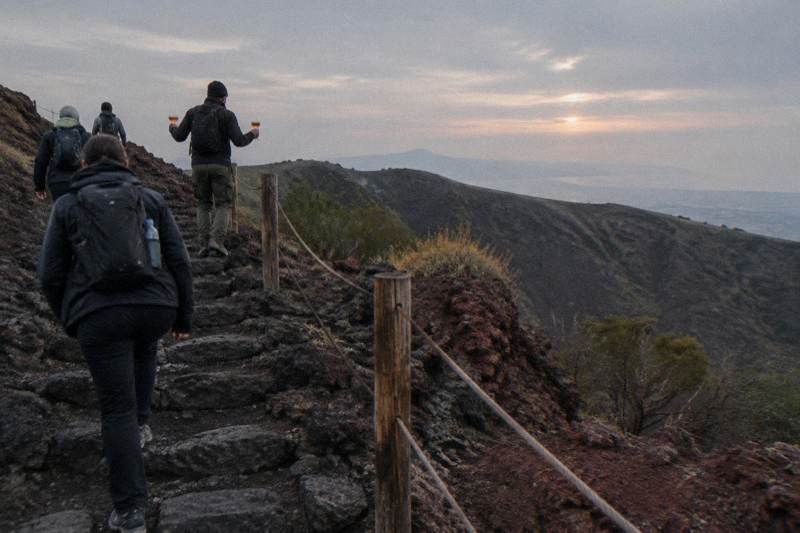
How Hard Is The Mount Vesuvius Hike
The park rates Trail 5, the Gran Cono crater walk, as low difficulty, short and easy. That rating is accurate as far as it goes, but the gradient and the loose volcanic gravel underfoot are what catch people out, and summer heat changes the calculation again.
Short answer
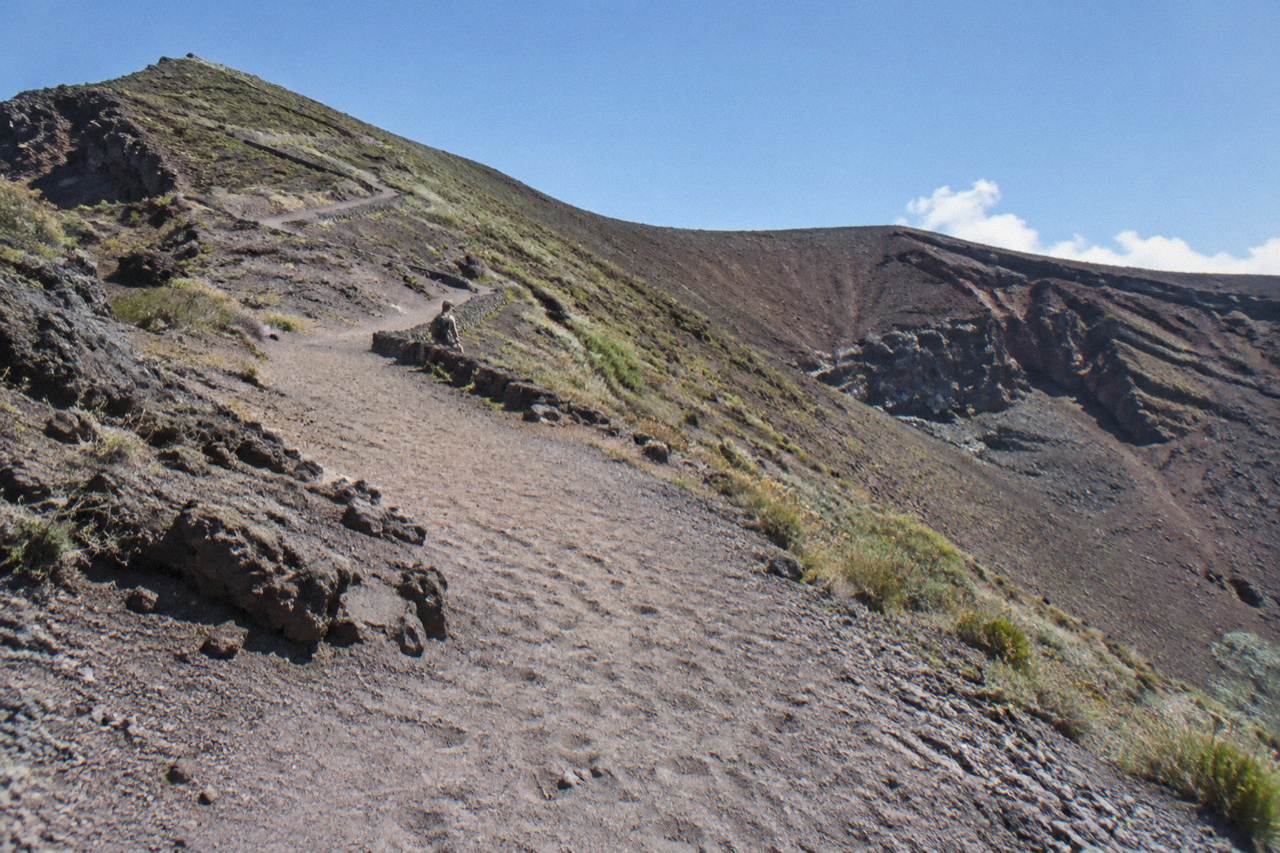
The Mount Vesuvius crater hike is officially rated low difficulty by the park: 4,010 m round trip, about 2 hours 30 minutes, topping out at 1,175 m. Most reasonably fit walkers manage it. The challenges are the steady uphill gradient, loose gravel on the path, and heat in July and August, when summit highs average 22.8 C.
The Gran Cono trail, path number 5 in the Parco Nazionale del Vesuvio's network, is the walk almost every visitor means when they say "the Vesuvius hike". It is the only route to the crater rim open to the public, and the park's own infobox grades it "Bassa", low difficulty, adding "pendente, facile e breve", sloping, easy and short. Those four words are the official position, and they are fair. Yet the same page records the round trip at 4,010 m with a top altitude of 1,175 m, and reviews from the tours that climb it keep returning to two things: uneven surfaces and heat. Millie from the United Kingdom, reviewing the Naples day tour with lunch, put it plainly: "Very uneven surfaces and very hot in summer so trainers and water bottles."
This guide, part of the coverage on Mount Vesuvius Tours, takes the difficulty question apart piece by piece: what the official rating covers, what the trail physically asks of you, who struggles and why, how the weather reshapes the effort by month, and which bookable options match each fitness level. The full practical walkthrough of the route itself lives in the How To Hike Mount Vesuvius guide, and what you see when you arrive is covered in Inside The Mount Vesuvius Crater.
What Is The Official Difficulty Rating Of The Vesuvius Crater Hike?
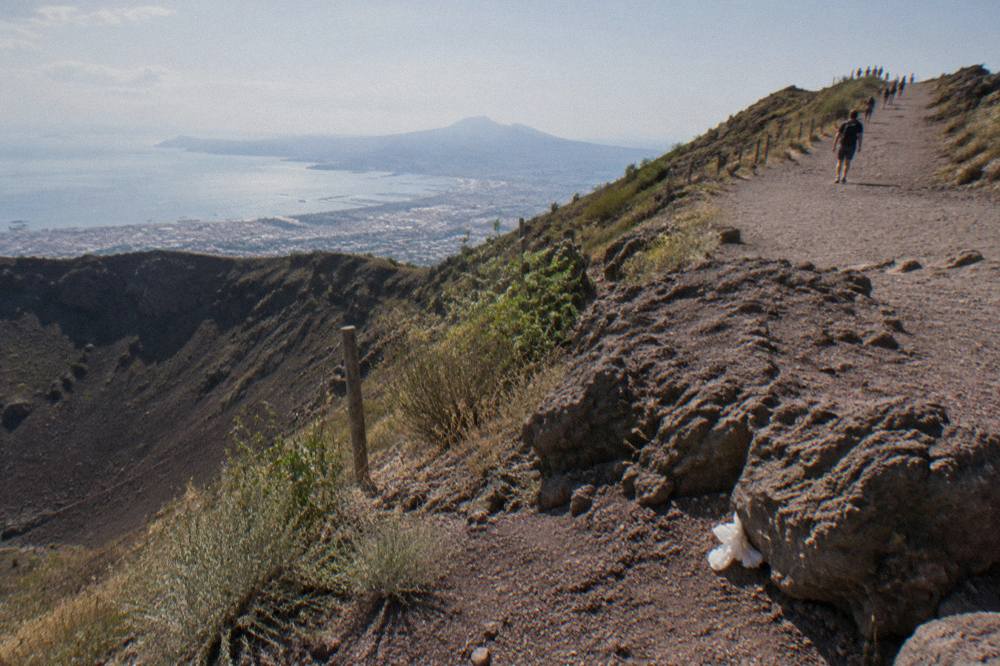
The park's own trail page rates the Gran Cono, Trail 5, as low difficulty, described in Italian as "pendente, facile e breve", meaning sloping, easy and short. The same official infobox gives the round trip as 4,010 m, a total time of 2 hours 30 minutes, a maximum altitude of 1,175 m, and the start and finish point at San Vito in Ercolano. Those are the numbers the park publishes, and they frame everything else on this page. A protocol approved by the park in 2026 adds that a guided excursion may not exceed 2 hours on the shortest route and 3 hours on the longest, which tells you the park expects the walk to fit inside a generous but bounded window.
"Low difficulty" here is not marketing. It is a classification within a national park that also maintains ten other numbered trails, several of them longer, steeper and genuinely demanding. The Gran Cono is the park's showcase route, built to be walked by the general public in ordinary shoes, at a pace set by a guide. The rating assumes decent weather, and that assumption matters: the same park rules state that the ticket office and trail close automatically on any day with an orange weather alert or higher, with automatic refunds for slots inside the closure. You can read the rating, the hours and the refund rules on the park's official Gran Cono page.
What the rating does not capture is texture. The word "pendente", sloping, is doing quiet work in that Italian phrase. The trail climbs from the Quota 1000 plaza to a turnaround called the Capannuccia at 1,170 m, with the ticket hut at 1,118 m along the way. Almost the entire outbound leg is uphill, and all of it comes back down on the return. Downhill, on gravel, is where the "easy" part gets tested for plenty of walkers, a point several guest reviews return to. None of this contradicts the rating. It just fills in what a single word leaves out.
How Steep Is The Trail To The Vesuvius Crater Rim?
The trail runs from the Quota 1000 plaza, at roughly 1,000 m, up to the Capannuccia turnaround at 1,170 m, with the ticket hut at 1,118 m en route. The gradient is steady rather than cliff-like, the path is wide, and the outbound leg is uphill nearly all the way. The public trail ends at 1,175 m, short of the true summit at 1,281 m, a figure published by INGV, the national volcanology institute, so nobody should arrive expecting to stand on the highest point. The rim route above the turnaround is reserved for researchers and closed to the public.
Steady is the operative word. There are no ladders, no scrambling sections and no exposed ledges on the standard route. What there is, consistently, is slope. Walkers used to flat city pavement notice the ascent within the first ten minutes, and the pattern does not let up until the turnaround. The official 2 hours 30 minutes round trip is comfortably paced for an average adult, including a stop at the rim to look into the crater, which is elliptical with a maximum diameter of 580 m, fumaroles steaming gently on its inner walls. Fit hikers do it faster; families with small children or walkers with knee trouble do it slower, and both are within the normal range the park plans for.
The descent deserves its own sentence. Every metre climbed comes back down on the same path, on the same surface, with the Bay of Naples opening up behind you and attention wandering accordingly. Reviews of the combined Pompeii and Vesuvius tours repeatedly mention uneven surfaces on exactly this section. If your knees dislike downhill more than your lungs dislikes uphill, plan for that: trekking poles are not required, but sturdy shoes genuinely are, and the park itself advises suitable footwear. For the wider question of whether the effort pays off, the Is It Worth Going Up Mount Vesuvius? post on this site weighs the view against the climb, and readers consistently answer yes.
Choosing how you climb is partly a difficulty decision, and the roster of Mount Vesuvius hiking tours spans every effort level, from a bare transfer-and-ticket to a small-group guided walk. Three options frame the range for most readers.
The featured pick, a 3-hour small-group walk from Pompeii led by an expert guide, rated 4.8 from 242 reviews, is the strongest match for a reader worried about fitness who still wants interpretation on the trail. The bus transfer with park entry included, from €35.10 per person, suits confident walkers who only need logistics. The Ercolano roundtrip bus with entry, from €36 per person, does the same from the Ercolano side. Difficulty-wise they are identical once you are on the gravel; what changes is who is beside you and what they explain.
Is The Loose Gravel On The Vesuvius Path A Real Problem?
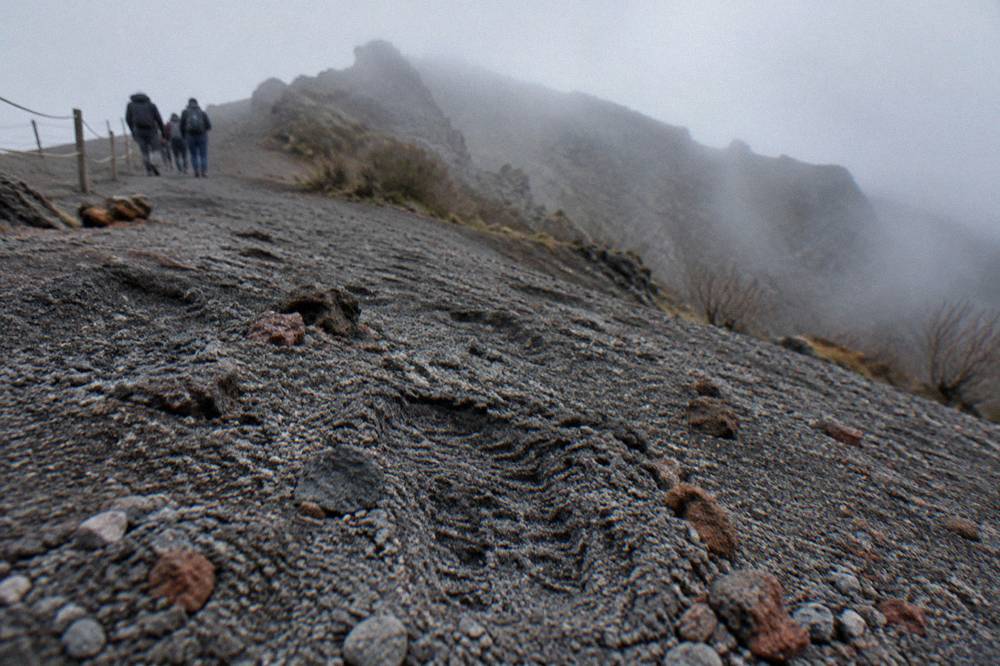
Yes, for some walkers, and it is the single most under-reported aspect of the trail's difficulty. The path surface is volcanic gravel and ash, loose in dry conditions and slick when wet, and it shifts underfoot on both the climb and, especially, the descent. Guest reviews name it more often than the gradient. Millie's "very uneven surfaces" comment from the Naples day tour is representative rather than exceptional. The park's low-difficulty rating assumes you treat the surface with respect: wear closed shoes with grip, keep to the right side of the walkway as the rules ask, and shorten your stride coming down.
Why gravel instead of stone steps? Because this is an active volcano's cone, rebuilt by the 1944 eruption's own deposits, and the park's 2026 ecosustainable protocol deliberately keeps the route light-touch rather than paving a mountain. The trade-off is honest: the path is wide and never technical, but it demands attention. Three groups feel it most. Walkers in sandals or thin-soled shoes feel every stone through the sole. Walkers with balance concerns find the shifting surface harder than a firm trail of the same gradient. And anyone descending fast after a long day at Pompeii, a common itinerary, tires their stabilising muscles in ways the outbound climb did not.
Wet gravel changes the equation again. Rain is not rare on the mountain: the modelled 1991-2020 climate average for the 1,000 m level puts November at 180 mm across 13.6 rain days, October at 129 mm across 10.5 days, and even September at 90 mm. On orange weather alerts or higher the trail closes outright, as the rules require, but a passing shower on a yellow-alert or ordinary day can still leave the surface greasy between the closures. If you are booking months ahead and cannot reschedule around weather, a guided tour is the safer wrapper: the operator manages timing, and the listings across this site flag free cancellation, so a washed-out forecast does not have to mean a lost booking.
| Surface condition | How the gravel behaves | Who should adjust plans |
|---|---|---|
| Dry summer | Loose, dusty, shifts on descent | Wear grip shoes, slow the descent |
| After light rain | Compacted but slick patches | Shorten stride, avoid edges |
| Orange alert or higher | Trail and ticket office closed automatically | Automatic refund applies to slot tickets |
| Winter morning | Possible frost early, January lows average 0.0 C | Later slot, layers, check the listing |
Who Actually Finds The Vesuvius Hike Hard?
Three groups report the most trouble: walkers with knee or balance problems, hit hardest by the gravel descent; visitors overexerted by July and August heat, when summit highs average 22.8 C on the modelled 1991-2020 average and Naples reaches 29.3 C; and anyone doubling the crater walk with a full Pompeii visit on the same day. For everyone else the honest summary is that the hike feels like a brisk 60 to 90 minute hill walk with a view, not a mountaineering outing. The mandatory volcanological guides above 1,000 m set a group pace that accommodates ordinary walkers rather than racing them.
The knee and balance point is worth dwelling on because the trail's official profile, mostly one steady climb, hides how much of the strain lands on the way down. Reviews of the guided combos, where walkers arrive at the trailhead already several hours into their day, mention legs feeling the descent more than the climb. If that describes you, two adjustments help: take a morning crater slot before Pompeii rather than an afternoon one after it, and let a guide set a slower descent line. The expert-guided small-group tour from Pompeii is built for exactly that pace, capped in group size, with a guide who knows where the surface is worst.
Heat is the second filter. The crater hours run to 18:00 in July and August, and midday slots put walkers on unshaded gravel at the warmest part of the day. The trail has no tree cover and no water point above the plaza, where the park notes public toilets are temporarily unavailable too, so carry what you need. Families and older walkers do this walk constantly and mostly enjoy it; the family calculus and the half-day versus full-day decision both shape how tired your legs are when you start, and each has its own guide on this site (see Half-Day Vs Full-Day). The honest framing: this is a hike people of average fitness finish happily, and a minority of people with specific limitations should reshape rather than attempt.
A guided option is the standard answer for the worried-fit reader, and among the Vesuvius tickets with tour roster the Pompeii expert-guide walk, 3 hours, 4.8 from 242 reviews, from €65 per person, pairs the entry logistics with a guide who adjusts pace to the group. Free cancellation is flagged on the listing, which matters when you are booking around a fitness question you cannot test in advance.
How Does The Difficulty Change Month By Month?
The trail itself never changes, but the conditions on it swing widely: crater access runs 09:00 to 18:00 in July and August versus 09:00 to 15:00 in January, February, November and December, summit high temperatures span from an average of 5.6 C in January to 22.8 C in August, and rain ranges from 16 mm in July to 180 mm in November. All climate figures below are the modelled 1991-2020 climate average for the 1,000 m level, not a forecast. Pick your month with the table, then confirm the operator's current schedule on the live listing before locking plans, since trail status is volatile and the rules on automatic weather closures apply year-round.
| Month | Crater access hours | Daily cap | Summit high/low C (avg) | Rain mm (days) | Difficulty feel |
|---|---|---|---|---|---|
| January | 09:00-15:00 | 2,160 | 5.6/0.0 | 119 (11.7) | Cold start, frost possible |
| February | 09:00-15:00 | 2,160 | 6.0/-0.1 | 103 (11.2) | Similar, icy patches early |
| March | 09:00-16:00 | 2,520 | 8.3/1.5 | 104 (10.5) | Cool, changeable |
| April | 09:00-17:00 | 2,880 | 11.1/3.8 | 87 (11.1) | Comfortable |
| May | 09:00-17:00 | 2,880 | 15.1/7.5 | 59 (8.0) | Close to ideal |
| June | 09:00-17:00 | 2,880 | 19.2/11.6 | 30 (5.3) | Warm, dry surface |
| July | 09:00-18:00 | 3,240 | 22.1/14.5 | 16 (3.3) | Heat is the challenge |
| August | 09:00-18:00 | 3,240 | 22.8/15.2 | 22 (3.9) | Peak heat, book early slots |
| September | 09:00-17:00 | 2,880 | 18.7/12.0 | 90 (8.7) | Warm, first rain returns |
| October | 09:00-16:00 | 2,520 | 14.8/8.5 | 129 (10.5) | Mild, wetter surface |
| November | 09:00-15:00 | 2,160 | 10.4/4.9 | 180 (13.6) | Wettest month, short window |
| December | 09:00-15:00 | 2,160 | 6.7/1.4 | 147 (13.1) | Cold, damp, short window |
Two structural points sit behind those numbers. First, closing times are last-access times, and the park requires the visit to end within an hour of them, so winter days compress the whole experience into a tight midday window. Second, the summit level runs about 6 to 7 C cooler than Naples in every month of the modelled average, which cuts both ways: relief in August, a genuine chill in January when the coast sits at 11.7 C and the trail at 5.6 C. The month-by-month detail lives on this site's Mount Vesuvius by month season pages, which carry the same table with fuller commentary for each month.
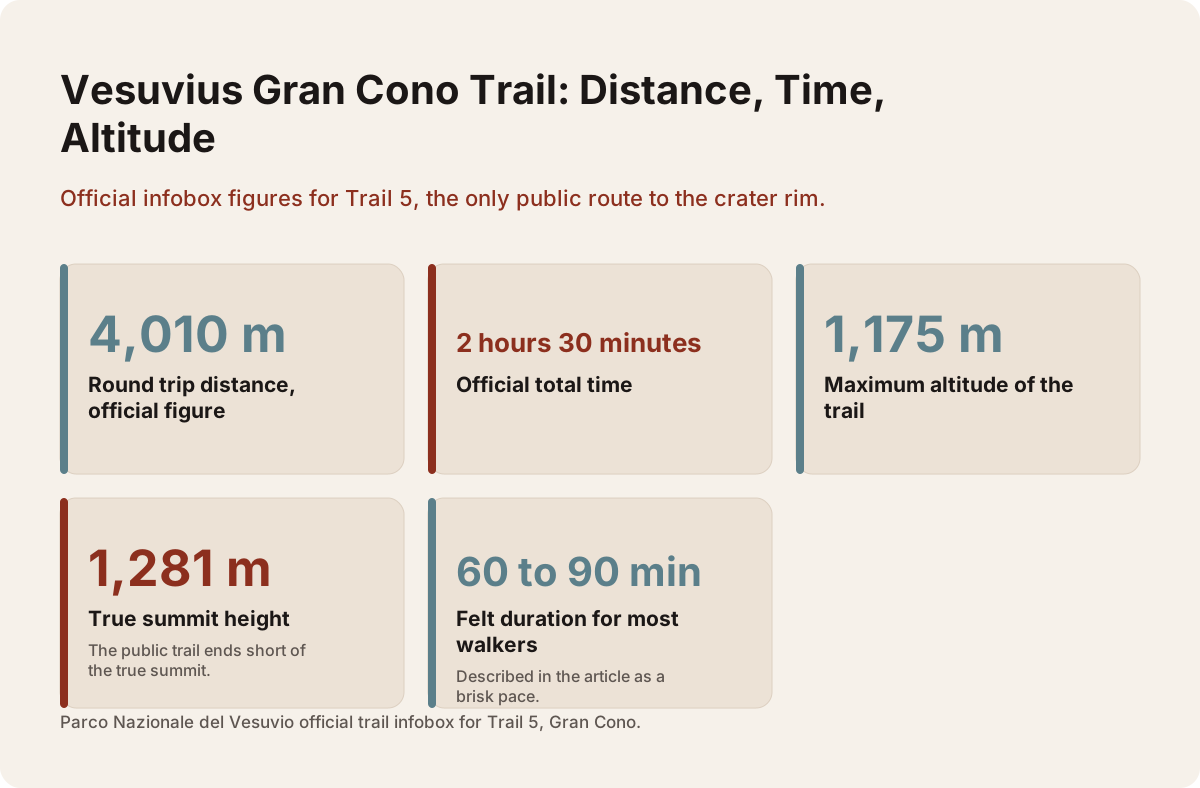
For a reader whose main worry is effort rather than scenery, May, June, September and the shoulder weeks of April and October are the kindest months on paper: moderate temperatures, longer access windows and, outside November to February, a drier path. None of that is a booking guarantee, and standing open or closed claims belong to no article, but the seasonal pattern is durable climate data, not a status report.
Do You Need To Be Fit To Book A Guided Vesuvius Hike?
No special fitness is needed for the standard Gran Cono walk with a guide: the park's low rating, the 2 hours 30 minute round-trip figure and the guided group pace are all calibrated for ordinary visitors. Minimum ages on guided listings, where stated, run as low as 4 or 6 years old, which tells you the bar. The real preconditions are steadier ones: shoes with grip, water, sun protection on exposed days, and an honest read of your own knees on the descent. Walkers who want the crater without the climb question at all should look at this site's guide for less fit visitors, which sets out the gentler alternatives.
The guided formats on this site sort themselves by how much walking support they wrap around the same trail. The table below compares the main bookable shapes by duration, starting price and what the difficulty-minded reader gets from each. All prices are from-prices in euros as printed on the listings, and ratings are shown with their review counts.
| Tour (decision name) | Duration | From price | Rating (reviews) | Difficulty support |
|---|---|---|---|---|
| Expert Hiking Guide From Pompeii | 3 hours | €65 per person | 4.8 (242) | Small group, guide sets pace |
| Direct Transfer, Guaranteed Entry | 3 hours | €35.10 per person | 4.4 (1,785) | Self-guided walk, logistics only |
| Bus Transfer, Park Entry Included | 3 hours | €35.10 per person | 4.3 (1,923) | Self-guided, entry bundled |
| Half-Day Volcano Trip From Naples | 3.5 to 4 hours | €44.80 per person | 4.5 (891) | Pickup, guided crater visit |
| Guided Volcano Hike From Pompeii | 3 hours | €65 per person | 4.8 (282) | Guided, min age 4 |
| Naples E-Bike Ride To The Crater | 4.5 to 7 hours | €60.50 per person | 4.5 (17, small pool) | Motor assistance on approach |
A word on that last row and on small pools: a 4.5 from 17 reviews is a small sample, named here as such, and the e-bike format assists the approach rather than removing the crater walk itself. Whichever shape you choose, the mandatory accompaniment rule means a park volcanological guide meets every group above 1,000 m regardless of what you booked, so nobody is ever alone on the cone. What a paid guide adds is pacing, interpretation and someone watching the weather and the clock for you.
Two more roster options fit specific fitness questions. The guided walk from Pompeii with transfer, 4.8 from 282 reviews, from €65 per person, is the same guided format from the same town, useful when the featured pick's dates are full.
And the half-day all-inclusive from Naples, 4.5 from 891 reviews, from €44.80 per person with pickup flagged, suits travellers who want the crater done with the least planning overhead and a shorter total day than the full Pompeii combos.
How Hard Is The Hike Combined With Pompeii On The Same Day?
The combination is the most popular way to climb Vesuvius and also the most tiring: Pompeii alone warrants several hours on flat but relentless hard surfaces, and the crater walk then adds the full gravel climb and descent on legs that are already worked. A review from Jody S. on the three-site day captures the payoff side: "We had a good hike to the crater of Mt. Vesuvius with a beautiful view of Naples, the crater, the country side, Sorrento and Capri." The combined day is entirely doable for average fitness, but the order you walk it in matters more than the walks themselves.
Ordering logic is simple: crater first, ruins second, whenever the timetable allows. The morning air is cooler, the gravel is drier, the legs are fresh, and the crater's closing times, last access 16:00 in October, 15:00 in winter months, are less forgiving than Pompeii's 17:30 last entry in the summer season. Doing Pompeii first means reaching the trail's steepest section at the hottest, tiredest point of the day. The ordering question has its own post on this site, Should I Go To Pompeii Or Vesuvius First, and the full one-day itinerary is covered in the Pompeii And Vesuvius In One Day guide. Difficulty-wise, the headline combo tours all follow this logic in their scheduling.
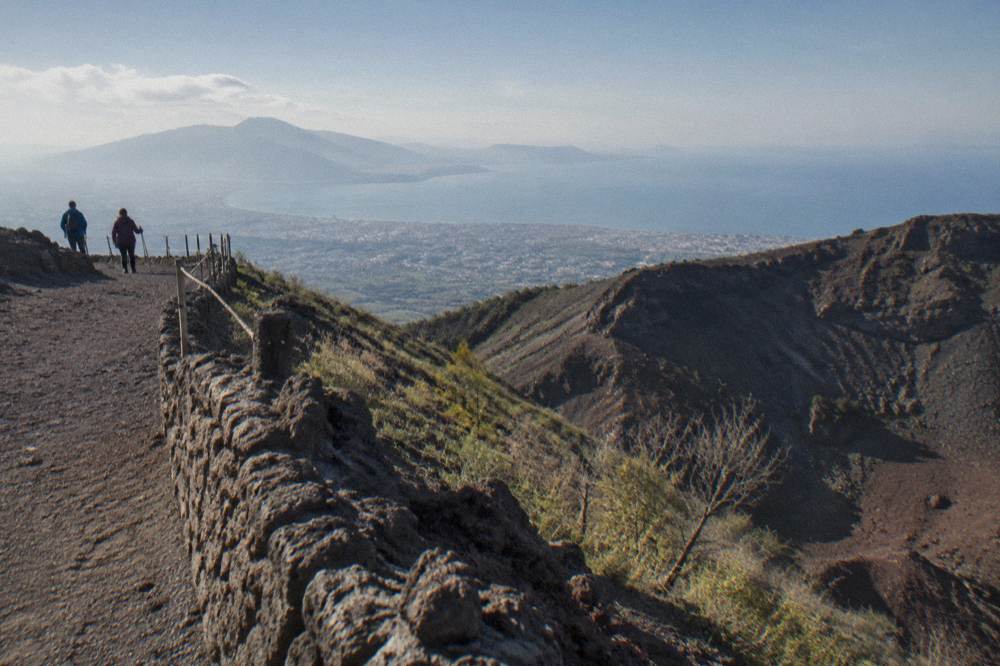
The combined tours on the roster differ mainly in what they include and what they ask of you. The pizza-lunch day trip from Naples, 4.8 from 9,744 reviews, from €53.25 per person, is the value benchmark; the archaeologist-guided exclusive from Naples, 4.7 from 3,701 reviews, from €78.20 per person, adds expert interpretation; the all-inclusive with lunch and wine, 4.6 from 2,804 reviews, from €127.50 per person, finishes with a winery stop that makes the day a reward rather than a march. None of them changes the physical trail, which is the point: pick on inclusions, not on the walk.
| Combined tour | Crater walking | Meal | From price | Rating (reviews) |
|---|---|---|---|---|
| Pizza on the Volcano Slopes | Guided day, crater hike | Pizza lunch | €53.25 per person | 4.8 (9,744) |
| Archaeologist Guide, Lava Caves Option | Guided, expert-led | Lunch | €78.20 per person | 4.7 (3,701) |
| Lunch and Wine Tasting Included | Guided | Lunch and tasting | €127.50 per person | 4.6 (2,804) |
| Naples Day Tour, Lunch Included | Guided, pickup | Lunch | €67.20 per person | 4.3 (14,121) |
| From Sorrento, Lunch Included | Guided from Sorrento | Lunch | €109.25 per person | 4.8 (2,383) |
What Should You Wear And Carry For The Difficulty Level?
For the park's low-rated trail, the honest kit list is short: closed shoes with real grip, water, sun protection for the exposed climb, and a layer for the summit, which runs 6 to 7 C cooler than Naples on the modelled average, every month of the year. The park advises suitable footwear and care on the path, and reviews convert that advice into specifics, trainers rather than sandals, water bottles in summer. The full clothing logic, including what changes between a July morning slot and a February one, is laid out in this site's what to wear and what to bring guides, which take the same monthly numbers and turn them into a packing list.
Footwear is the one genuine requirement. Grip matters more than ankle height, because the surface's difficulty is loose gravel rather than rock steps or roots. A trail shoe with a lugged sole turns the descent from cautious into comfortable. Water matters almost as much on summer slots: the climb is unshaded for its full length, there is no vendor on the trail, and the plaza facilities are limited, with the park stating that public toilets at Quota 1000 are temporarily unavailable. Sunscreen and a hat earn their place from May through September, when summit highs average 15.1 C, 19.2 C, 22.1 C, 22.8 C and 18.7 C respectively.
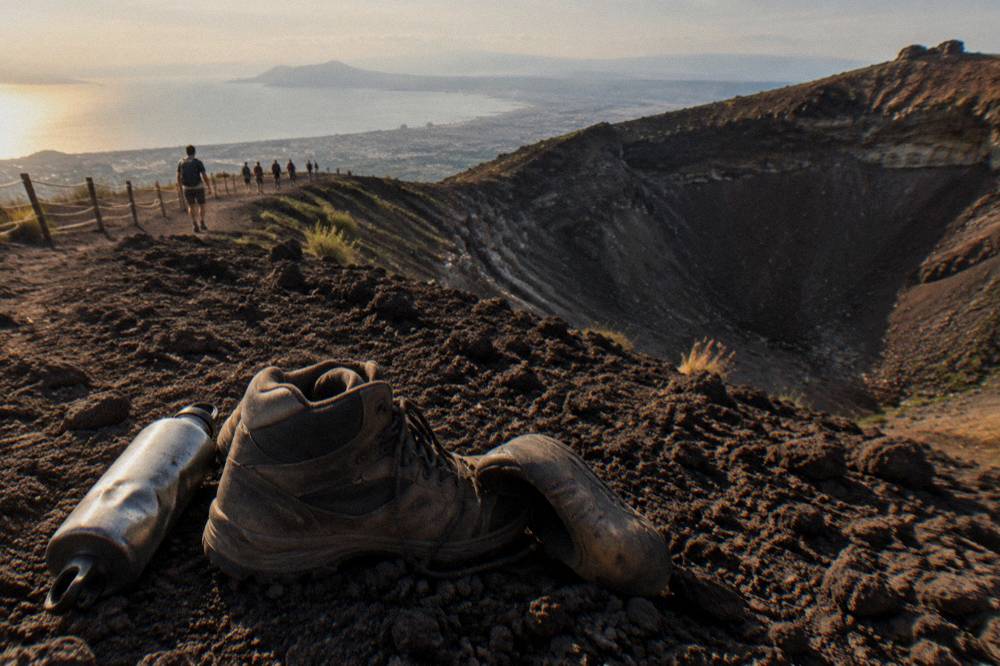
Layers answer the temperature gap. A morning October slot can start near the 8.5 C average low on the summit level while Naples feels like early autumn at 14.1 C overnight; by the rim, in wind, that is jacket weather for anyone pausing to look at the fumaroles. The reverse mistake, dressing for the coast in August and arriving underprepared for wind on an exposed cone, is common enough that reviews mention it. This site's Is It Cold At The Top Of Vesuvius post answers exactly this question with the same monthly numbers.
Can You Do The Vesuvius Hike Without A Tour At All?
Yes. The trail is a public park path, and independent visitors buy the same timed online tickets as everyone else, from the park's authorised online seller, at €10 under the park's ticketing rules with the authorised seller showing €11.68. Nothing about the hike requires a commercial tour, and the mandatory volcanological guide accompaniment above 1,000 m is a park service that applies to every climber, independent or booked. The Can You Visit Vesuvius On Your Own post on this site covers the full self-guided route, and the booking-in-advance question matters more than the tour question itself, because slots sell out and last-minute tickets are limited, nominative and released only 30 minutes before each slot.
Self-guided difficulty is the same trail with less scaffolding. You manage your own timing against the last-access hours, your own pace on the gravel, and your own transport to the trailhead, whether that is the EAV 808 bus from Pompei Piazza Anfiteatro, €3.80 on board for the single trip, or a private shuttle from Ercolano Scavi station. The getting-there guides on this site cover the routes from Pompeii and from Naples in detail, along with the shuttle bus and parking rules, with official parking details at the Ercolano parking operator's page.
The independent option's hidden difficulty is the ticket itself, not the walk. Tickets are sold only online by 10-minute slot, 50 per slot, released 30 days ahead, and the 20 percent last-minute pool is capped at 10 tickets per slot, matched to ID, buyable only via the wifi near the entrance. A tour that bundles entry removes that entire layer of planning risk, which is why the transfer-and-ticket products on this site, despite offering no guiding at all, are among the most-booked shapes for independent-minded travellers. Confirm on each listing what entry is included; the listing states it, and where it does not, check before assuming.
For visitors arriving without any of this planned, the transfer with guaranteed entry from Naples, 4.4 from 1,785 reviews, from €35.10 per person with pickup flagged, is the simplest bridge between full independence and a guided day.
Is The Vesuvius Hike Harder Than Other Famous Volcano Walks?
On paper the Gran Cono is one of the gentlest crater walks anywhere: 4,010 m round trip, 2 hours 30 minutes, official difficulty low, versus full-day ascents on peaks like Etna, whose figures this site does not verify and will not print. What makes Vesuvius feel hard to some walkers is never distance or altitude, it is surface and season, the gravel and the heat, and both are manageable with slot timing and footwear. The honest comparison is not against other volcanoes but against your own last hill walk of similar length. If a 90 minute hill walk with a rough path sounds fine, Vesuvius is fine. If it sounds marginal, read the sections above on knees, heat and month choice before booking.
The site's own comparison material supports the same conclusion. The Vesuvius vs Etna guide on this site covers how the two mountains differ as destinations, and this page is the deepest dive on the Gran Cono trail itself. The guided-tour-versus-self-guided decision page and the what-happens-on-a-tour walkthrough reinforce the same finding from different angles: the Gran Cono's difficulty is real but bounded, and it is the most accessible volcano rim walk in this part of Italy by a wide margin. If you are torn between both volcanoes on a single trip, the side by side breakdown of Vesuvius and Etna as hiking days out helps you pick the better fit for your legs and your schedule.
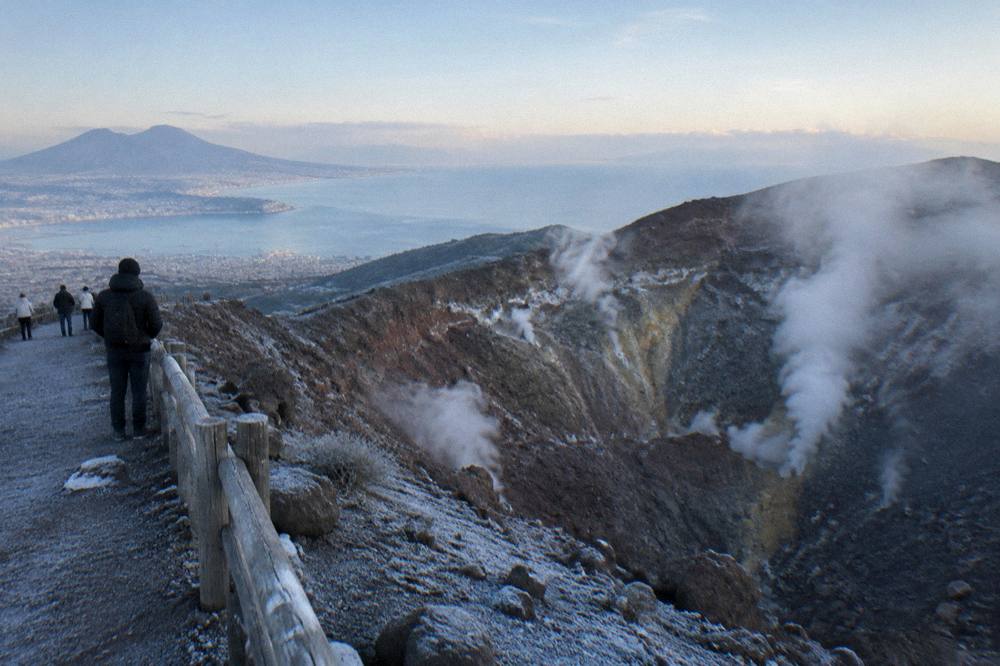
One caveat keeps the comparison honest. The 1,281 m summit figure belongs to the mountain; the public trail ends at 1,175 m, and the upper rim route beyond the turnaround is closed to everyone but researchers. Visitors comparing summit-to-summit should know the Vesuvius experience is a rim walk, not a summit bag. What you get at the turnaround is the crater's elliptical edge, up to 580 m across, with steam rising from the inner walls and the whole Bay of Naples below, delivered by a trail the park itself calls easy, short and sloping, on a mountain whose last eruption was in March 1944, a story told in this site's Mount Vesuvius last eruption guide.
Which Vesuvius Tour Should You Book If You Are Worried About Fitness?
Book a small-group guided crater walk rather than a self-guided transfer: the featured expert-guided tour from Pompeii, 3 hours, 4.8 from 242 reviews, from €65 per person, is the clearest fit, with the half-day guided trip from Naples, from €44.80 per person, as the pickup-included alternative. Both put a guide beside you on the gravel, both flag free cancellation on the listing, and both leave the harder decision, which month and which slot, inside your control. The trio below reprises the full range from guided to transfer-only so the choice stays visible at the decision point.
The decision rule, one last time in three lines. If your worry is the walk itself, take a guided small-group option and a shoulder-month morning slot. If your worry is only logistics, a transfer with entry included delivers you to the same trailhead for the same low-rated path. If your worry is the day's total length, skip the Pompeii combination on this visit and do the crater alone, then decide from the rim whether the ruins deserve a second day, as the Pompeii Or Vesuvius comparison on this site suggests many travellers should. Every option on this page is bookable for future dates; confirm the operator's current schedule on the live listing before you travel.
Common Questions About The Vesuvius Hike Difficulty
How Hard Is The Mount Vesuvius Hike?
The park officially rates the Gran Cono crater trail as low difficulty: 4,010 m round trip, 2 hours 30 minutes, topping out at 1,175 m. Most walkers of average fitness complete it comfortably. The real challenges are the steady uphill gradient, loose volcanic gravel underfoot, and summer heat, with summit highs averaging 22.8 C in August on the modelled 1991-2020 climate average.
Is The Vesuvius Hike Suitable For Older Walkers Or Beginners?
Yes, in most cases. The trail is wide, never technical, and every visitor above 1,000 m is accompanied by the park's volcanological guides, who set a group pace suited to ordinary walkers. Beginners should wear closed shoes with grip, carry water, and prefer a morning slot in the warmer months. Walkers with knee trouble should plan for the gravel descent, which reviews mention more often than the climb.
What Makes The Vesuvius Trail Difficult If The Rating Is Low?
The surface and the season. The path is loose volcanic gravel that shifts underfoot, especially downhill, and the outbound leg climbs steadily from the Quota 1000 plaza to the turnaround at 1,170 m. In July and August, unshaded heat adds the main strain. In wet months from October onward, rain averaging 129 mm in October and 180 mm in November can slick the surface between scheduled weather closures.
Do You Need Training Or Special Fitness For The Vesuvius Crater Walk?
No. The park's figures, 4,010 m and 2 hours 30 minutes round trip, describe a brisk hill walk rather than a training-dependent hike, and guided listings on this site state minimum ages as low as 4 or 6 years old where given. Shoes with grip, water and sun protection cover the practical requirements. The mandatory park guide accompaniment above 1,000 m means no one climbs alone regardless of fitness.
Is The Vesuvius Hike Harder Going Up Or Coming Down?
Coming down, for most people. The ascent is a steady but simple climb; the descent retraces the same loose gravel with tired legs and a distracting view. Guest reviews of the combined Pompeii and Vesuvius tours repeatedly mention uneven surfaces on this section, and the park advises suitable footwear and keeping to the right side of the walkway. Slow, short strides and grippy shoes solve most of it.
Does Weather Change The Difficulty Of The Vesuvius Hike?
Yes, and it can close the trail outright. Under the park's rules the ticket office and path close automatically on any day with an orange weather alert or higher, with automatic refunds for slots inside the closure. On ordinary days, heat is the main summer difficulty, damp gravel the main autumn and winter one, and the summit runs 6 to 7 C cooler than Naples in every month, so layers matter outside summer. Check the operator's live listing before travelling.