Inside The Mount Vesuvius Crater
The Vesuvius crater is an ellipse up to 580 m across, ringed by fumaroles, and the public trail stops at 1,175 m, a hundred metres below the summit. Here is exactly what that means for the walk you are booking.
Short answer
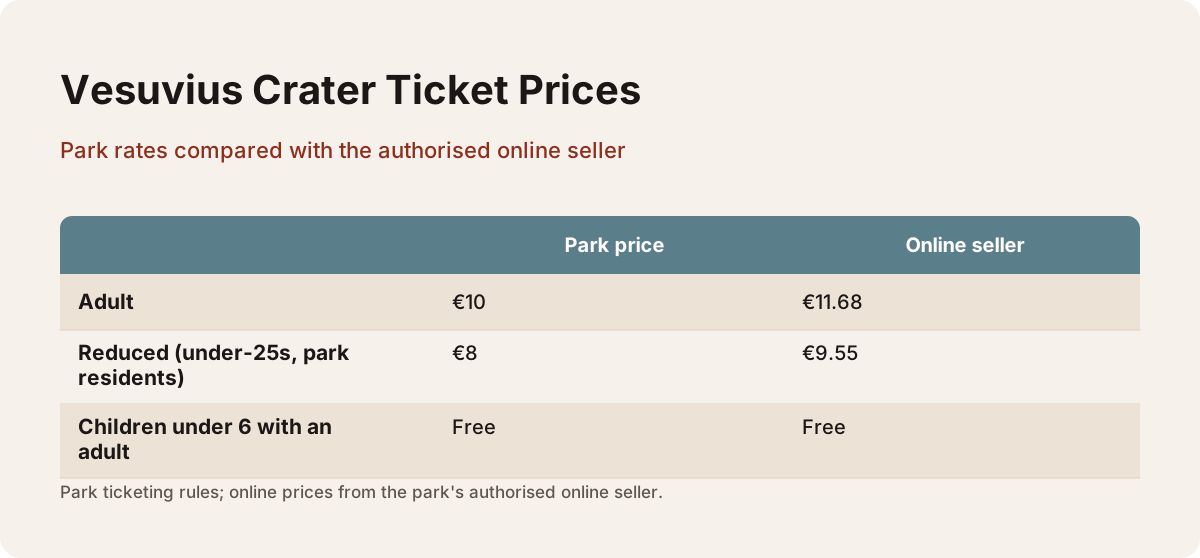
The Gran Cono trail climbs 4,010 m round trip to a turnaround at 1,175 m, below the 1,281 m summit. The crater is elliptical, up to 580 m across, with fumaroles on the inner walls. Entry is by timed online ticket, €10 (€11.68 from the authorised seller), and a park volcanological guide accompanies every visitor above 1,000 m.
The Vesuvius crater is the reason the trail exists. Everything a visitor does on this mountain, the shuttle up from Ercolano, the timed ticket, the volcanic soil underfoot, leads to roughly twenty minutes standing on the rim of the cavity that swallowed the old summit in AD 79. What surprises many first-time visitors is how regulated that moment is, and how far short of the true summit it lands. This guide sets out what the crater actually is, what you see from the turnaround, and how the access rules shape the visit. The tight access rules also raise an obvious souvenir question, and our guide to whether you can take a rock home from Vesuvius covers what the park actually publishes.
The numbers matter because a lot of loose talk circulates about this crater. The park's own page gives the ellipse a maximum diameter of 580 m. It publishes no depth figure at all, and any number you have read elsewhere is a guess dressed as fact. The public trail ends at 1,175 m. The summit, per the INGV, is 1,281 m. Nobody on a standard visit stands on the highest point, and nobody walks the upper rim. Those two facts alone change what you should expect from the photos.
What Is The Vesuvius Crater?
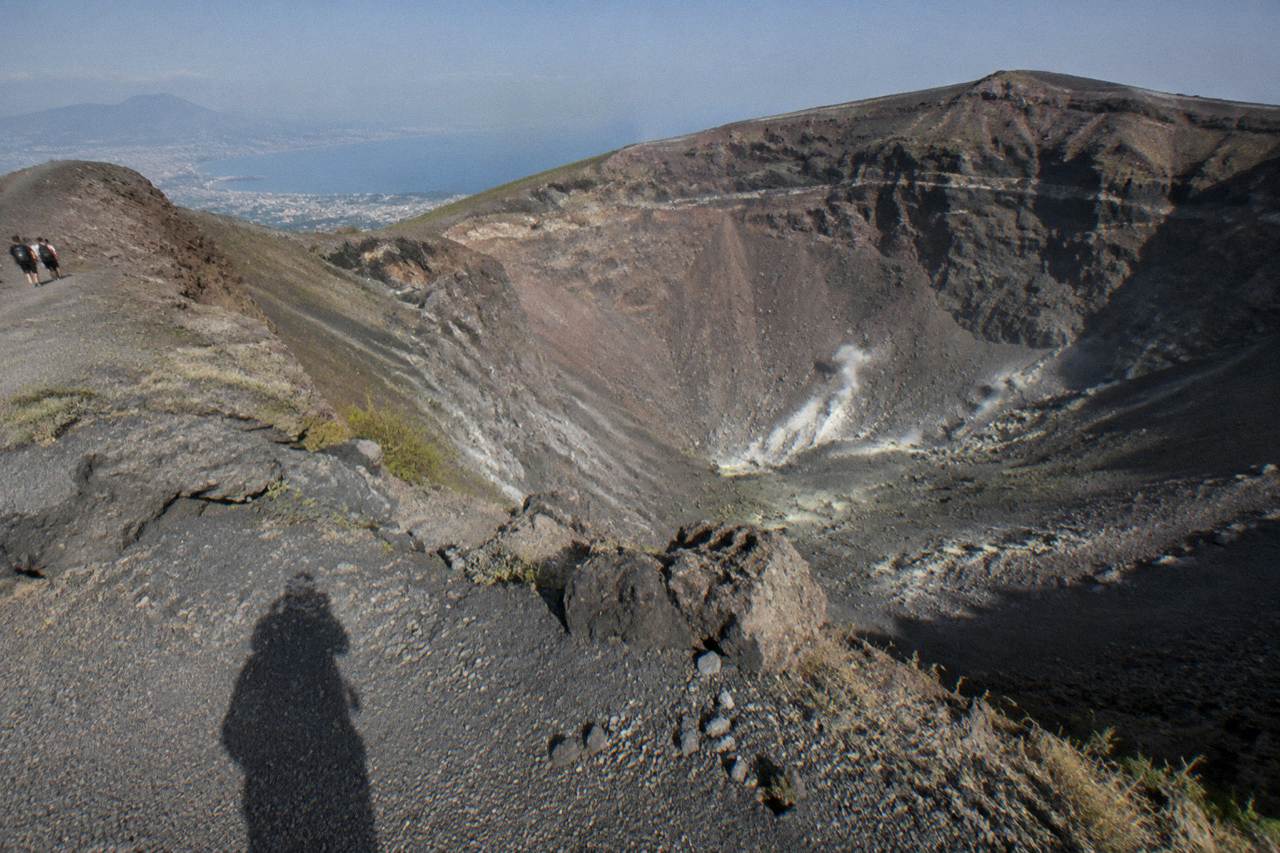
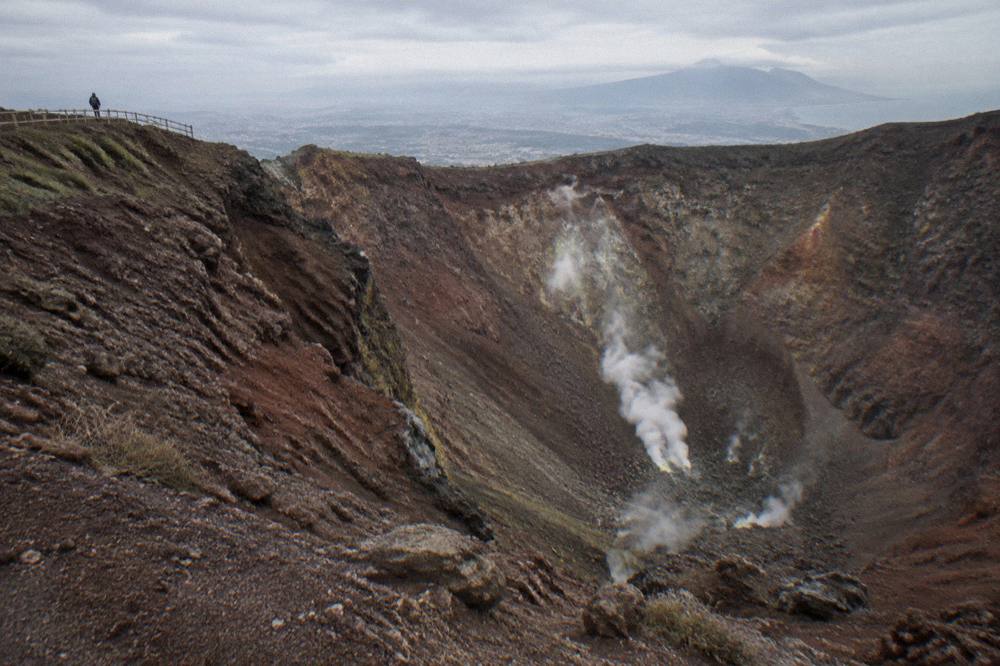
The Vesuvius crater is the large elliptical depression at the top of the Gran Cono cone, formed by collapse and explosion during the AD 79 eruption and modified by every eruption since, most recently in 1944. The park measures its maximum diameter at 580 m. Fumaroles still vent on the inner walls, which is why the volcano is described as active but in a state of quiescence.
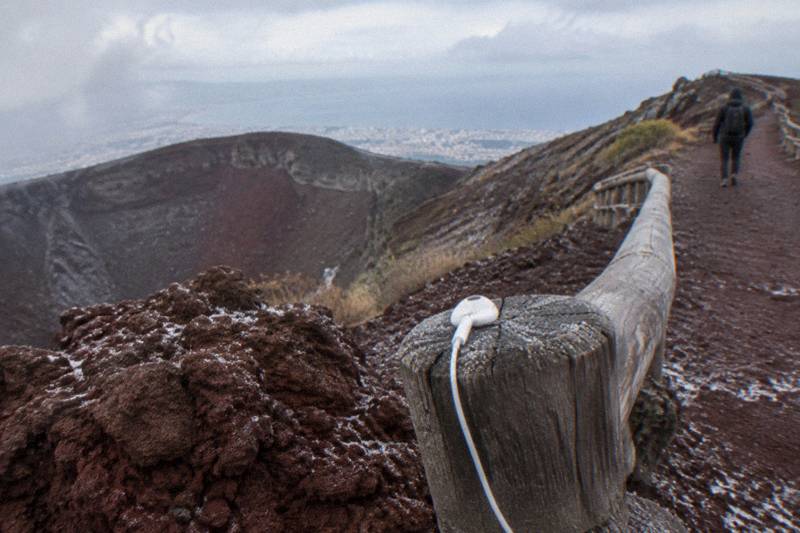
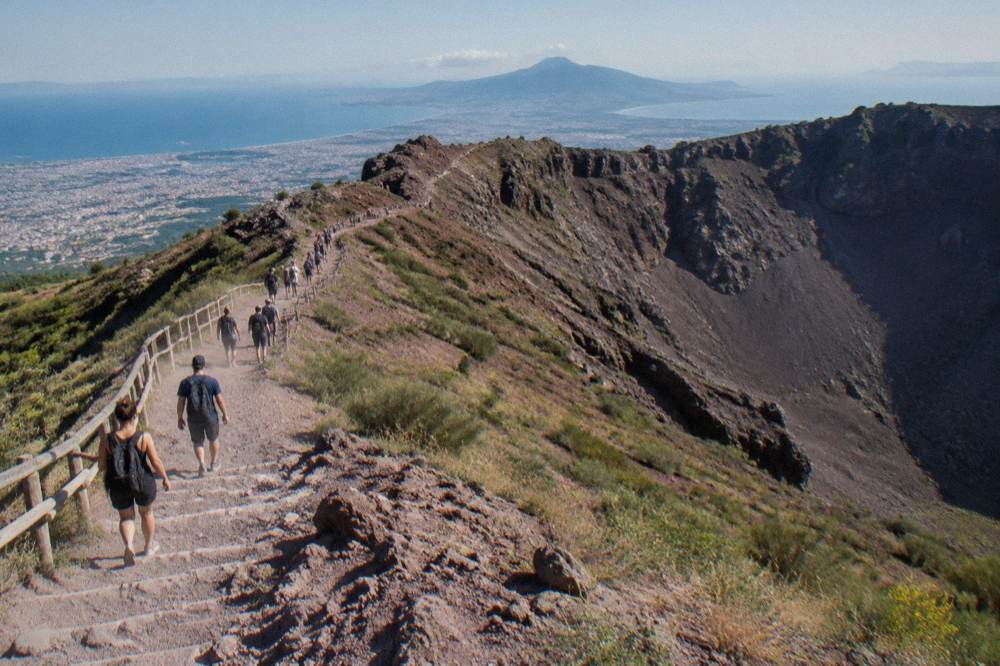
The cone you climb, the Gran Cono, grew inside the ruined rim of older Mount Somma after AD 79. Think of the mountain as two structures: an ancient outer wall, Monte Somma, and the younger inner cone that carries the crater. The trail to the turnaround zigzags up the flank of that younger cone from the Quota 1000 plaza near Ercolano, per the park's Trail 5 infobox.
The last eruption reshaped the crater floor in March 1944, when activity began on 18 March, intensified on 19 March, and lava reached the towns on 21 March, per the INGV Osservatorio Vesuviano. Since then the crater has been quiet, but not inert. Fumarolic activity continues on the inner walls, and the Osservatorio's monitoring, currently at green alert level, records small earthquakes most months, 121 of them in the September bulletin with a maximum magnitude of 1.7. Standing at the turnaround you can sometimes see the faint vapour threads and smell the sulphur. It is a working volcano on a very long pause.
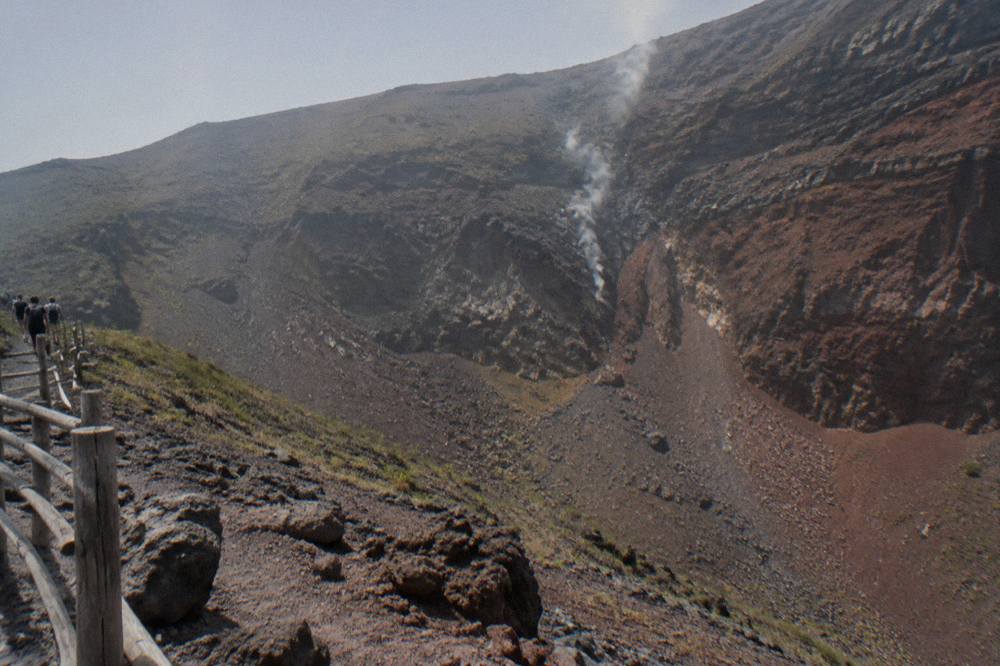
One boundary rule defines the visit: the upper rim route is closed to the public, reserved for researchers. Visitors walk to a viewpoint area near the turnaround at 1,170 m and no further along the rim itself. Anything advertising a "crater walk" beyond that, or a descent into the crater, is not describing a product that exists on this mountain.
How Far Up The Crater Trail Can You Actually Walk?
The Gran Cono trail runs 4,010 m round trip from the Quota 1000 plaza to a turnaround at 1,170 m, with the path's stated maximum altitude at 1,175 m, and takes about 2 hours 30 minutes round trip. The park rates the difficulty low. It is an out-and-back walk on volcanic gravel, not a summit hike, and you stop roughly 100 m below the true summit at 1,281 m.
The route starts at San Vito, on the Ercolano side, at the Quota 1000 plaza. A ticket hut sits at 1,118 m, where staff check the timed entry, and the turnaround viewpoint, called the Capannuccia, sits at 1,170 m. Between those points the path is a broad, churned track of ash and loose lapilli. The park's protocol caps any organised tour at 2 hours on the shortest route and 3 hours on the longest, a loop variant toward Rifugio Imbo. Independent visitors on a standard ticket get whatever the closing schedule allows, since every visit must end within one hour of the last access time.
For walkers deciding whether this is the right outing, the fuller preparation detail, footwear, pacing, water, lives in our How To Hike Mount Vesuvius guide, and the routes across the whole national park are mapped in Mount Vesuvius Trail Map And Routes. The crater trail is Trail 5, one of eleven numbered paths in the park.
Every visitor above 1,000 m is accompanied by the park's volcanological guides, one for each group. This is mandatory under the park protocol, not an optional extra. In practice it means a short briefing at the top and park staff stationed along the rim stretch, keeping walkers to the right side of the walkway. If you want a deeper version of that guidance, a volcanologist-led product like the Vesuvio 3h trekking tour with volcanological guide, from €260 per group of up to 4, stretches the visit to the protocol's full allowance. You can Check availability if that format appeals.
What Do You See From The Crater Rim?
From the turnaround you look directly across the elliptical crater mouth, up to 580 m at its widest, with fumaroles visible as vapour on the far inner walls. Turn outward and the reward is the panorama: the Bay of Naples, the islands, the Sorrento peninsula, and, on clear days, the whole sprawl of the red-zone towns that live beside a live volcano.
The crater view is closer to standing on a stadium wall than peering from a peak. The rim curve is wide, the interior a steep bowl of rust and grey ash bands, each layer an eruption. Because the upper rim path is off limits, your angle is fixed: you see the crater from the designated stretch near the turnaround, with park guides managing the flow. Photography works best in the morning, before the haze that often builds over the bay by early afternoon, a pattern covered in detail in our weather guide and in the seasonal pages under Mount Vesuvius by month. That open stretch of rim bakes in the sun and catches wind off the bay, so our guide to what to wear on the Vesuvius trail covers the layers and footwear that hold up best on the ash.
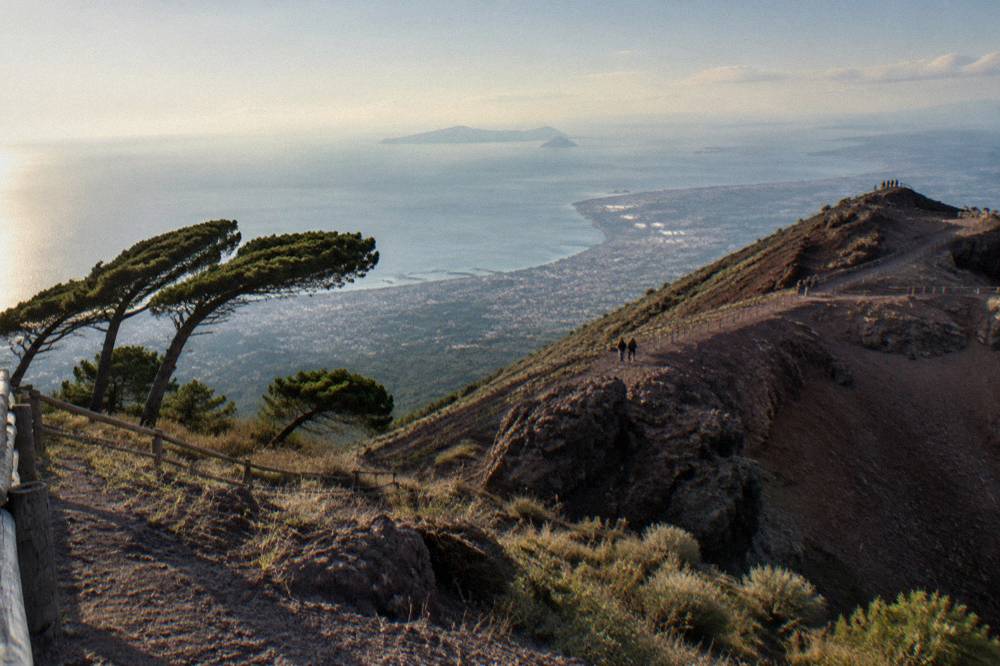
The outward view explains why this lookout became the classic image of Naples. To the west lies the bay and the city; to the south, Sorrento and Capri on clear days; northward, the wooded wall of Monte Somma with its valleys and old lava channels. The red zone around the mountain holds about 700,000 residents across 25 municipalities, per Regione Campania Civil Protection, and from the rim you can read that geography in a single glance: towns pressed to the slope on all sides.
Whether the payoff justifies the effort is genuinely personal, and we unpack the arguments, cost, crowds and views, in Is It Worth Going Up Mount Vesuvius?. Reviews on the roster's crater-heavy tours lean positive: the skip-line ticket with digital guide product holds 4.2 from 3,756 reviews, and guests on transfer-based options regularly praise the independence the format gives them, one calling it "great and being able to explore and walk up in our own time was amazing".
How Does Crater Entry And Ticketing Work?
Crater entry is online-only, by timed 10-minute slot, with 50 tickets per slot released 30 days ahead. The park's adult ticket is €10 under its ticketing rules; the park's authorised online seller shows €11.68. Reduced tickets are €8 (€9.55 online) for under-25s and residents of the 13 park municipalities, and children under 6 with an adult go free.
The full mechanics deserve their own reading, and our tickets guide covers them, but the crater-specific points are these. A normal ticket is valid from 120 minutes before to 120 minutes after the printed slot, within opening hours, which gives you real flexibility on the day. When advance slots sell out, a last-minute release of 10 tickets per slot appears 30 minutes before each slot, buyable only over the wifi near the entrance, capped at 5 per email address, and named, so the ticket must match your ID.
If you would rather not manage any of this, transfer-and-ticket products bundle the ride and the entry. The Mount Vesuvius Transfer with Entry Tickets from €35.10 per person, rated 4.4 from 1,785 reviews, is the cleanest example departing Naples, and the bus transfer with park entry from Pompeii at from €35.10 per person, 4.3 from 1,923 reviews, does the same from the ruins side. Check each listing for exactly what entry is included.
When Is The Crater Trail Open, And When Does It Close?
Crater access runs 09:00 to 15:00 in January, February, November and December, to 16:00 in March and October, to 17:00 in April, May, June and September, and to 18:00 in July and August. The closing time is last access, and the visit must end within one hour of it. The trail and box office close automatically on any day with an orange regional weather alert or higher.
That weather rule is the single most useful thing to know about planning, more than any month ranking. An orange or red alert from the regional civil protection authority shuts the path without negotiation, and tickets for slots inside a closure are refunded automatically. Slots adjacent to a closure are refundable on request within 30 days. This is why every operator on our roster phrases its crater products as bookable for future dates, with free cancellation flagged on nearly all the listings, and why you should keep an eye on the forecast in the 48 hours before your slot.
| Month | Crater access (last access) | Daily visitor cap | Summit avg high/low (C) | Summit rain mm (days) |
|---|---|---|---|---|
| January | 09:00-15:00 | 2,160 | 5.6/0.0 | 119 (11.7) |
| February | 09:00-15:00 | 2,160 | 6.0/-0.1 | 103 (11.2) |
| March | 09:00-16:00 | 2,520 | 8.3/1.5 | 104 (10.5) |
| April | 09:00-17:00 | 2,880 | 11.1/3.8 | 87 (11.1) |
| May | 09:00-17:00 | 2,880 | 15.1/7.5 | 59 (8.0) |
| June | 09:00-17:00 | 2,880 | 19.2/11.6 | 30 (5.3) |
| July | 09:00-18:00 | 3,240 | 22.1/14.5 | 16 (3.3) |
| August | 09:00-18:00 | 3,240 | 22.8/15.2 | 22 (3.9) |
| September | 09:00-17:00 | 2,880 | 18.7/12.0 | 90 (8.7) |
| October | 09:00-16:00 | 2,520 | 14.8/8.5 | 129 (10.5) |
| November | 09:00-15:00 | 2,160 | 10.4/4.9 | 180 (13.6) |
| December | 09:00-15:00 | 2,160 | 6.7/1.4 | 147 (13.1) |
Climate figures are modelled 1991-2020 climate averages for the 1,000 m level, not forecasts, and the summit-level highs run about 6 to 7 C below Naples in every month. The pattern that matters for a rim visit: winter slots are few, cold and the wettest (November averages 180 mm of rain), while July and August offer the longest days, the biggest crowds and heat on the unshaded gravel. The trade-offs by season are laid out month by month in our best-time-to-visit guide and in Mount Vesuvius by month.
Because access ends between 15:00 and 18:00 depending on season, there is no crater hike at sunset from this trail, whatever a listing title implies. Park access ends before sunset in every month of the year.
How Many People Are On The Crater Trail At Once?
The trail admits a maximum of 360 hikers per hour, in groups of 60 every 10 minutes, each split into three groups of 20. The daily cap ranges from 2,160 in the winter months to 3,240 in July and August. Above 1,000 m, park volcanological guides accompany every group, which is a permanent rule, not a crowding measure.
Those caps, set by the park's protocol of 29 June 2026, mean the turnaround can feel busy at peak, since everyone converges on the same short rim stretch, but the flow is metered rather than a free-for-all. Arriving for the first or last slot of the day thins the numbers considerably. The 20 percent last-minute allocation, 10 tickets per slot, exists precisely because advance tickets vanish in summer; if you are on site anyway, trying the wifi release 30 minutes before a slot is a legitimate plan.
| Period | Hourly cap | 10-minute flow | Daily cap | Last access |
|---|---|---|---|---|
| January, February, November, December | 360 | 60 in 3 groups of 20 | 2,160 | 15:00 |
| March, October | 360 | 60 in 3 groups of 20 | 2,520 | 16:00 |
| April to June, September | 360 | 60 in 3 groups of 20 | 2,880 | 17:00 |
| July, August | 360 | 60 in 3 groups of 20 | 3,240 | 18:00 |
Small-group tour formats absorb some of that pressure for you. The Mount Vesuvius guided tour from Pompeii with transfer, from €65 per person and 4.8 from 282 reviews, keeps a licensed guide and a modest group size on the standard route, while the expert-guide version, also from €65 per person, 4.8 from 242 reviews, is a small-group product outright. For visitors who want the crater with the fewest moving parts, the skip-line excursion with digital guide at from €16 per person, 4.2 from 3,756 reviews, covers the ticket and an app commentary, though check the listing for what entry is included.
How Do You Get To The Crater Trailhead?
The trailhead is the Quota 1000 plaza above Ercolano. By car, take the A3 to the Torre del Greco exit and the SP144 to the Quota 800 car park, 15 minutes, 7.3 km, then walk about 30 minutes (1.8 km) or pay the Ercolano shuttle €1 each way, about 4 minutes. By transit, the Circumvesuviana to Ercolano Scavi or Pompei-Villa dei Misteri, then a shuttle or the EAV 808 bus.
Parking is its own small bureaucracy. There is no parking at Quota 1000 itself, and no public toilets there for now. Parking along the provincial road is run by the Comune di Ercolano: a maximum 4-hour stay, with cars up to 8 seats paying €7 in Area B, per the official parking operator. The park's own advice is to secure the crater ticket first and only then buy parking. Traffic limits on Via Osservatorio bar private cars at set hours, which is another reason the shuttle from Quota 800 is the standard last leg.
From the Pompeii side, the EAV bus 808 runs from Pompei Piazza Anfiteatro to Quota 1000 in 55 minutes for €3.80 on board, with nine departures a day each way under the timetable in force from 1 October 2026, per EAV. Note the catch: the last bus up arrives 15:25, after the winter last entry, so in the short-access months the bus cannot be your only plan. The full route options, including the transfer products that solve all of this for you, are compared in our shuttle and parking guide and in our guide to reaching Vesuvius from Pompeii (see Shuttle Bus And Parking). The trailhead logistics from Naples are mapped separately in our Naples transport guide.
| Approach | Route | Cost | Time | Caveat |
|---|---|---|---|---|
| Car + shuttle | A3 exit Torre del Greco, SP144 to Quota 800, shuttle to Quota 1000 | Parking €7 (cars to 8 seats), shuttle €1 each way | 15 min drive, then ~4 min shuttle | 4 h max parking stay; buy ticket before parking |
| Car + foot | Same drive, then walk 1.8 km to Quota 1000 | €7 parking | ~30 min walk | Unshaded stretch; factor the hour-rule |
| EAV bus 808 | Pompei Piazza Anfiteatro to Quota 1000 | €3.80 on board | 55 min | Last up run arrives 15:25 |
| Circumvesuviana + shuttle | Napoli Centrale to Ercolano Scavi, then private shuttle up | Train fare not stated | Varies by shuttle | Confirm the operator's current schedule |
| Guided transfer product | Naples or Pompeii pickup to trailhead, entry often bundled | From €35.10 per person | About 3 hours total | Check the listing for what entry is included |
One product family on the roster exists almost entirely for this trailhead problem. The guided crater transfer from Pompeii, from €65 per person with a 4.8 rating from 282 reviews, and the bus-transfer-with-park-entry product from €35.10 per person, 4.3 from 1,923 reviews, both deliver you to Quota 1000 with the entry question already answered, which is why reviews like Nicola's, "easy way to get from Pompeii to Vesuvius and back again", keep landing on them.
What Are The Crater Trail Rules You Should Know Before Booking?
Three rules shape every crater visit: entry is online-only with a timed slot, everyone above 1,000 m walks with the park's volcanological guides, and the upper rim route is closed to the public, so the turnaround at 1,170 m is the highest point you may reach. Weather alerts of orange or higher close the trail automatically, with automatic refunds for slots inside a closure.
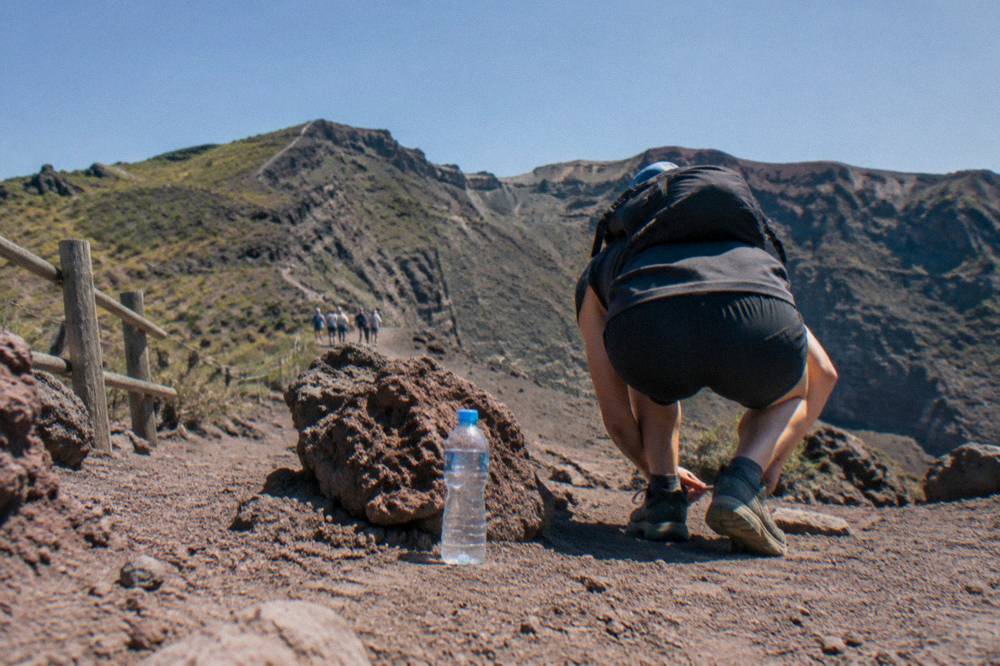
The practical layer matters too. Wear closed shoes with grip; the surface is loose volcanic gravel the whole way, and one guest review of a combined Pompeii and Vesuvius day puts it plainly: "very uneven surfaces and very hot in summer so trainers and water bottles". Carry more water than feels reasonable between June and September, since the track is fully exposed and the summit-level highs still reach the low 20s C even while Naples swelters in the high 20s.
Timing your slot against the rest of your day is the other decision. Many visitors pair the crater with Pompeii; the pairing strategy, which site first and how long each deserves, is worked through in our Pompeii and Vesuvius in one day guide and across the combined Pompeii-and-Vesuvius listings on this site. The general rule from the timings: the crater needs two to three hours from trailhead and back, while Pompeii can absorb a whole day, so most paired itineraries give Pompeii the morning and the crater the afternoon, arriving on a slot that respects the last-access hour.
Can You Go Inside The Vesuvius Crater?
No. Walking into the crater, along the upper rim, or to the true summit at 1,281 m is not permitted on any standard visit. The public trail ends at the turnaround at 1,170 m, the upper rim route is reserved for researchers, and the park's volcanological guides enforce the boundary. No operator on this roster sells interior access, because none exists to sell.
This is worth stating flatly because the phrase "crater tour" invites the wrong mental picture. You walk to the rim's edge, look in, and walk back. What you get for that is a genuine close-up of a young volcanic cone, the layered ash walls, the fumaroles, and one of the great coastal panoramas in Europe, all inside about two and a half hours. What you do not get is a summit standing, a rim circuit or a descent. Set expectations to match and the visit almost always lands well; expect a summit conquest and it will not.
For visitors whose real interest is the volcano's science rather than the viewpoint, the two-hour VIP tour with a volcanological guide, from €129 per person and rated 4.9, though from a small pool of only 15 reviews, sells exactly that framing: time with a specialist on the standard route. The 3-hour trekking product from €260 per group of up to 4, 4.7 from 15 reviews, another small pool, is the extended version. Both stay within the same trail limits as everyone else.
How Does The Crater Compare Across Tour Formats?
Crater visits come in four formats: a bare timed ticket and self-guided walk, a transfer-and-ticket product that solves the trailhead, a guided group hike with an operator's guide, and specialist products with a volcanological guide. Prices on this roster run from €16 per person for the ticket-plus-app option to €260 per group of up to 4 for the specialist trek. All walk the identical trail to 1,175 m.
No format buys you a different crater. What changes is who handles the entry, the ride, and the interpretation. The comparison below uses the roster's own firm figures so you can see the spread at a glance, and the deeper format-by-format trade-offs, group versus private, guided versus independent, are analysed in our guided versus self-guided guide and in our Vesuvius tickets explainer.
| Format | Example product (roster) | From price | Rating (reviews) | What it adds |
|---|---|---|---|---|
| Ticket + digital guide | Mount Vesuvius Excursion: Skip-Line Ticket and Digital Guide | €16 per person | 4.2 (3,756) | Entry handling plus app commentary |
| Transfer + entry | Mount Vesuvius Transfer with Entry Tickets | €35.10 per person | 4.4 (1,785) | Naples pickup, trailhead delivery, entry |
| Guided group hike | From Pompeii: Mount Vesuvius Guided Tour with Transfer | €65 per person | 4.8 (282) | Licensed guide, small group, transfer |
| Volcanologist trek | Vesuvio: 3h trekking tour with volcanological guide | €260 per group (up to 4) | 4.7 (15, small pool) | Specialist guide, full protocol time allowance |
The honest closing comparison: if you have a car and book early, the bare ticket is the cheapest route to the same rim. If you do not, or if your dates sit in the sold-out summer window, the transfer products earn their margin, and a review like Mia's, "the staff on both ends in Pompeii and on the volcano are friendly", reflects why. The specialist formats are for visitors who want the volcano explained, not just shown.
Readers planning a fuller week around the mountain will find the whole bookable range, wine, horse riding, Pompeii combinations, laid out across this site's hubs, starting from Mount Vesuvius Tours.
Common Questions About The Vesuvius Crater
How big is the Vesuvius crater?
The crater is elliptical with a maximum diameter of 580 m, per the park's own figures. The park publishes no depth, and no verified depth figure exists, so treat any number you read elsewhere with suspicion. Fumaroles vent on the inner walls.
Can you walk to the top of Mount Vesuvius?
No. The public trail ends at a turnaround at 1,170 m, with the path's maximum altitude at 1,175 m, while the summit is 1,281 m per the INGV. The upper rim route is closed to the public and reserved for researchers.
Do you need a guide for the crater trail?
Yes, in a specific sense: above 1,000 m every visitor is accompanied by the park's volcanological guides, one per group, under the park protocol. Booking an operator's guided tour adds interpretation and logistics on top of that mandatory accompaniment.
How long is the walk to the crater rim?
The Gran Cono trail is 4,010 m round trip and takes about 2 hours 30 minutes round trip at a moderate pace. Organised tours are capped at 2 hours on the shortest route and 3 hours on the longest.
Can the crater trail close after I book?
Yes. The trail and box office close automatically on days with an orange regional weather alert or higher. Tickets for slots inside a closure are refunded automatically, and adjacent slots are refundable on request within 30 days.
Is the Vesuvius crater still active?
The volcano is active but in quiescence. The alert level is green, and the September 2026 INGV bulletin recorded 121 small earthquakes, maximum magnitude 1.7, with fumaroles visible on the crater's inner walls. The last eruption was March 1944.