Mount Vesuvius Webcam And Current Conditions
There is no single official Vesuvius webcam to rely on, and trail conditions change with every weather alert. Here is how to read the real signals before you climb.
Short answer
Vesuvius conditions are governed by rules, not by guesswork: the crater trail and its ticket office close automatically on any day with an orange weather alert or higher, with automatic refunds for affected slots. Check the park's Gran Cono page for status and hours, and the INGV Osservatorio Vesuviano page for the volcano alert level, which is published as green.
Checking conditions on Mount Vesuvius before a visit is mostly a question of knowing which signals matter. A camera pointed at the mountain tells you almost nothing, because the two things that actually decide your day, the regional weather alert level and the daily ticket capacity, are published on official pages rather than streamed anywhere. This guide explains what to check, when to check it, and how the closure and refund rules work, so you can book with a plan rather than a hope. The short version: read the park's Gran Cono page and the observatory's status page, understand that an orange alert closes the trail automatically, and treat any tour booking as flexible until the forecast settles.
Where Can You See Live Mount Vesuvius Conditions?
No official Vesuvius webcam exists as a verified source, and this site does not link or name one. The two authoritative live signals are the Parco Nazionale del Vesuvio Gran Cono page, which carries the ticketing rules, hours and closure conditions, and the INGV Osservatorio Vesuviano status page, which publishes the volcano alert level and monthly seismic bulletin. Everything else is commentary.
Plenty of third-party sites and tourism pages embed feeds labelled as Vesuvius cameras, but their reliability, framing and freshness cannot be checked from the outside, and a stale or mislabelled feed is worse than no feed at all. What we recommend instead is a two-step routine. First, the park's own Gran Cono page states the access rules that apply on any given day, including the automatic closure mechanism and the seasonal hours. Second, a general weather forecast for the Naples area gives you the practical picture, because summit conditions track the regional weather with a temperature offset of roughly six to seven degrees against the city.
That temperature offset matters more than most visitors expect. The public trail tops out at 1,175 m, and the modelled 1991-2020 climate average puts summit daytime highs about 6 to 7 C below Naples in every month of the year. A warm spring afternoon in the city can still be jacket weather at the ticket hut at 1,118 m. For a fuller treatment of summit weather patterns, read our guide to Mount Vesuvius Weather And Summit Visibility, and for the layering question specifically, the blog post Is It Cold At The Top Of Vesuvius? answers it directly.
| Source | What it actually tells you | How fresh it is |
|---|---|---|
| Park Gran Cono page | Access rules, seasonal hours, ticket mechanics, closure conditions | Maintained by the park authority |
| INGV Osservatorio Vesuviano status page | Volcano alert level and monthly seismic bulletin | Updated monthly, alert level as published |
| Regional Civil Protection alerts | The weather alert colour that triggers automatic closure | Issued day by day |
| Your tour operator | Whether your specific departure is running | Confirm the operator's current schedule |
How Do You Know If The Vesuvius Crater Trail Is Open Today?
The trail and the ticket office close automatically on any day the regional Civil Protection authority issues a weather alert of orange or higher, with no manual judgement involved. Tickets for slots inside a closure are refunded automatically, and adjacent slots can be refunded on request within 30 days. This is a rule, not a standing status, so never trust a page that claims the trail is open or closed as a permanent fact.
This automatic mechanism is the single most useful thing to understand about Vesuvius planning. It means you do not need to chase rumours or read tea leaves: on a green or yellow alert day the normal rules apply, and from orange upward the mountain closes itself. No closure for August heat or for holidays is documented in the official rules, so discount any blog that tells you the crater shuts for the summer. For current status, the Mount Vesuvius Tours homepage carries a This Season band, and the park's own page is the primary record.
The refund structure also removes most of the risk from booking ahead. If you buy a crater ticket directly and the day turns orange, the money comes back without you filing anything, with refunds processed within 60 days. If you book a tour, most listings on this site flag free cancellation, and operators rebook around closures as a matter of routine, though you should confirm the operator's current schedule before travel. The practical consequence is that waiting for a perfect forecast often costs you the date, because slots sell on a 30-day release window and capacity is fixed by rule, not by demand.
If you would rather have someone else make the weather call, the Pompeii: Mount Vesuvius Hike & Tour by Bus, rated 4.1 from 213 reviews and from €35.10 per person, bundles the transfer from Pompeii with the crater entry, and the Mount Vesuvius Tour with Ticket from Naples, 4.5 from 596 reviews and from €41 per person, does the same from the city. The Exclusive Pompeii & Vesuvius Tour with Lunch from Naples, 4.7 from 3,701 reviews and from €78.20 per person, adds a meal and an archaeologist guide to a full-day frame.
What Does A Clear Day Look Like From The Vesuvius Crater?
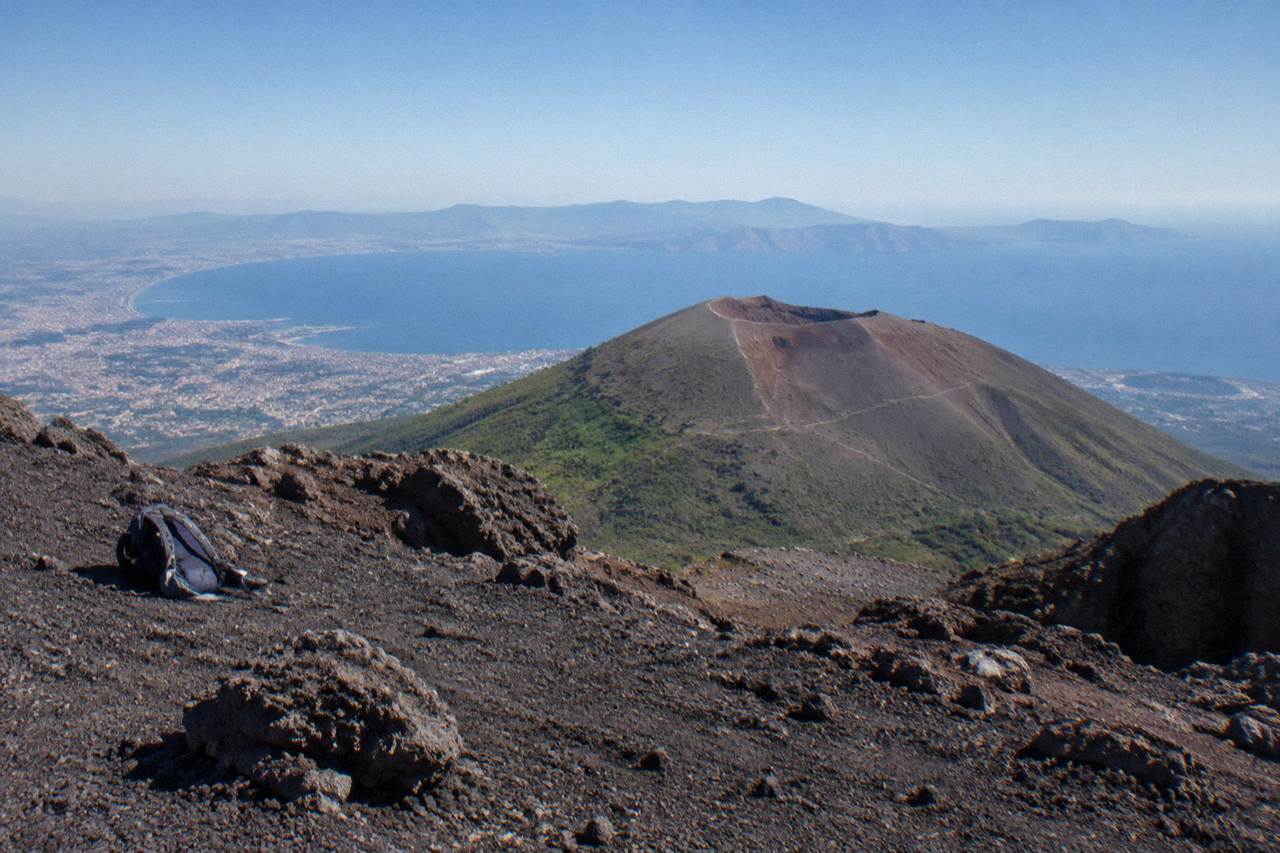
On a genuinely clear day the crater rim delivers one of the widest single views in Italy: the whole Bay of Naples, the Sorrento Peninsula and Capri to the south, the islands of Ischia and Procida to the west, and the Apennines inland. Visibility is the variable, not the volcano. Hazes build quickly over the bay in warmer months, so the clearest mornings are usually the ones after a front has passed.
Guest reviews consistently name the panorama rather than the crater itself as the payoff of the climb. One traveller on the Day Trip to Pompeii, Herculaneum and Vesuvius from Naples described "a beautiful view of Naples, the crater, the country side, Sorrento and Capri" from the hike (see Pompeii And Herculaneum In One Day). That is the standard clear-day inventory, and it lines up with the geography: the turnaround point at 1,170 m sits high enough to clear the local ridgeline and open the entire bay.
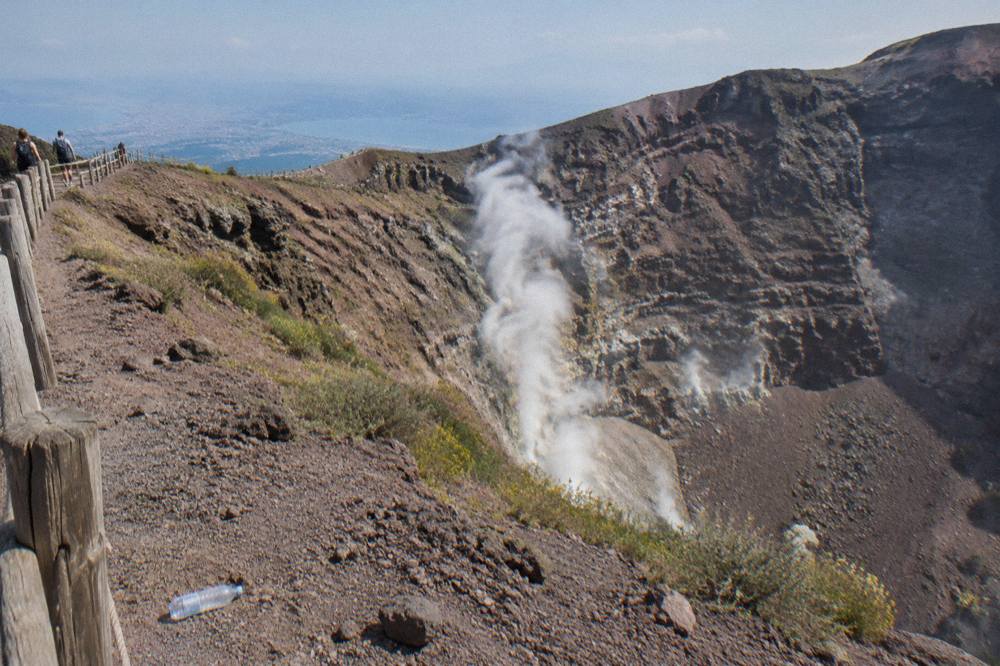
The crater you look into is an elliptical depression with a maximum diameter of 580 m, with fumaroles visible on the inner walls, a reminder that this is an active volcano in a quiescent phase. The upper rim route itself is closed to the public and reserved for researchers, so every visitor walks the same designed trail and turns at the same point. Keep to the right side of the walkway, as the park instructs, because visitor flow is two-way on a single path.
Timing shapes what you see. Late-morning haze over the bay is common from late spring onward, while winter days are often crisper but shorter, with the last crater access at 15:00 from November through February. If the view is the whole point of your trip, plan the earliest slot you can reasonably reach and treat the afternoon as a bonus. The monthly detail, including sunrise and sunset times against the access hours, is laid out in our Mount Vesuvius by month pages at Mount Vesuvius by month.
A guided ticket-and-transfer product removes the main failure mode on a marginal day: arriving at Quota 1000 only to find the last entry has passed or the slots are gone. Operators watch the alert levels, and a tour booked with free cancellation converts a weather gamble into a booking you can hold while the forecast settles.
How Reliable Is The Weather At The Vesuvius Summit?
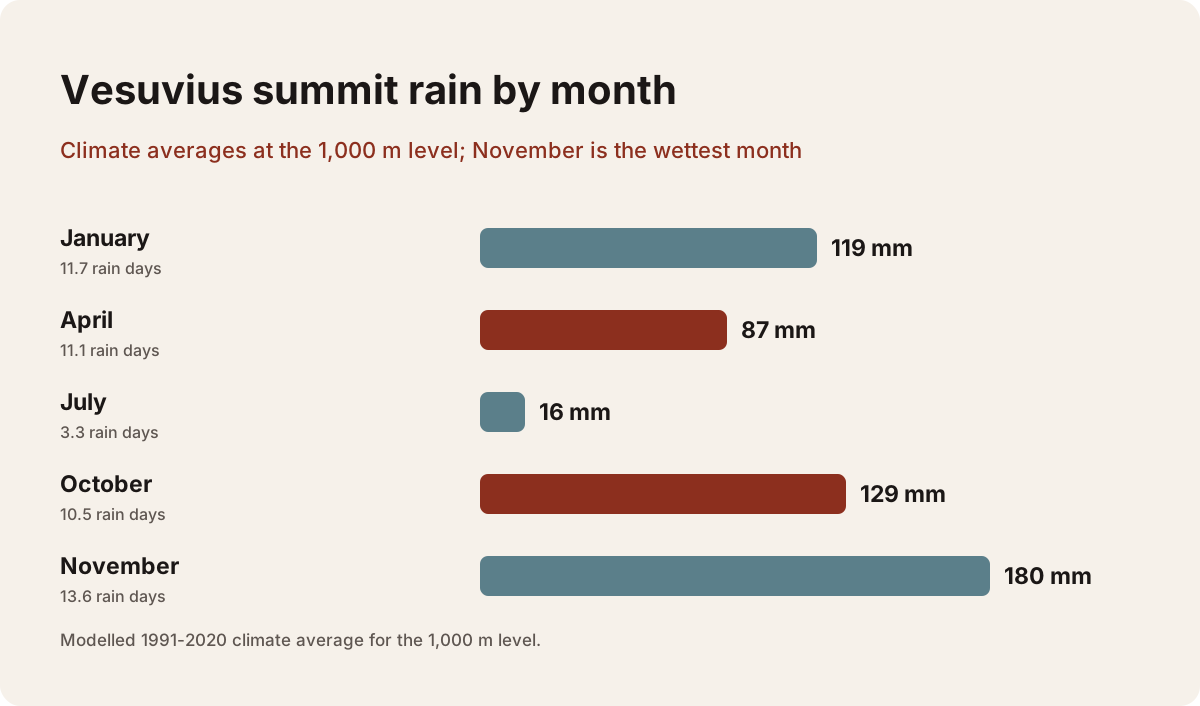
Summit weather is reliably cooler and wetter than Naples, by roughly 6 to 7 C on daytime highs and with substantially more rain in the wet months. The modelled 1991-2020 climate average for the 1,000 m level shows November as the wettest month at 180 mm and July as the driest at 16 mm. Plan layers and a rain shell in every season except high summer, and expect a real windchill at the turnaround point.
The table below pulls the seasonal rows a conditions-checker actually needs. These are climate averages, not forecasts, so they tell you what a month is typically like rather than what next Tuesday will do. Use them to decide what to pack and which half of the day to aim for, then check a real forecast in the 48 hours before you travel.
| Month | Summit high/low C (average) | Summit rain mm (days) | Naples high/low C |
|---|---|---|---|
| January | 5.6 / 0.0 | 119 (11.7) | 11.7 / 5.5 |
| April | 11.1 / 3.8 | 87 (11.1) | 17.4 / 9.4 |
| July | 22.1 / 14.5 | 16 (3.3) | 28.6 / 20.3 |
| October | 14.8 / 8.5 | 129 (10.5) | 20.9 / 14.1 |
| November | 10.4 / 4.9 | 180 (13.6) | 16.4 / 10.4 |
Two patterns in that data drive most visitor surprises. First, the offset: even in August, when Naples averages 29.3 C, the summit level averages 22.8 C, and the rim is windy enough to feel colder than the number. Second, the shoulder months carry real rain: October and November together average more than 300 mm at the summit level, which is exactly the window in which orange alert days become more frequent and the automatic closure rule bites. None of this argues against visiting in those months, only against planning them the way you would plan July.
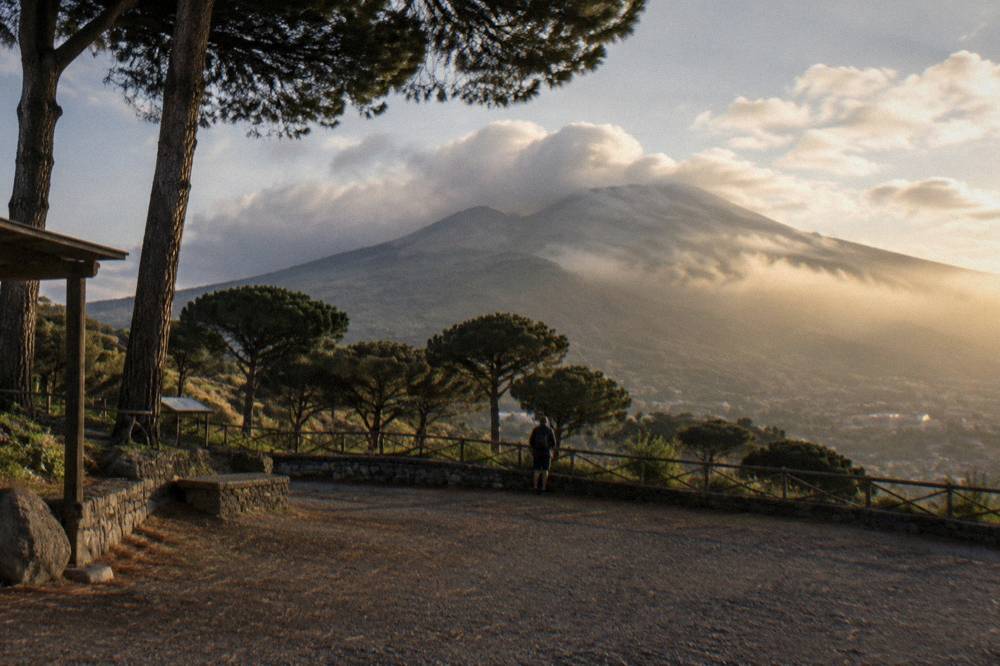
Snow is genuinely rare at the trail level, about 1.7 days a year in the modelled average for the 1,020 m grid cell, so winter visitors should plan for cold mud rather than a snowline. Footwear advice follows from the surface: one guest review of the full-day Naples tour noted "very uneven surfaces and very hot in summer so trainers and water bottles", which holds in every season with the temperature swapped out. Our How To Hike Mount Vesuvius guide covers shoes, pacing and the trail profile in detail at How To Hike Mount Vesuvius.
What Time Does The Vesuvius Crater Trail Close Each Month?
Crater access runs from 09:00 to a last-access time that shifts by month: 15:00 in January, February, November and December, 16:00 in March and October, 17:00 from April to June and in September, and 18:00 in July and August. The visit must end within one hour of the last access. Daily caps scale with the hours, from 2,160 visitors in the short winter months to 3,240 in July and August.
The closing time is the last entry, not the moment the park empties, so a 16:00 last access in October still gives you until 17:00 on the trail. What it does not give you is slack at the end of the day, and this is where transport planning fails. The EAV bus 808 from Pompei arrives at Quota 1000 for the last time at 15:25, which is after the winter last entry, so in the November-to-February window the bus cannot be your only plan. The full timetable lives on the official EAV page for line 808.
| Months | Crater access hours | Daily visitor cap |
|---|---|---|
| January, February, November, December | 09:00 to 15:00 | 2,160 |
| March, October | 09:00 to 16:00 | 2,520 |
| April, May, June, September | 09:00 to 17:00 | 2,880 |
| July, August | 09:00 to 18:00 | 3,240 |
Capacity flows are metered, not bulk: the rule is 60 people every 10 minutes in three groups of 20, a maximum of 360 hikers per hour, with tickets sold only online in timed slots of 50 released 30 days ahead. A last-minute release of 10 named tickets per slot opens 30 minutes before each slot, buyable only via the wifi near the entrance and capped at 5 per email address. Twenty percent of each day's tickets are held back for this last-minute pool. For walkers rather than riders, the site's Mount Vesuvius hiking tours category collects the guided options that include entry.
Is Vesuvius Safe To Visit Right Now?
The published volcano alert level is green, the lowest, with monitoring parameters within base values. The September 2026 observatory bulletin recorded 121 small earthquakes, none stronger than magnitude 1.7, and notes a long-term decline in hydrothermal activity in the crater. Above 1,000 m every visitor is accompanied by the park's volcanological guides, which makes the crater walk a guided one by rule, not by choice.
The monitoring context is worth understanding, because it explains why the park can run a daily visitor operation on an active volcano. Vesuvius is intensively instrumented, and the alert level is a formal published parameter rather than a mood. The current level and the latest bulletin can be read directly on the Osservatorio Vesuviano status page. Small earthquakes in the crater area are normal background seismicity, the kind the bulletin counts every month, and the bulletin's note on declining hydrothermal activity has been consistent across recent editions.
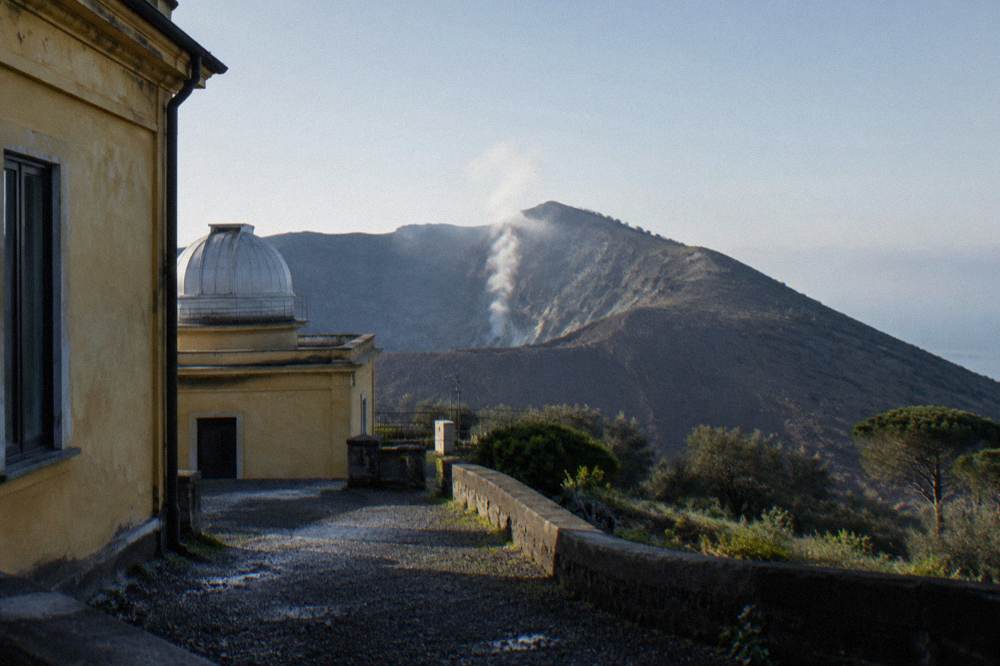
The mandatory accompaniment rule means that even a visitor who arrives with a plain entry ticket walks the upper trail behind a park guide. Every group above 1,000 m is accompanied by guides of the park's permanent volcano service. That structure, plus the timed slots and the automatic closure rule, is the safety system. It is also why the crater hike is not comparable to a wild mountain walk: capacity, pace and route are all controlled.
The last eruption was in March 1944, when lava reached the surrounding towns on 21 March after activity that began on the 18th. Nothing in the current bulletin suggests a change of phase, and the formal position of the observatory is routine monitoring within base values. If a reader's real question is whether the region around the volcano is exposed, the red zone plan covers about 700,000 residents across 25 municipalities, a figure maintained by the regional Civil Protection authority and worth knowing as background rather than as a travel worry.
Should You Book A Vesuvius Tour Or Wait For The Forecast?
Book first, then watch the forecast, provided the booking carries free cancellation, which nearly every listing on this site flags. Direct crater tickets sell in 30-day timed releases and the last-minute pool is small and named, so waiting rarely wins you anything. A tour with a flexible policy plus the automatic refund rules turns weather risk into a scheduling detail rather than a lost day.
The arithmetic is straightforward. Tickets are released 30 days ahead in slots of 50, and the peak months cap at 3,240 visitors a day. The last-minute release of 10 named tickets per slot, buyable only on the mountain's wifi 30 minutes before entry, is a backstop for locals and the flexible, not a strategy for a traveller with a fixed itinerary. Meanwhile the closure rule refunds automatically, so the downside of an early booking is close to zero. The genuine failure mode is booking a no-refund element, such as a rigid private transfer, around a marginal forecast day.
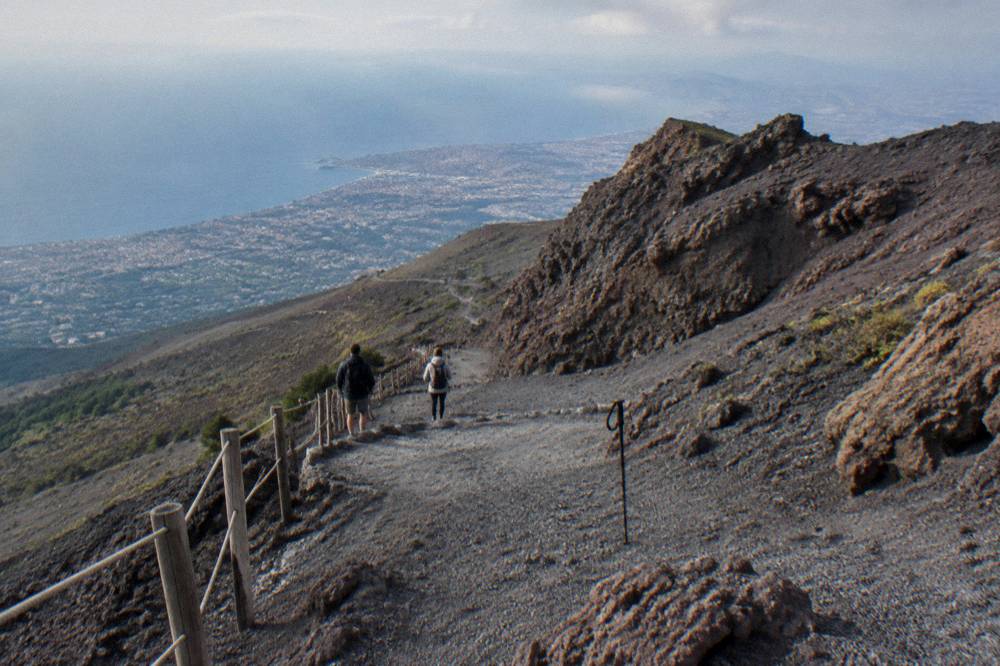
For travellers starting in the city, the Mount Vesuvius Tour with Ticket from Naples covers pickup, a guided walk and the skip-line entry in about four hours, rated 4.5 from 596 reviews and from €41 per person. It suits a morning slot and leaves the afternoon for Pompeii or Naples. The From Naples All-Inclusive Mount Vesuvius Half-Day Tour, 4.5 from 891 reviews and from €44.80 per person, is the same shape with hotel pickup included, a good fit when the forecast only cooperates for half a day.
If your conditions window is tight but you want the full ruins-and-volcano day, the Exclusive Pompeii & Vesuvius Tour with Lunch from Naples runs eight hours with pickup, a meal and the crater hike, rated 4.7 from 3,701 reviews and from €78.20 per person. Its early structure means you are on the trail before the afternoon haze builds, which is the single best visibility decision you can make on the mountain.
What Do Other Visitors Say About Conditions On The Trail?
Reviews name three recurring condition factors: heat and uneven surfaces in summer, wind and cool air at the rim, and the payoff of the bay panorama on clear days. None of them describe the trail as technically hard, and the park's own difficulty rating for the Gran Cono is low. The complaints that do appear are mostly about timing, heat, or sold-out slots, all of which are planning problems rather than trail problems.
A few verbatim reviews illustrate the pattern. Millie from the United Kingdom, on the From Naples: Pompeii Ruins & Mount Vesuvius Day Tour, wrote: "It was really good. The tour guide was entertaining and we learnt a lot and had plenty of opportunities to take photos. Very uneven surfaces and very hot in summer so trainers and water bottles." Jody S., on the three-site day trip, described the hike as "a good hike to the crater of Mt. Vesuvius with a beautiful view of Naples, the crater, the country side, Sorrento and Capri."
| Tour | Rating and pool | What reviews flag about conditions |
|---|---|---|
| From Naples: Pompeii Ruins & Mount Vesuvius Day Tour | 4.3 from 14,121 reviews | Summer heat, uneven surfaces, guides praised for pacing |
| Day Trip to Pompeii, Herculaneum and Vesuvius from Naples | 4.6 from 588 reviews | Clear-day views, long but rewarding full-day structure |
| Pompeii: Mount Vesuvius Hike & Tour by Bus | 4.1 from 213 reviews | Simple transfer-and-ticket format, easy rebooking around weather |
The pattern to take away is that conditions complaints cluster around preparation, not difficulty. Water, real shoes, a layer for the rim and an early slot resolve nearly all of them. For visitors with mobility or fitness questions, our dedicated pages on trail difficulty and preparation go deeper, and the planning hub at Mount Vesuvius by month helps you pick a month whose averages match your tolerance for heat or cold.
What Should You Check The Morning Of Your Vesuvius Visit?
Check three things in order: the regional weather alert colour, because orange or higher closes the trail automatically; your slot time against the month's last access, since the ticket is valid from 120 minutes before to 120 minutes after the printed time; and your operator's departure confirmation if you are on a tour. The whole check takes five minutes and it is the difference between a planned day and a wasted journey.
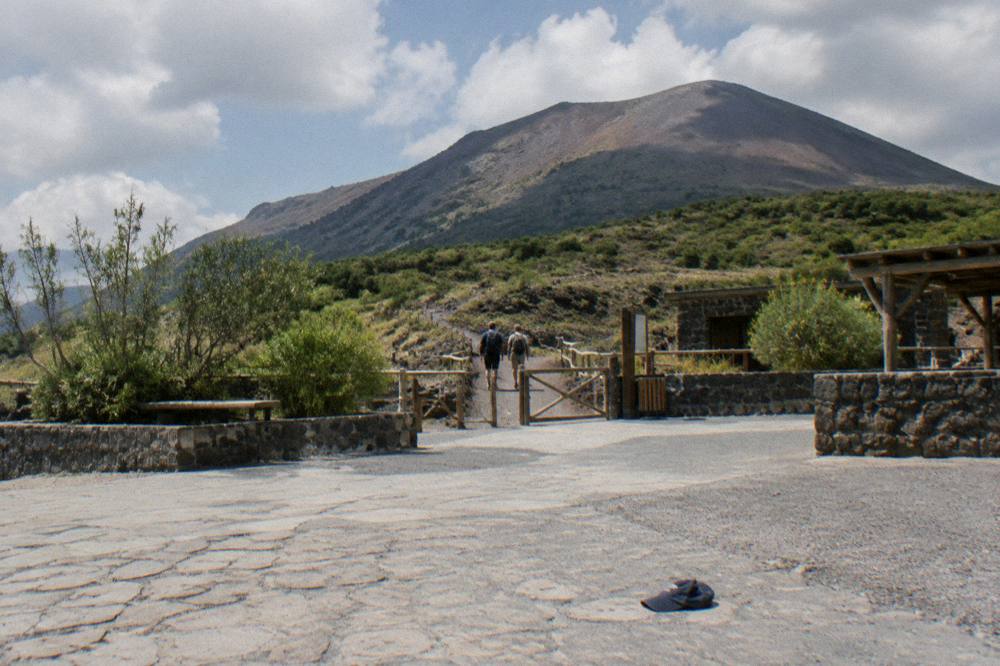
The ticket window rule is the one most visitors miss. A normal Gran Cono ticket is valid from 120 minutes before to 120 minutes after the printed slot, within opening hours, which gives you real flexibility on the climb-up timing without invalidating the entry. Last-minute tickets are stricter, valid from 30 minutes before to 15 minutes after their slot. If you are driving, remember that parking along the provincial road is capped at a four-hour maximum stay and the Quota 1000 plaza itself has no visitor parking.
| Check | Where | What decides your day |
|---|---|---|
| Weather alert colour | Regional Civil Protection bulletins | Orange or higher closes trail and ticket office automatically |
| Slot time and month's last access | Your ticket plus the park hours table | Entry window is the printed slot plus or minus 120 minutes |
| Operator confirmation | The operator's booking page | Bookable for future dates, confirm the current schedule |
| Footwear, water, layer | Your own bag | Uneven surfaces, rim wind, sun exposure |
For a self-guided arrival with the paperwork handled, the Mount Vesuvius Excursion: Skip-Line Ticket and Digital Guide, rated 4.2 from 3,756 reviews and from €16 per person, pairs the timed entry with an audio commentary, a practical combination on a day when the forecast is solid and you want to move at your own pace. Check the listing for what entry is included, since ticket-included terms vary by product.
Which Vesuvius Tour Fits A Conditions-First Planner?
A conditions-first planner should pick the product that matches their risk tolerance: a cheap transfer-and-ticket bundle from €35.10 per person if flexibility is the priority, a half-day guided tour from €41 to €44.80 if the weather window is short, or a full-day lunch tour from €78.20 if the forecast is settled and you want the complete day. All three formats on this site carry free-cancellation flags on their listings.
The trio below covers that spread. The hike-and-bus product from Pompeii is the value anchor, the Naples ticket-and-tour is the compact guided option, and the exclusive lunch tour is the full-day commitment. Whichever you choose, the booking sequence stays the same: reserve early with a free-cancellation listing, watch the alert colour in the final week, and let the automatic refund rule absorb the residual risk.
The one habit that ties all of this together is treating conditions as a rule-based system rather than a mystery. The alert colour decides openness, the month decides hours and capacity, the climate averages decide your packing, and the refund rules decide how little you have to lose by booking ahead. A visitor who checks the two official pages the night before and the alert colour in the morning has done everything a webcam would tell them, and more.
Common Questions About Vesuvius Conditions And Webcams
Is there an official Vesuvius webcam?
No official Vesuvius webcam is verified as a source, and this site does not link or name one. The authoritative live signals are the park's Gran Cono page for access rules and status, and the INGV Osservatorio Vesuviano page for the volcano alert level.
How do I know if the Vesuvius crater trail is closed?
The trail and ticket office close automatically on any day the regional Civil Protection authority issues an orange weather alert or higher. Tickets for slots inside a closure are refunded automatically, and adjacent slots can be refunded on request within 30 days.
What time does the Vesuvius crater trail close?
Last access is 15:00 in January, February, November and December, 16:00 in March and October, 17:00 from April to June and in September, and 18:00 in July and August. The visit must end within one hour of the last access time.
Is Vesuvius safe to visit at the moment?
The published alert level is green, with monitoring parameters within base values; the September 2026 bulletin recorded 121 small earthquakes, maximum magnitude 1.7. Above 1,000 m all visitors are accompanied by the park's volcanological guides.
Should I book Vesuvius tickets in advance or wait for the weather?
Book in advance with a free-cancellation listing and let the automatic refund rules absorb the weather risk. Direct tickets sell in 30-day timed releases, and the last-minute pool of 10 named tickets per slot is too small to rely on for a fixed itinerary.
How much colder is the top of Vesuvius than Naples?
Summit daytime highs run about 6 to 7 C below Naples in every month in the modelled 1991-2020 climate average, and wind at the rim adds further chill. Bring a layer even in summer.